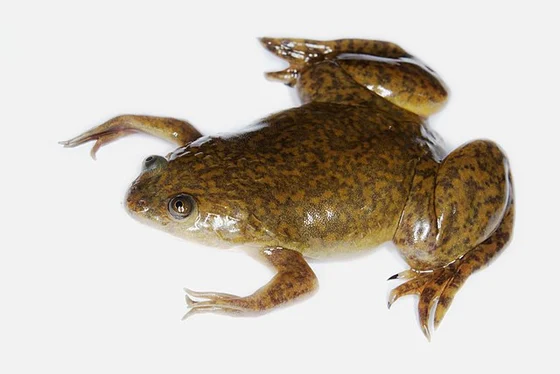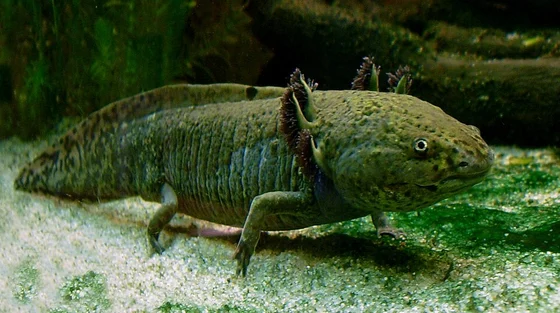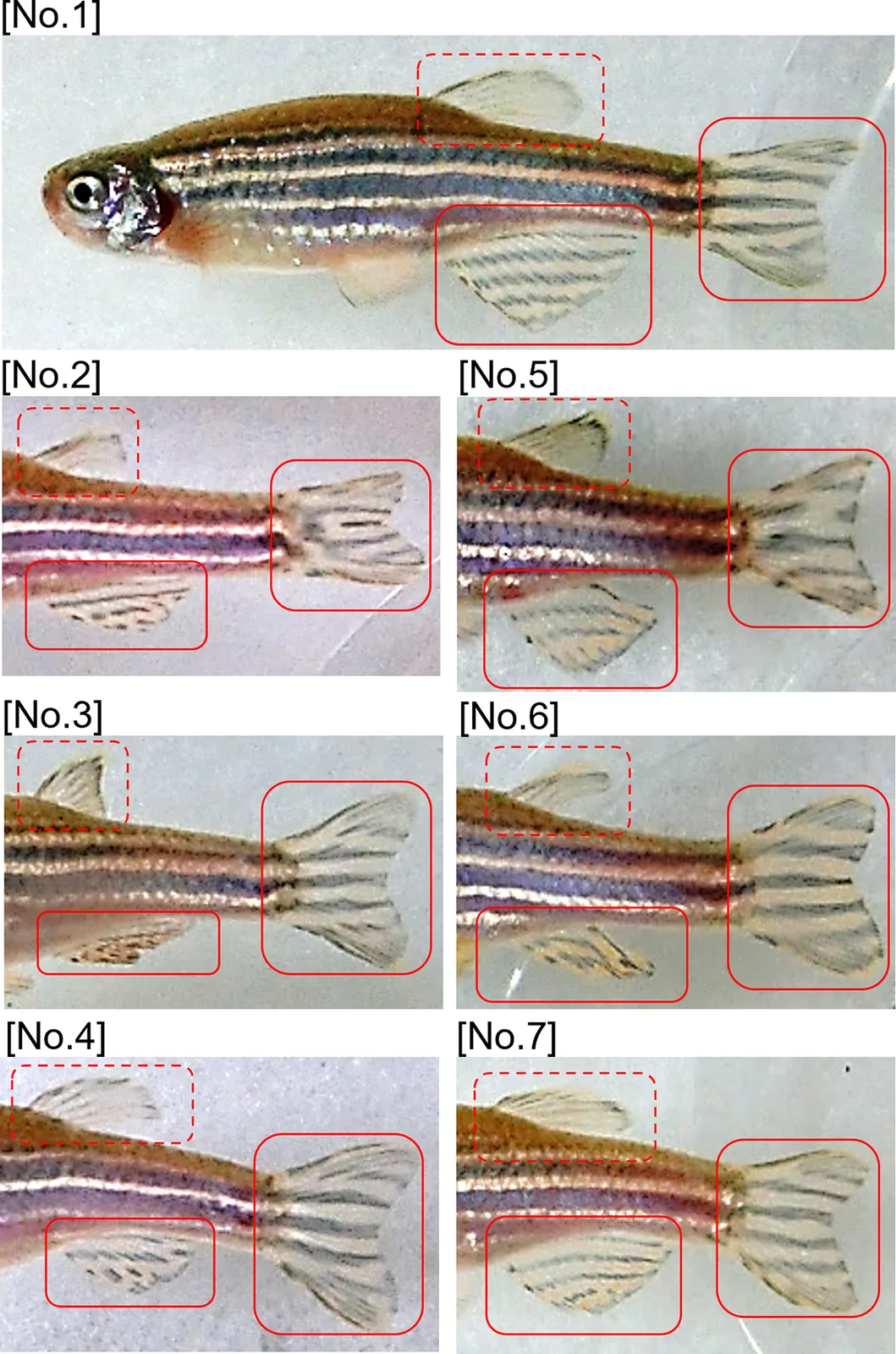
Seven adult zebrafish side-view photographs with dark horizontal body stripes and red boxes marking caudal, anal and dorsal fin patterns.
Adult zebrafish photographed in a side-viewing device for comparing individual fin stripes. Whole Figure2 retains the authors’ identification boxes.
Overview
Zebrafish, Danio rerio, provide a vertebrate model for studying how sensory information guides movement. Zhu and colleagues investigated vertical swimming in larvae seven to nine days after fertilization in 2024. Their apparatus tracked body position and pitch while fish moved freely in darkness. Larvae swam in short bouts separated by inactive intervals. Consecutive bouts tended to retain a similar upward or downward heading, enabling greater changes in depth than shuffled sequences of the same recorded movements.
The study tested whether gravity sensation contributed to this pattern. Otogelin-mutant larvae lacked the gravity-sensing utricular otolith at the tested age. Compared with sibling controls, they maintained heading less consistently and changed direction more between successive bouts. Their depth changes were less effective. The comparison does not mean they were unable to swim or change depth at all. It identifies a contribution of gravity information to the coordination of a sequence of movements, alongside the biomechanical effects of posture and propulsion.
Targeted loss of ascending neurons in the tangential vestibular nucleus and of descending neurons in the midbrain INC/nMLF likewise disrupted heading consistency and depth-change efficacy. In contrast, lesions of vestibulospinal neurons did not produce the same loss of effective vertical navigation, although they altered individual swimming kinematics. This distinction argues against treating all vestibular pathways as interchangeable. The authors proposed a pathway from the inner ear through ascending hindbrain and midbrain populations to spinal motor circuitry, with a possible short-term persistence of gravity-derived commands.
That memory-like explanation was a circuit hypothesis rather than a direct recording of a stored goal. The fish were observed without a designated destination, so the authors explicitly discussed whether their behaviour should be termed navigation or orientation. The experiments establish gravity-guided control of heading under these conditions, not a map of a natural habitat or proof of conscious planning. The small field of view limited long trajectories, and genetic backgrounds varied among experimental groups. Lesions also occurred at different ages, leaving possible differences in adaptation before testing. Sibling comparisons and complementary manipulations strengthen the account while preserving these limitations. Findings in larvae should not automatically be generalized to all adult zebrafish or other vertebrates.
Origins & earliest records
The cited work concerns living laboratory larvae and conserved circuit organization. It does not date the origin of zebrafish or identify a direct ancestral species.
Evidence & interpretation
Free-swimming tracking, sibling-controlled otogelin comparisons and targeted neural lesions support a gravity-guided heading mechanism. Proposed persistence of neural commands and broader evolutionary comparisons remain explanatory interpretations rather than direct recordings of memory.
Selected bibliography
Documented works and useful reading. This is not a list of every appearance.
- 01
Evolutionarily conserved brainstem architecture enables gravity-guided vertical navigation
PLOS Biology 22(11):e3002902, 12 November 2024; DOI 10.1371/journal.pbio.3002902. Complete main Introduction, Results, Discussion, Conclusion and Materials and Methods with textual captions read; original videos, source-data/code reruns and figure pixels not inspected. Unrestricted CC Attribution notice; attributed original summary.
Family, evolution & connections
Taxonomic classification
A hierarchy of classified groups, not a chain of direct ancestors.
- genusDanio
- speciesDanio rerio
Located primary passages
Specific passages supporting details in this entry, grouped by their published witness.
Evolutionarily conserved brainstem architecture enables gravity-guided vertical navigation
2024 published article
- Larval zebrafish changed depth through consecutive swim bouts with relatively stable headings in darkness. Loss of gravity-sensing otoliths or selected ascending vestibular and midbrain neurons reduced heading consistency and depth-change efficacy. Lesions of descending vestibulospinal neurons produced a different pattern, helping separate navigation from individual-bout kinematics. The authors propose a gravity-derived short-term neural memory, which remains a mechanism for further testing. Behaviour lacked a defined destination, so this witness does not demonstrate goal-directed route planning.
No supporting files, table-image pixels, raw data/code or rerun. Lesion ages, possible adaptation, restricted tracking field and genetic-background differences limit comparisons; adult or natural-population behaviour was not tested.
References
Sources supporting this profile. Linked pages have their own scope and editorial standards.
- ResearchEvolutionarily conserved brainstem architecture enables gravity-guided vertical navigationResearch access: 2026-10-06
Image credits
Scientific animal photograph and fin-pattern comparison compositeSeven adult zebrafish side-view photographs with dark horizontal body stripes and red boxes marking caudal, anal and dorsal fin patterns.
Adult zebrafish photographed in a side-viewing device for comparing individual fin stripes. Whole Figure2 retains the authors’ identification boxes.