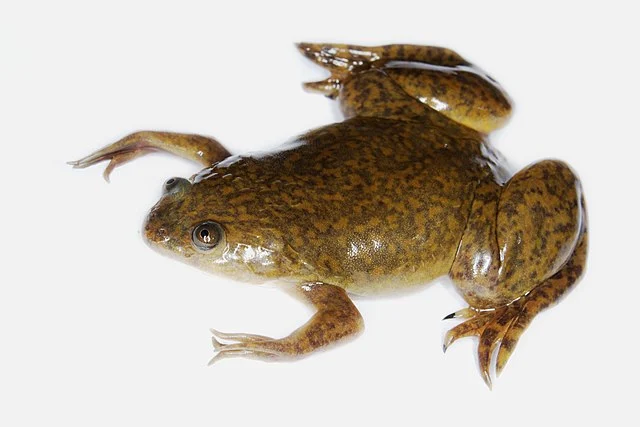
African clawed frog Xenopus laevis photographed from above on a pale background, with mottled body and webbed hind feet
A dorsal view of an African clawed frog, showing its flattened mottled body and webbed hind feet. The source identifies this individual as Xenopus laevis; the photograph is a specimen view rather than a depiction of its entire natural habitat.
Overview
Xenopus laevis, the African clawed frog, is widely studied in developmental biology, cell biology and immunology. Its genetic history also makes it a model for whole-genome duplication. The species has 36 chromosomes, compared with 20 in the related Western clawed frog, Xenopus tropicalis. Session and colleagues reported a chromosome-scale genome in 2016, using DNA from a single female of the inbred J strain. They combined sequencing with chromosome mapping and chromatin-contact information, assigning more than 91% of the assembled sequence to chromosomal locations.
The genome contains two related subgenomes called L and S, named after their longer and shorter corresponding chromosomes. These are not simply two alleles at the same locus: they descend from distinct progenitor lineages that were brought together through hybridization and genome doubling. Remnants of different transposable-element families occur predominantly in one chromosome set or the other. Together with gene-sequence comparisons, these signatures support an allotetraploid origin despite the absence of living representatives of the exact diploid progenitors. Xenopus tropicalis is a comparison species, not one of those identified direct parents.
The researchers estimated that the progenitor lineages diverged around 34 million years ago and merged around 17–18 million years ago. These are molecular reconstructions of genomic events, not directly observed fossil dates or a simple birthday for the modern species. The two subgenomes subsequently changed unequally. The S set experienced more deletions and internal chromosome rearrangements, while the L set more often retained the inferred ancestral organization. Gene loss was also asymmetric: among genes with clear corresponding copies in the comparison genome, 31.5% were lost from S versus 8.3% from L.
Many duplicated genes nevertheless remained. At least 56.4% of genes duplicated through the inferred polyploidization were retained in both copies, with especially high retention in several developmental signalling and regulatory categories. RNA sequencing from developmental stages and adult tissues also revealed differences in when and how strongly paired genes were expressed. These patterns suggest that gene dosage and division of ancestral functions helped shape retention, but correlation does not resolve every causal mechanism. The authors left open whether the unequal subgenome evolution originated in differences between the progenitors or emerged after their merger. The genome provides evidence for a complex evolutionary history without turning modern experimental frogs into direct stand-ins for extinct ancestral species.
Origins & earliest records
A 2016 chromosome-scale J-strain assembly supports an allotetraploid history through comparative mapping, sequence divergence and subgenome-specific transposable-element remnants. Estimated progenitor divergence and merger times concern reconstructed genomic events, not independently dated fossils.
Evidence & interpretation
Whole-genome sequencing, 798 mapped BAC clones, chromatin-contact data, gene annotation and developmental/adult RNA sequencing support the account. The exact progenitors are extinct or otherwise unavailable; historical timing and explanations for asymmetric gene retention are inferences.
Selected bibliography
Documented works and useful reading. This is not a list of every appearance.
- 01
Genome evolution in the allotetraploid frog Xenopus laevis
Nature 538:336–343; online 19 October 2016. DOI 10.1038/nature19840. Complete main sections, Conclusion, main Methods and textual captions 1–4 read; supplementary notes, extended-data analyses, datasets and code not inspected or rerun. CC BY 4.0; attributed original summary.
Family, evolution & connections
Taxonomic classification
A hierarchy of classified groups, not a chain of direct ancestors.
- genusXenopus
- speciesXenopus laevis
L and S subgenomes
Session et al. infer two distinct diploid progenitors from subgenome-specific transposon remnants and sequence divergence. The living progenitor species are unknown; Xenopus tropicalis is a comparative relative, not an identified parent.
Located primary passages
Specific passages supporting details in this entry, grouped by their published witness.
Genome evolution in the allotetraploid frog Xenopus laevis
2016 published article
- Sequence, chromosome mapping and expression comparisons support an origin of Xenopus laevis through hybridization and genome duplication involving two extinct diploid progenitors. Transposable-element remnants distinguish its L and S subgenomes. The inferred merger dates are estimates rather than direct observations. The S subgenome shows greater deletion and rearrangement, whereas many duplicated developmental genes persist. Expression differences and preferential retention are associated with several proposed mechanisms; the study does not settle whether subgenome asymmetry originated before or after their merger.
No separate Supplementary Notes, extended-data analysis, deposited datasets, figure pixels or rerun. Chromosome-scale draft and historical annotation estimates remain distinct from a current complete genome.
References
Sources supporting this profile. Linked pages have their own scope and editorial standards.
- ResearchGenome evolution in the allotetraploid frog Xenopus laevisResearch access: 2026-10-06
Image credits
Scientific organism photographAfrican clawed frog Xenopus laevis photographed from above on a pale background, with mottled body and webbed hind feet
A dorsal view of an African clawed frog, showing its flattened mottled body and webbed hind feet. The source identifies this individual as Xenopus laevis; the photograph is a specimen view rather than a depiction of its entire natural habitat.