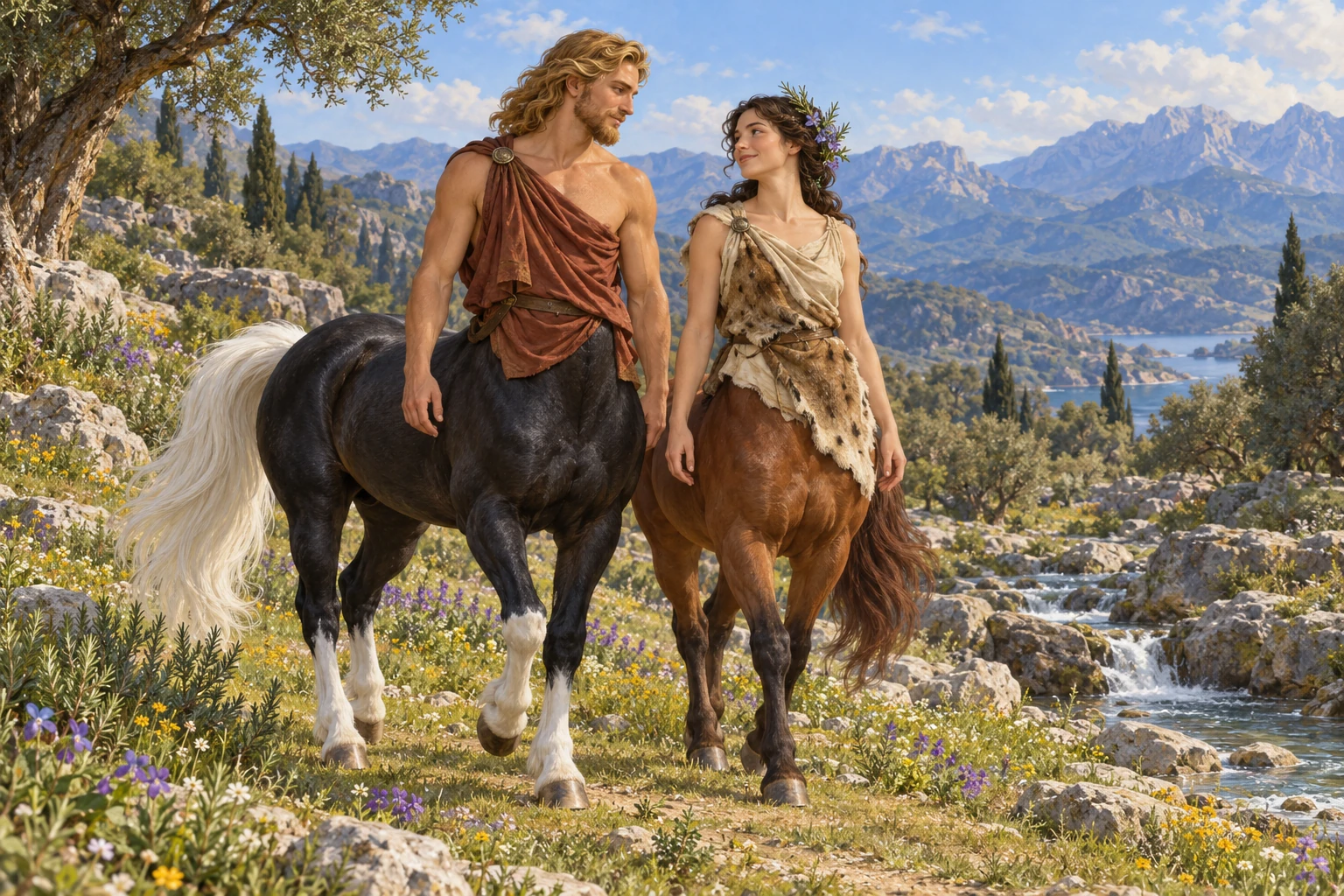
AI-generated interpretation of Cyllarus and Hylonome’s companionship before the battle in Ovid. Cyllarus’s golden hair, black horse body and white legs and tail, and Hylonome’s hair ornaments and animal skin follow Riley’s rendering. Her coat colour, faces, exact garments and landscape are imagined; this is not an ancient artwork or a scene from their deaths.
Modern interpretation of one literary couple, not a universal centaur anatomy or historical reconstruction.
Overview
Ovid places Cyllarus and Hylonome within Nestor’s account of the battle between the Lapiths and Centaurs. In Riley’s historical English rendering, Nestor tells the story to the Greek leaders after Achilles defeats Cygnus. The wedding violence forms the surrounding narrative, but these two centaurs receive a separate account of appearance, affection and loss. Their episode is not the same as the invulnerable Caeneus’s final struggle or the later story of Pholus.
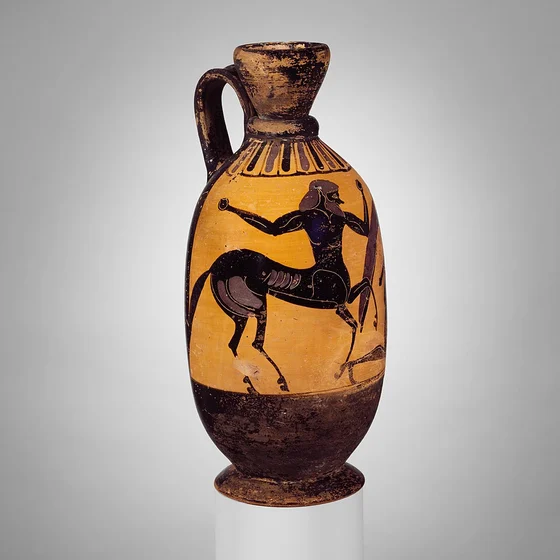
Cyllarus has golden hair and a beginning beard, with human face, neck, shoulders, hands and chest joined to a handsome horse body. The equine part is black with white legs and tail. Hylonome is described as exceptionally beautiful among her own kind. She combs her hair, adorns it with flowers, bathes in woodland streams and wears selected animal skins. These details belong to the named pair; they do not prescribe the appearance or behaviour of every centaur. Riley’s note 39 also distinguishes the name Cyllarus from the horse associated with Castor.
Their affection is explicitly mutual. They wander in the mountains and enter caves together, arrive together at the Lapith wedding and fight together. A javelin from an unidentified attacker mortally wounds Cyllarus. Hylonome receives him and tries to preserve his life, but he dies. Nestor says the surrounding clamour prevents him from hearing her next words. The account then describes her self-inflicted death with the same weapon and her final embrace of her husband. It gives neither an identified killer nor a recovered final speech.
The surrounding fable eventually returns to Caeneus and closes with fighting, flight and night. Riley’s separate Explanation proposes that centaurs may be based on horse-riding people and speculates about a historical tradition behind the couple. Those nineteenth-century suggestions are editorial interpretation, not demonstrated history or biology. The pair’s love and deaths remain an attributed ancient literary episode rather than a verified event, universal centaur custom or documented source for modern fantasy.
Origins & earliest records
Ovid’s Roman poetic narrative is read through Henry Thomas Riley’s 1851 English translation as reprinted by George Bell & Sons in 1893. The combined Fables III–IV division belongs to the translator’s presentation. No independent Latin collation, verified event or earliest oral origin is claimed.
Records & interpretation
Complete Book XII, Fables III–IV, including Riley’s synopsis and Explanation, read with all 31 attached notes, 17–47. The couple’s episode occupies approximately verses 393–428, printed pages 428–429. Source narrator and translator’s commentary remain separate.
Selected bibliography
Documented works and useful reading. This is not a list of every appearance.
- 01
The Metamorphoses of Ovid, Books VIII–XV
Book XII, Fables III–IV, pp. 421–434, verses 146–535, with synopsis, Explanation and notes 17–47. The couple’s episode begins at verse 393.
Family, evolution & connections
Centaur
Ovid’s Cyllarus and Hylonome add a named partnership and tragic outcome within the centaur wedding battle. Their mutual affection, individual appearance and unknown attacker belong to this particular account. Other centaur narratives, including Pholus’s hospitality and Chiron’s healing, have different actors and outcomes; the creature category does not impose one character or life history.
References
Sources supporting this profile. Linked pages have their own scope and editorial standards.
- Historical English rendering of ancient literary narrativeRiley, Ovid XII, Fables III–IV: Cyllarus and Hylonome with complete narrative contextResearch access: 2026-10-26
Image credits
Modern interpretation of a historical literary accountAI-generated interpretation of Cyllarus and Hylonome’s companionship before the battle in Ovid. Cyllarus’s golden hair, black horse body and white legs and tail, and Hylonome’s hair ornaments and animal skin follow Riley’s rendering. Her coat colour, faces, exact garments and landscape are imagined; this is not an ancient artwork or a scene from their deaths.
Modern interpretation of one literary couple, not a universal centaur anatomy or historical reconstruction.