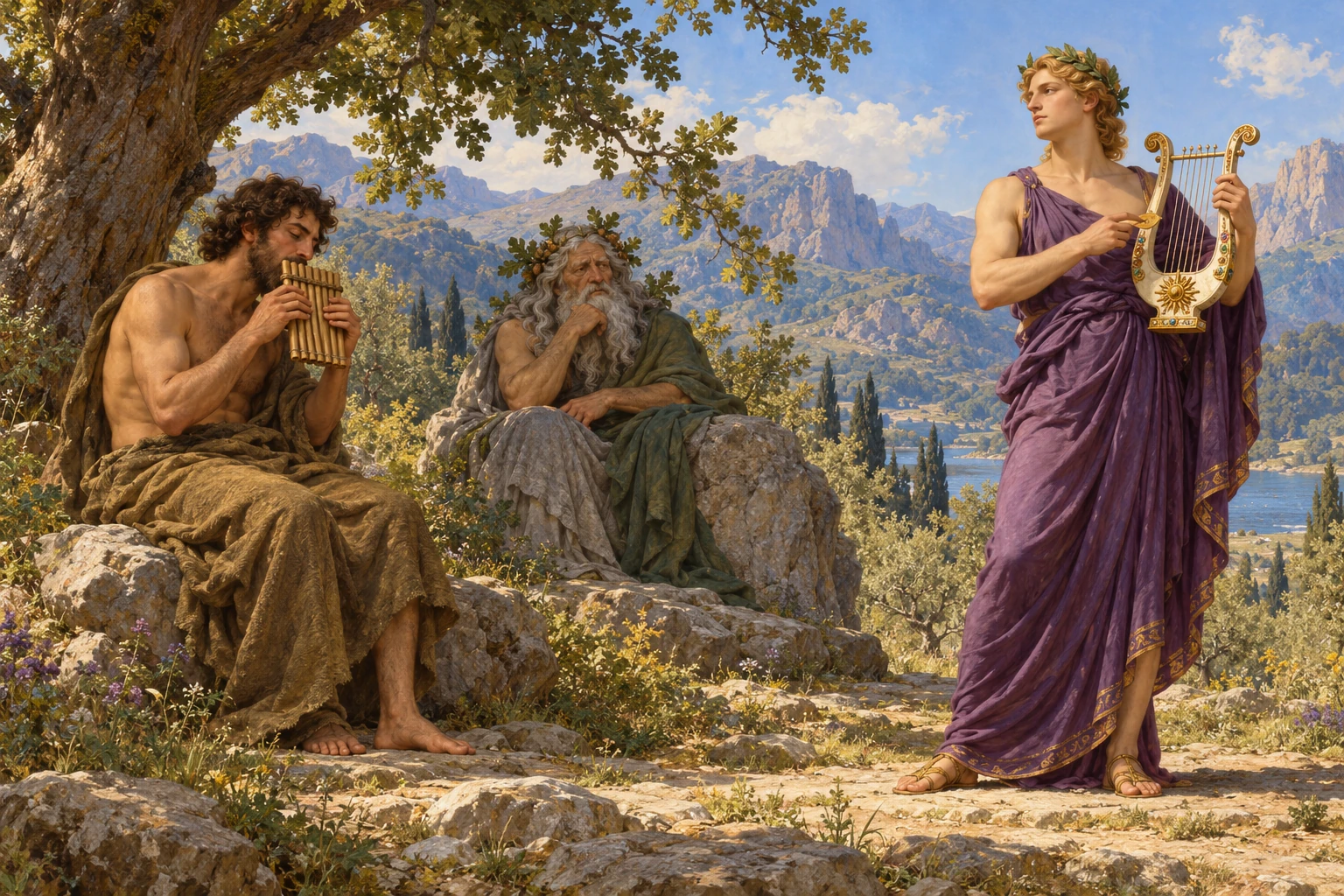
AI-generated interpretation of Pan’s contest with Apollo in Ovid. The reed pipes, decorated lyre, purple robe, laurel and oak-crowned judge follow Riley’s account. Faces, clothing details, setting and Pan’s humanlike form are artistic choices: the selected passage does not describe Pan’s anatomy. This is not an ancient artwork or an illustration of Narnia.
A modern scene from the selected musical contest; Midas’s later punishment and the reeds’ disclosure remain separate narrative moments.
Overview
In Ovid’s musical contest, Pan plays a pipe made from reeds joined with wax and challenges Apollo’s music. Riley’s historical English rendering places the meeting on Tmolus, where Midas follows Pan after turning away from riches. Tmolus is also the named mountain deity who judges the contest. He is portrayed as an aged figure clearing trees from his ears, with oak and acorns around his head. The landscape and the judging character therefore belong together in this particular narrative.
Pan’s rustic performance pleases Midas. Apollo then appears with yellow hair crowned in laurel, a long purple robe, a decorated lyre and a plectrum. Tmolus prefers the lyre and tells Pan to yield. The company accepts the decision, but Midas calls it unjust. Apollo responds by changing the king’s ears into long, grey-haired, movable ears like those of an ass. The rest of Midas remains human. This is a particular punishment of a listener, rather than a transformation of Pan or a universal rule about musical judgment.
The account continues beyond the competition. Midas hides the ears under a purple turban, but the servant who cuts his hair discovers them. Unable to reveal the secret openly or keep it to himself, he whispers it into a hole in the ground and covers the earth again. Reeds grow there. After a complete year they mature, and the gentle south wind makes them repeat the hidden words. The ending makes concealment fail through the sound of the landscape, without restoring the king’s ears or naming his barber.
Riley’s separate Explanation offers historical and linguistic theories about Midas, his wealth and his ears, as well as another account of Tmolus. Those are editorial interpretations, not independently established origins of Ovid’s story. The selected fable supplies Pan’s musical role and mountain setting but does not describe his bodily anatomy or identify him as a member of a faun species. Its named gods, judgment and secret-bearing reeds remain an attributed literary account, distinct from modern fantasy characters and from any claim that a later author consulted this translation.
Origins & earliest records
Ovid’s Metamorphoses XI in Henry Thomas Riley’s 1851 English translation, reprinted by George Bell & Sons in 1893. Fable III is the historical translator’s division. No independent Latin collation, earliest oral origin or historical authentication of Midas’s transformation is claimed.
Records & interpretation
Complete Fable III, its synopsis, Riley’s Explanation and all attached notes 11–13 read from the retained historical edition. The outcome includes the barber, buried secret, reeds and a full year’s growth, rather than ending at Pan’s defeat.
Selected bibliography
Documented works and useful reading. This is not a list of every appearance.
- 01
The Metamorphoses of Ovid, Books VIII–XV
Book XI, Fable III, verses 146–193, pp. 387–389; synopsis, Explanation and notes 11–13. The preceding gold-touch and following Troy episodes are separate units.
Family, evolution & connections
Faun (Narnia)
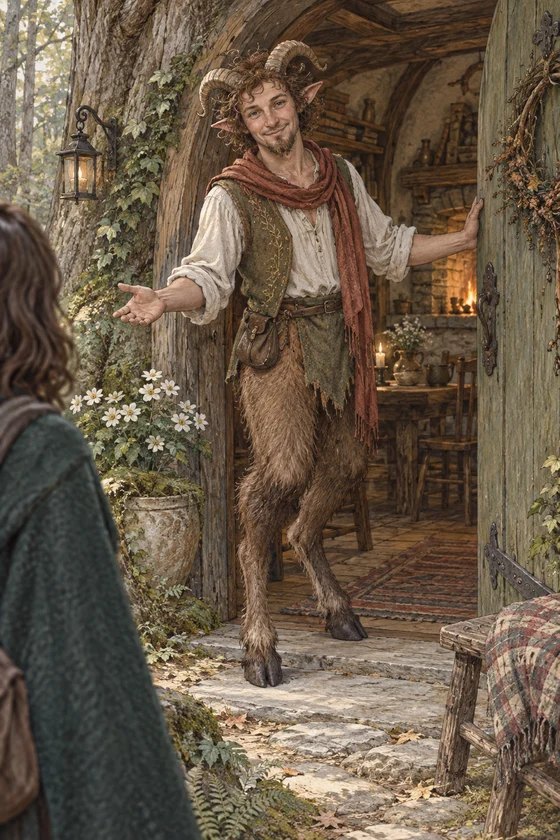
Pan’s reed-pipe contest offers a particular classical example of music in a wooded mountain setting, beside the musical and woodland associations of Narnia’s fauns. Pan is a named deity in Ovid’s account; the contest, Apollo’s judgment and Midas’s ears are not events in Narnia. This limited motif comparison neither assigns Pan to a faun species nor establishes that Lewis consulted this tale or translation.
References
Sources supporting this profile. Linked pages have their own scope and editorial standards.
- Historical English rendering of an ancient poemRiley, Ovid XI, Fable III: Pan’s contest with Apollo and Midas’s earsResearch access: 2026-10-26
Image credits
Modern interpretation of a historical literary accountAI-generated interpretation of Pan’s contest with Apollo in Ovid. The reed pipes, decorated lyre, purple robe, laurel and oak-crowned judge follow Riley’s account. Faces, clothing details, setting and Pan’s humanlike form are artistic choices: the selected passage does not describe Pan’s anatomy. This is not an ancient artwork or an illustration of Narnia.
A modern scene from the selected musical contest; Midas’s later punishment and the reeds’ disclosure remain separate narrative moments.