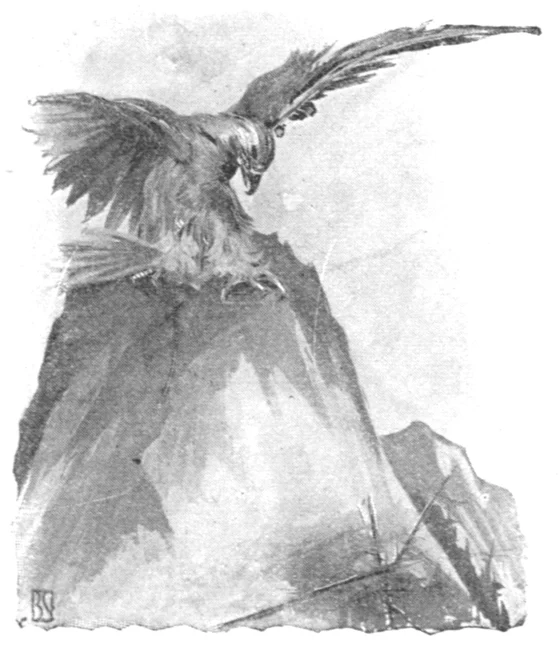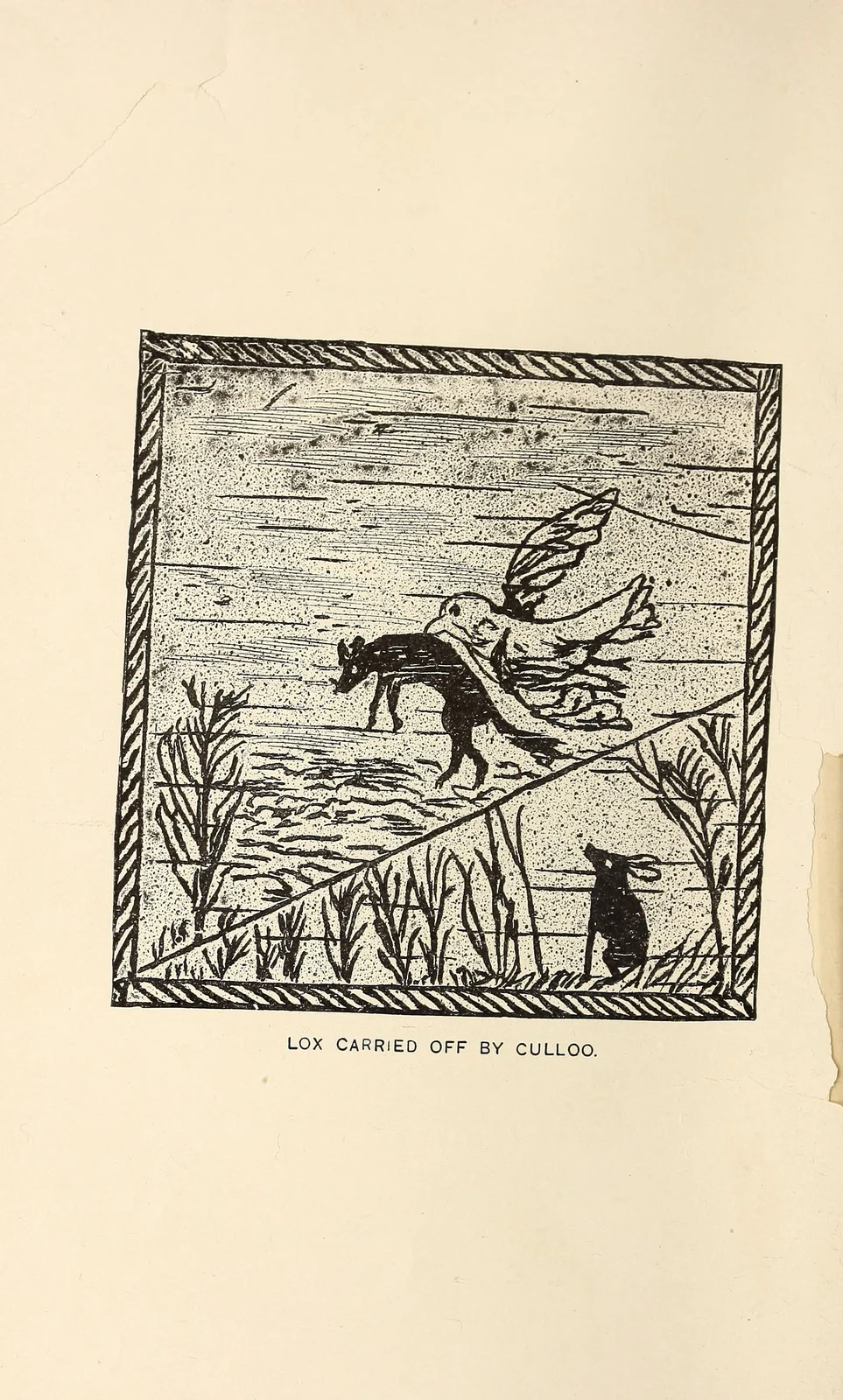
Culloo carrying Lox above the forest, after Tomah Joseph’s birchbark design
The plate names Culloo carrying off Lox. Here the great bird holds the trickster in its beak; the adjacent narrative describes seizure in its claws, so the drawing and wording remain distinct witnesses.
Overview
Lox encounters children of a Culloo household and draws them away with deceptive sounds of play. He tries to pass as a family member by singing over a baby; the mother recognizes the deception, and he kills her. The returning children discover the murder and pursue him. Crow and Eagle relatives follow in turn, taking pieces of his clothing while he mocks their efforts.
The great Culloo then seizes Lox in its claws and carries him to the sky’s height. Dropped from there, Lox falls from dawn to sunset and breaks apart on impact. Before landing he protects his backbone with magic. When his younger brother later addresses the remains, the surviving bone calls the scattered parts together and Lox lives again. Culloo’s immense flight and physical force therefore do not guarantee victory over the trickster’s particular protection.
A different relationship develops in Rand’s ‘The Small Baby and the Big Bird,’ credited to Susan Barss at Charlottetown in winter 1847–1848. A boy raised by an old woman wounds a people-carrying Culloo, then reaches its village and discovers his own parents and sister among the captives awaiting slaughter. He kills the chief and its household, but spares a small Culloosees on condition that it become his helper. This young bird grows into a loyal companion, carries provisions, and brings the boy’s foster mother to join his recovered family. Rand explicitly marks his explanation of how the infant originally became separated from his mother as conjecture.
The companion carries the young man to an upper earth to find a wife. It warns him against an old woman’s poisoned food and waits below a cliff to catch him if her wrestling challenge succeeds. Instead, the young man throws the old woman over; the bird lets her fall. He marries one daughter and establishes a household. Later the Culloo knows that their child has been stolen and guides its father to a distant dance. The father cannot recognize his son among the adult-looking dancers, but the bird can: when seized, the dancer instantly becomes a baby again. The Culloo prescribes washing and fresh clothing before nursing to remove the lingering enchantment.
The bird also anticipates the abductors’ retaliation. It and the father shoot arrows through the lodge’s roof opening, bringing down twelve attackers; the following inspection finds that the wounded men have risen and departed. Expecting a larger attack, the Culloo carries the family, including the wife’s sister, back down to the young man’s parents on the lower earth. A welcoming feast closes the account. Rand’s suggested subsequent marriage for the sister-in-law is explicitly his own addition, unsupported by the tale. This protective companion’s conduct is kept distinct from the formidable avenger in Leland’s Lox cycle.
Origins & earliest records
Leland’s 1884 Lox narrative combines multiple versions and explicitly describes confusion between a Mi’kmaq Badger and a Passamaquoddy Wolverine protagonist. His footnotes credit Louis Mitchell for nearby Passamaquoddy dialogue. No individual narrator is securely assigned to the Culloo episode itself. Rand’s separately located version was published posthumously in 1894 under Helen L. Webster’s editorship; its named teller is Susan Barss. Webster describes Rand’s English translations from spoken Mi’kmaw accounts, subsequently checked with tellers, and Leland’s earlier use of Rand manuscripts.
Records & interpretation
The complete household attack, pursuit, aerial punishment and resurrection sequence was inspected with its preceding setup. Leland’s identification of Culloo as a cloud emblem is an interpretive footnote, not a narrated identity; no thunderbird equivalence is assumed. The composite editing prevents presenting this as an unaltered single-community transcript. Rand IX, pp.81–93, was read through the final reunion and feast; the narration is distinguished from Rand’s bracketed conjectures and invented closing suggestion. The young Culloo is not made an alias of Leland’s individual avenger.
In the literature
“even from the first dawn unto sunset he went down”
Of the Surprising and Singular Adventures of two Water Fairies ...; bounded Culloo household sequence, Crane death through Lox second resurrection · Leland English collected retelling; specific credits retained
Revived Lox lures two boys from the Culloo household, impersonates family and kills their mother when she rejects his deception. The boys, Crow and Eagle pursue and take clothing. Great Culloo carries him skyward in claws and drops him; the fall lasts dawn to sunset. His backbone survives and his younger brother addresses the remains; scattered parts reassemble. The punishment does not end his life.
Selected bibliography
Documented works and useful reading. This is not a list of every appearance.
- 01
The Algonquin Legends of New England
Lox cycle, Culloo household and aerial punishment sequence, from the revived trickster’s encounter with two children through his second resurrection; surrounding version notes.
- 02
Legends of the Micmacs
IX, The Small Baby and the Big Bird, pp.81–93; Susan Barss, Charlottetown, winter1847–1848 (p.82). Complete narrative and marked editorial additions; preface v–ix for translation and manuscript mediation.
- 03
The Algonquin Legends of New England — Of the Surprising and Singular Adventures of two Water Fairies ...
Original work1884; Gutenberg6803 selected transcription, exact source print impression/pages unidentified. Full Preface and Authorities independently read.
Family & connections
A source-supported family tree or inspiration record has not yet been compiled for this profile. Related reading below indicates a connection in subject matter, not a proven lineage or creative influence.
Located primary passages
Specific passages supporting details in this entry, grouped by their published witness.
The Algonquin Legends of New England
Original work1884; Gutenberg6803 selected transcription, exact source print impression/pages unidentified. Full Preface and Authorities independently read.
- Revived Lox lures two boys from the Culloo household, impersonates family and kills their mother when she rejects his deception. The boys, Crow and Eagle pursue and take clothing. Great Culloo carries him skyward in claws and drops him; the fall lasts dawn to sunset. His backbone survives and his younger brother addresses the remains; scattered parts reassemble. The punishment does not end his life.
No whole collection, separately recorded oral transcript or separately cited manuscript/comparative edition inspected. Variant/narrator distinctions preserved; no earliest/diffusion/treatment proof claimed.
References
Sources supporting this profile. Linked pages have their own scope and editorial standards.
- ResearchLeland: located primary collection with source notesResearch access: 2026-10-05
- Primary textRand1894: complete tale IX and teller attributionResearch access: 2026-10-05
Image credits
Historical illustrationCulloo carrying Lox above the forest, after Tomah Joseph’s birchbark design
The plate names Culloo carrying off Lox. Here the great bird holds the trickster in its beak; the adjacent narrative describes seizure in its claws, so the drawing and wording remain distinct witnesses.