
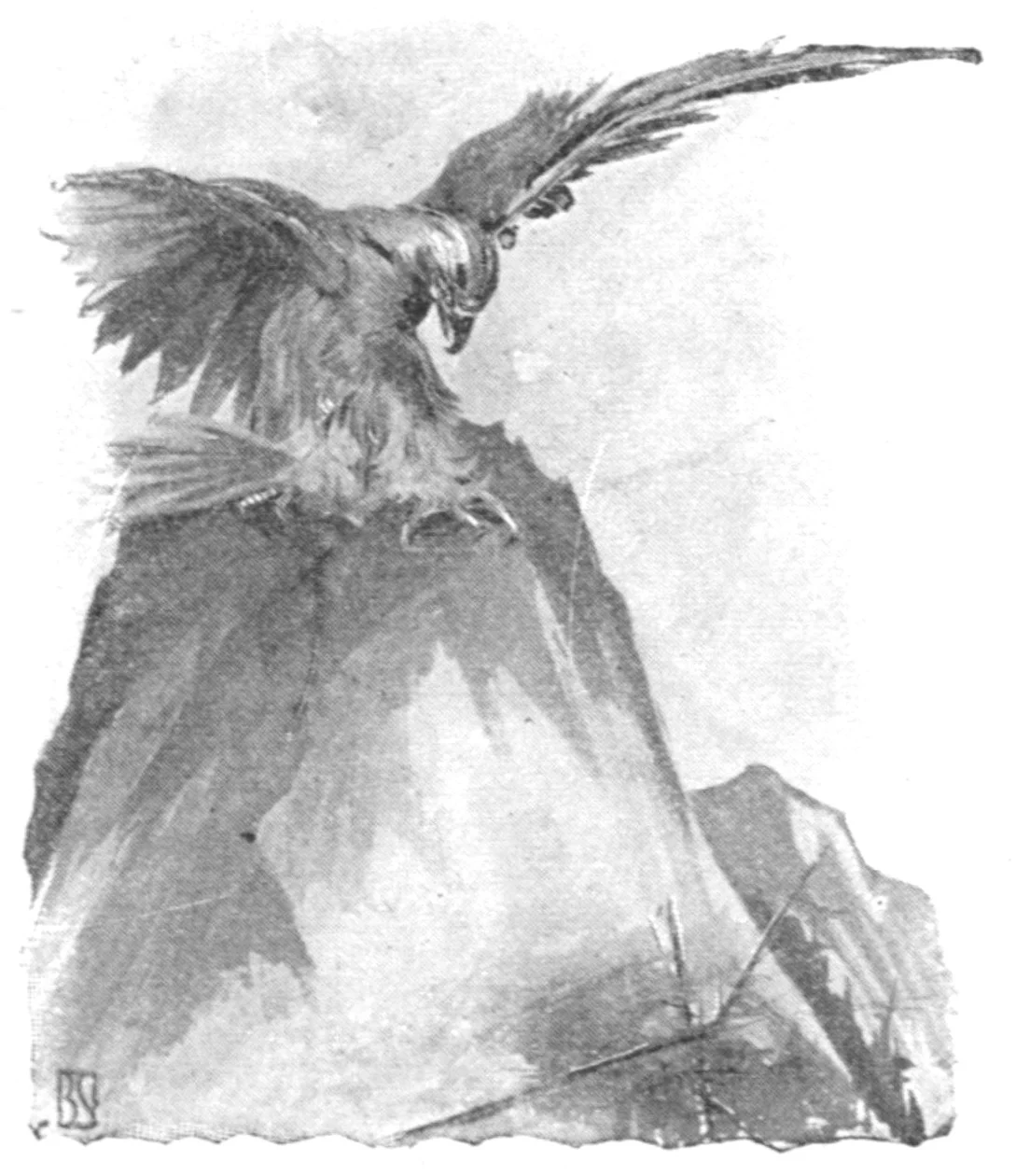
F. Berkeley Smith’s1902 Wuchoʿsen wind-eagle illustration: a large eagle spreads its wings over a rocky peak, with the artist’s monogram at lower left.
Wuchoʿsen in F. Berkeley Smith’s illustration for Leland and Prince’s1902 metrical adaptation. The eagle’s rocky perch and spreading wings accompany the Passamaquoddy wind story; this is the illustrator’s interpretation, distinct from the1884 prose witness.
Overview
In the story published by Leland, persistent storms prevent Glooskap from hunting sea birds by canoe. He travels far north and finds Wuchowsen on a high rock at the edge of the sky. Glooskap addresses the bird as grandfather and asks it to spare its grandchildren. The bird claims to have moved its wings before any other voice existed and refuses to surrender its freedom.
Glooskap grows mighty enough to seize it, binds both wings and leaves it in a rocky chasm. The resulting calm initially lets people travel freely, but after weeks and months the waters grow so stagnant and thick that Glooskap cannot paddle. He returns to the immortal bird, restores it to its rock and releases one wing. The ending explains moderated wind through a negotiated limit on the original power, not the bird’s death.
Origins & earliest records
Leland’s 1884 chapter explicitly derives this Passamaquoddy account from Louis Mitchell’s manuscript collection. Wochowsen is a spelling used in the same account, not a separate creature. The chapter supplies no more precise oral recording date or individual speaker beyond that transmission credit.
Records & interpretation
The complete encounter, immobilization and release were read. Leland also points to a different Mi’kmaq story and calls the Mitchell version original; this profile does not endorse that priority claim. His comparison with a Norse wind eagle remains interpretation.
In the literature
“As he had left him he found him, for Wuchowsen is immortal.”
How Glooskap bound Wuchowsen, the Great Wind-Bird, and made all the Waters in all the World Stagnant; full attached note · English collector/reteller Leland; source boundaries in context
The great white Wind-Bird lives on a high rock at the sky’s edge and claims primordial authority to move his wings. Glooskap binds both wings and casts him between rocks, but ensuing calm makes the water stagnant. He returns to the explicitly immortal bird and frees one wing, restoring moderated wind. No death or broken wing is narrated in this selected version; the following Micmac BrokenWing comparison is a separate tale.
Selected bibliography
Documented works and useful reading. This is not a list of every appearance.
- 01
The Algonquin Legends of New England
How Glooskap bound Wuchowsen, the Great Wind-Bird, and made all the Waters in all the World Stagnant; complete chapter.
- 02
The Algonquin Legends of New England — How Glooskap bound Wuchowsen, the Great Wind-Bird, and made all the Waters in all the World Stagnant
The Algonquin Legends of New England, first work1884; selected Gutenberg plain transcription6803 lacks a printed imprint/page sequence in the inspected frontmatter, so exact source impression and printed pages unidentified. Complete author preface and Authorities read; chapter headings used as locators.
Family & connections
A source-supported family tree or inspiration record has not yet been compiled for this profile. Related reading below indicates a connection in subject matter, not a proven lineage or creative influence.
Located primary passages
Specific passages supporting details in this entry, grouped by their published witness.
The Algonquin Legends of New England
The Algonquin Legends of New England, first work1884; selected Gutenberg plain transcription6803 lacks a printed imprint/page sequence in the inspected frontmatter, so exact source impression and printed pages unidentified. Complete author preface and Authorities read; chapter headings used as locators.
- The great white Wind-Bird lives on a high rock at the sky’s edge and claims primordial authority to move his wings. Glooskap binds both wings and casts him between rocks, but ensuing calm makes the water stagnant. He returns to the explicitly immortal bird and frees one wing, restoring moderated wind. No death or broken wing is narrated in this selected version; the following Micmac BrokenWing comparison is a separate tale.
No entire collection/introduction, separate cited manuscript or contemporary community account reviewed. Author’s Norse/Eskimo diffusion and racial hierarchies are historical claims, not endorsed or independently proved.
References
Sources supporting this profile. Linked pages have their own scope and editorial standards.
- ResearchLeland: located primary collection with source notesResearch access: 2026-10-05
Image credits
Historical literary illustration of the named wind-eagle in a1902 metrical adaptationF. Berkeley Smith’s1902 Wuchoʿsen wind-eagle illustration: a large eagle spreads its wings over a rocky peak, with the artist’s monogram at lower left.
Wuchoʿsen in F. Berkeley Smith’s illustration for Leland and Prince’s1902 metrical adaptation. The eagle’s rocky perch and spreading wings accompany the Passamaquoddy wind story; this is the illustrator’s interpretation, distinct from the1884 prose witness.