
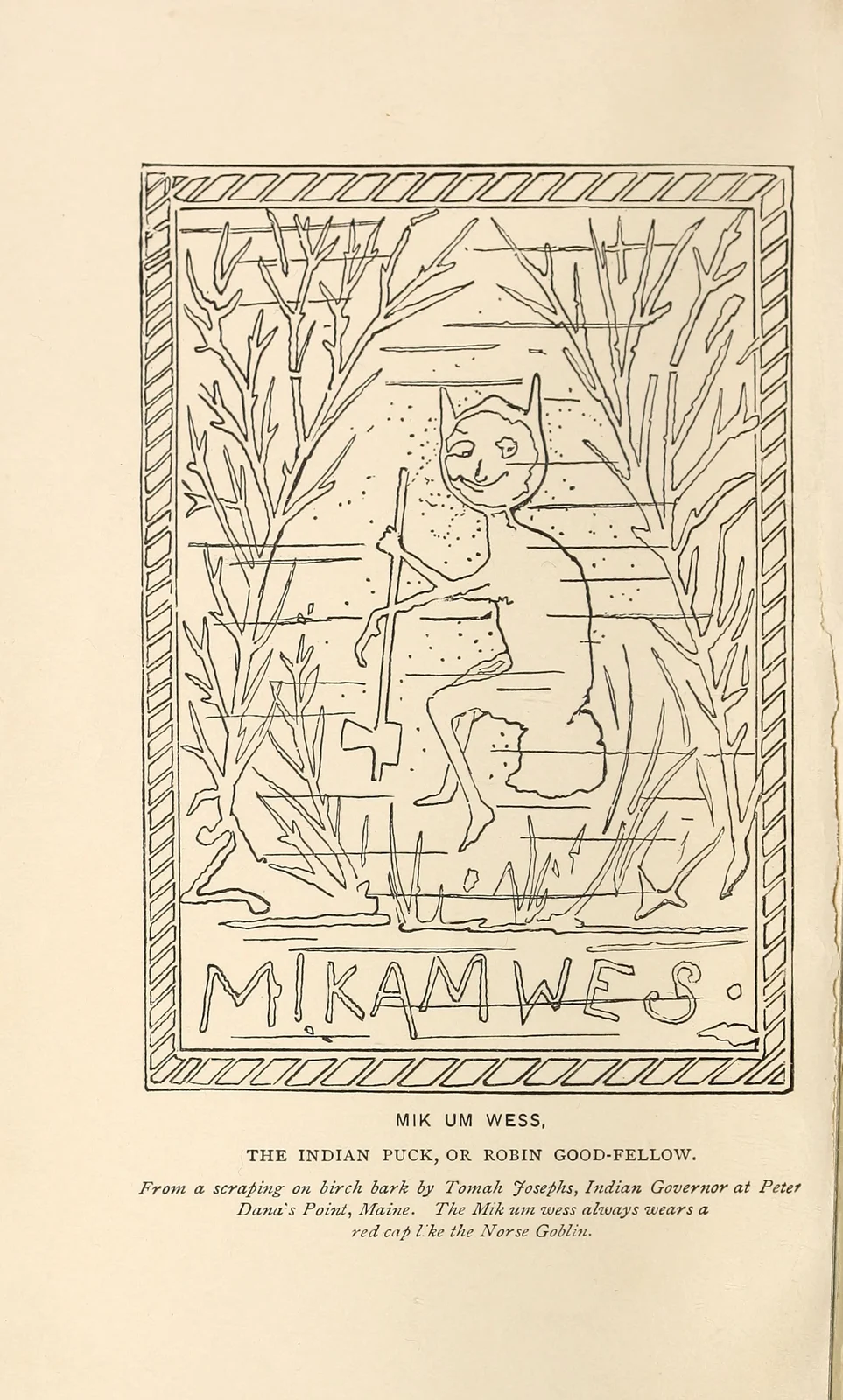
Mikamwes seated among trees, Tomah Joseph birchbark design reproduced in Leland 1884
Tomah Joseph’s birchbark design names Mikamwes beneath the seated figure holding a long-handled object among trees. The printed caption compares the being with Puck and describes a red cap; these are Leland’s editorial comparisons, while the monochrome reproduction preserves Joseph’s particular representation.
Overview
Two travellers seek Glooskap: one wants to become a Mikumwess and the other to marry a chief’s daughter. Glooskap cleans and clothes the first, gives him a magical hair string and a pipe, and teaches him to sing. The narrative’s introduction associates these woodland beings with music that charms animals and humans. The transformed helper takes responsibility for his companion as they sail to the chief’s settlement in Glooskap’s extraordinary canoe.
The chief demands a horned dragon’s head. The Mikumwess goes out at night, bridges its den with a log and summons it until its neck rests within reach of his hatchet. He then protects his friend in a deadly sled race and lends the pipe before the running contest. The companion wins the running and diving trials and marries the daughter. At the wedding the helper dances so powerfully that his feet excavate a deep trench in the floor.
On the voyage home he blows away a magically raised storm, disables an attacking giant beaver and kills a giant skunk. They return the borrowed canoe. Glooskap reveals his part in their successes and sends them toward different lives, the helper among his magical kind and the couple among humans, with a promise of help in future trouble.
Rand’s 1894 collection uses the spelling Megumoowesoo in the heading of tale X and tells a different transformation. A mocked young hunter loses his way in a storm and receives food, lodging and flute music from a forest host. What seems one night is a year at home. Returning for another visit, he acquires strength sufficient to carry half a moose, musical skill and the host’s magical powers. Two further nights pass as two years for his grandmother. After his return, he rejects the chief’s belated marriage offer, chooses a poor orphan girl and leaves for the forest with her, her sister and his grandmother. This episode names no individual teller and does not make Glooskap the transforming host.
In The Beautiful Bride, told by Ben Brooks on 31 August 1869, a Megumoowesoo instead joins a young man seeking a wife and recruits three specialists: a burden-bearer, a runner who binds one leg to slow himself and a man who plugs his nostrils to restrain storms. Glooscap lends the party a self-moving island as a canoe. The helper wins the dance and protects the suitor in the lethal sled contest; the runner and strongman win their respective trials. When village magicians send a storm after the departing wedding party, the wind-breather reverses it, destroying the pursuers’ village. All companions return to their own homes. These distinct performances of the helper role are not joined into a single continuous biography.
Origins & earliest records
Leland labels the narrative Mi’kmaq and says it is taken almost entirely from Rand’s manuscript. His opening comparison names Passamaquoddy Oonahgawessos, but the full marriage-trial narrative here is not reassigned to that community. The 1884 printed witness does not supply the original teller’s name.
Records & interpretation
The complete transformation, marriage trials and return journey were read. European elf terminology belongs to Leland’s translation and comparison. His classical initiation, Norse parallel and nature-allegory arguments are not treated as the narrators’ explanations. Complete Rand tales X and XXIV extend the comparison while retaining separate tellers and plots; Webster’s preface explains the surviving English translations and Rand manuscript material already used by Leland.
In the literature
“ever lead happy lives: thou amid the Elfin, they among mankind.”
How Glooskap made a Magician of a Young Man, who aided another to win a Wife and do Wonderful Deeds; complete chapter and all notes · Leland English collected retelling; case-specific contributor mediation retained
Glooskap transforms a traveller into a Mikumwess through gifts, clothing and musical skill. The helper kills the horned serpent, protects his companion in the lethal sled race, lends power for the running trial and celebrates the marriage with a ground-sinking dance. On the return he blows away a hostile storm, cuts off a giant beaver’s tail and kills a giant skunk. They actually return the borrowed canoe; Glooskap discloses his part and sends the helper to his magical kind, the married pair to human life. Running/diving identity assertions and collector nature-allegory speculation are kept distinct.
Selected bibliography
Documented works and useful reading. This is not a list of every appearance.
- 01
The Algonquin Legends of New England
How Glooskap made a Magician of a Young Man, who aided another to win a Wife and do Wonderful Deeds; complete chapter and source note.
- 02
Legends of the Micmacs
Complete X, The Indian Who Was Transformed into a Megumoowesoo, pp.94–98; XXIV, The Beautiful Bride, pp.185–189, told by Ben Brooks31August1869; prefacev–ix.
- 03
The Algonquin Legends of New England — complete Glooskap marriage-helper narrative
Original work1884; selected Gutenberg6803 plain transcription, exact source print impression and printed pagination unidentified. Full author Preface and Authorities independently read.
Family & connections
A source-supported family tree or inspiration record has not yet been compiled for this profile. Related reading below indicates a connection in subject matter, not a proven lineage or creative influence.
Located primary passages
Specific passages supporting details in this entry, grouped by their published witness.
The Algonquin Legends of New England
Original work1884; selected Gutenberg6803 plain transcription, exact source print impression and printed pagination unidentified. Full author Preface and Authorities independently read.
- Glooskap transforms a traveller into a Mikumwess through gifts, clothing and musical skill. The helper kills the horned serpent, protects his companion in the lethal sled race, lends power for the running trial and celebrates the marriage with a ground-sinking dance. On the return he blows away a hostile storm, cuts off a giant beaver’s tail and kills a giant skunk. They actually return the borrowed canoe; Glooskap discloses his part and sends the helper to his magical kind, the married pair to human life. Running/diving identity assertions and collector nature-allegory speculation are kept distinct.
No entire volume, independently recorded oral performance or separate cited manuscript/comparative book read. Narrator credits and endings remain case-specific; editorial origin, medical and diffusion hypotheses are not established facts.
References
Sources supporting this profile. Linked pages have their own scope and editorial standards.
- ResearchLeland: located primary collection with source notesResearch access: 2026-10-05
- Primary textRand1894: transformation and Ben Brooks marriage narrativeResearch access: 2026-10-05
Image credits
Historical illustrationMikamwes seated among trees, Tomah Joseph birchbark design reproduced in Leland 1884
Tomah Joseph’s birchbark design names Mikamwes beneath the seated figure holding a long-handled object among trees. The printed caption compares the being with Puck and describes a red cap; these are Leland’s editorial comparisons, while the monochrome reproduction preserves Joseph’s particular representation.