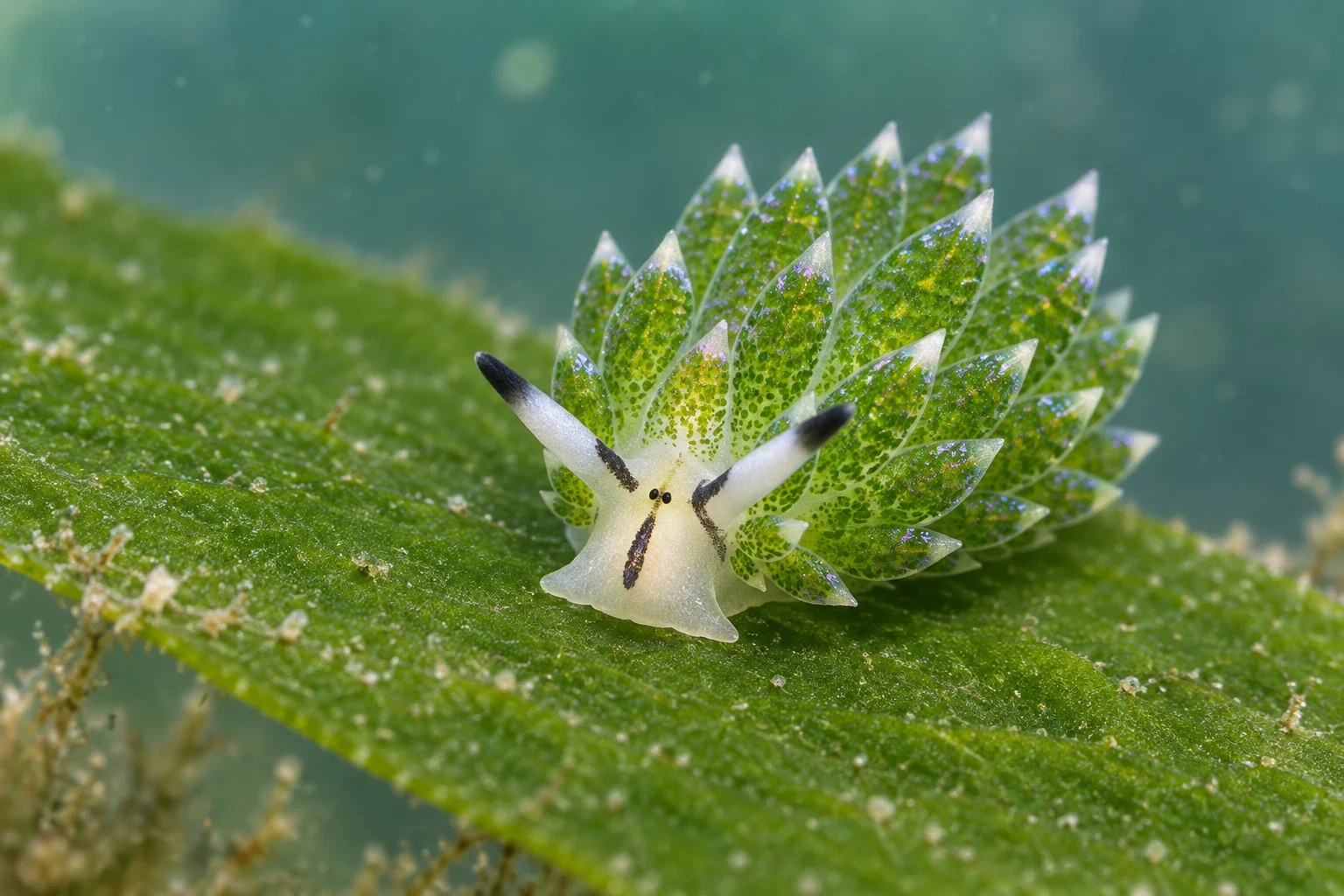
Costasiella kuroshimae - AI-generated scientific interpretation.
Modern AI-generated scientific illustration. Diagnostic anatomy follows selected research; colour, pose and unpreserved external detail are interpretive. Not fossil or photographic evidence.
Overview
The leaf-sheep nickname refers to appearance rather than mammalian anatomy. Australian Museum specialist Bill Rudman described a white head with dark markings, black-tipped white rhinophores and green cerata tipped with white. Cerata are dorsal projections; rhinophores are sensory structures. The published Japanese description dates to 1993.
Identification needs more than the familiar green silhouette. Rudman noted that several Costasiella species were described briefly and that a pictured animal only approached the named description. A photograph from a different locality or a different pattern should not automatically establish a secure species identification or range extension.
A 2009 primary comparative study measured photosystem activity in specimens labelled Costasiella cf. kuroshimae. The cf. qualification marks uncertainty in identification. Their initial fluorescence yields were low relative to the host alga and fell rapidly, supporting quick plastid degradation in that sampled material. This is narrower than the popular claim that the species simply lives on sunlight.
Kleptoplasty retains plastids obtained from food rather than turning an animal into a plant. Measurements of fluorescence, survival and nutritional benefit answer different questions. Results from one sacoglossan or an uncertainly identified specimen should not be transferred to every leaflike slug; the selected evidence keeps both taxonomic and functional limits visible.
Origins & earliest records
Ichikawa described the species from the Ryukyu Islands in 1993. Later photographs and comparative physiology expanded discussion while retaining identification problems in superficially similar Costasiella.
Evidence & interpretation
The morphology account is a museum specialist interpretation of the named description and photographs. The comparative physiology uses PAM fluorescence and explicitly cf.-identified specimens; it does not demonstrate unlimited photosynthetic support for securely identified C. kuroshimae.
Selected bibliography
Documented works and useful reading. This is not a list of every appearance.
- 01
Costasiella kuroshimae
Selected bibliography; bounded source account, not exhaustive coverage.
- 02
Functional chloroplasts in metazoan cells - a unique evolutionary strategy in animal life
Selected bibliography; bounded source account, not exhaustive coverage.
Family, evolution & connections
Taxonomic classification
A hierarchy of classified groups, not a chain of direct ancestors.
Source note: Sacoglossa is retained without forcing a current ordinal rank. The 2009 physiology specimens were cf. kuroshimae, so they are not treated as unqualified species vouchers.
- kingdomAnimalia
- phylumMollusca
- classGastropoda
- cladeSacoglossa
- familyCostasiellidae
- genusCostasiella
- speciesCostasiella kuroshimae
References
Sources supporting this profile. Linked pages have their own scope and editorial standards.
- InstitutionalCostasiella kuroshimaeResearch access: 2026-10-10
- InstitutionalFunctional chloroplasts in metazoan cells - a unique evolutionary strategy in animal lifeResearch access: 2026-10-10
Image credits
AI-generated scientific interpretationCostasiella kuroshimae - AI-generated scientific interpretation.
Modern AI-generated scientific illustration. Diagnostic anatomy follows selected research; colour, pose and unpreserved external detail are interpretive. Not fossil or photographic evidence.