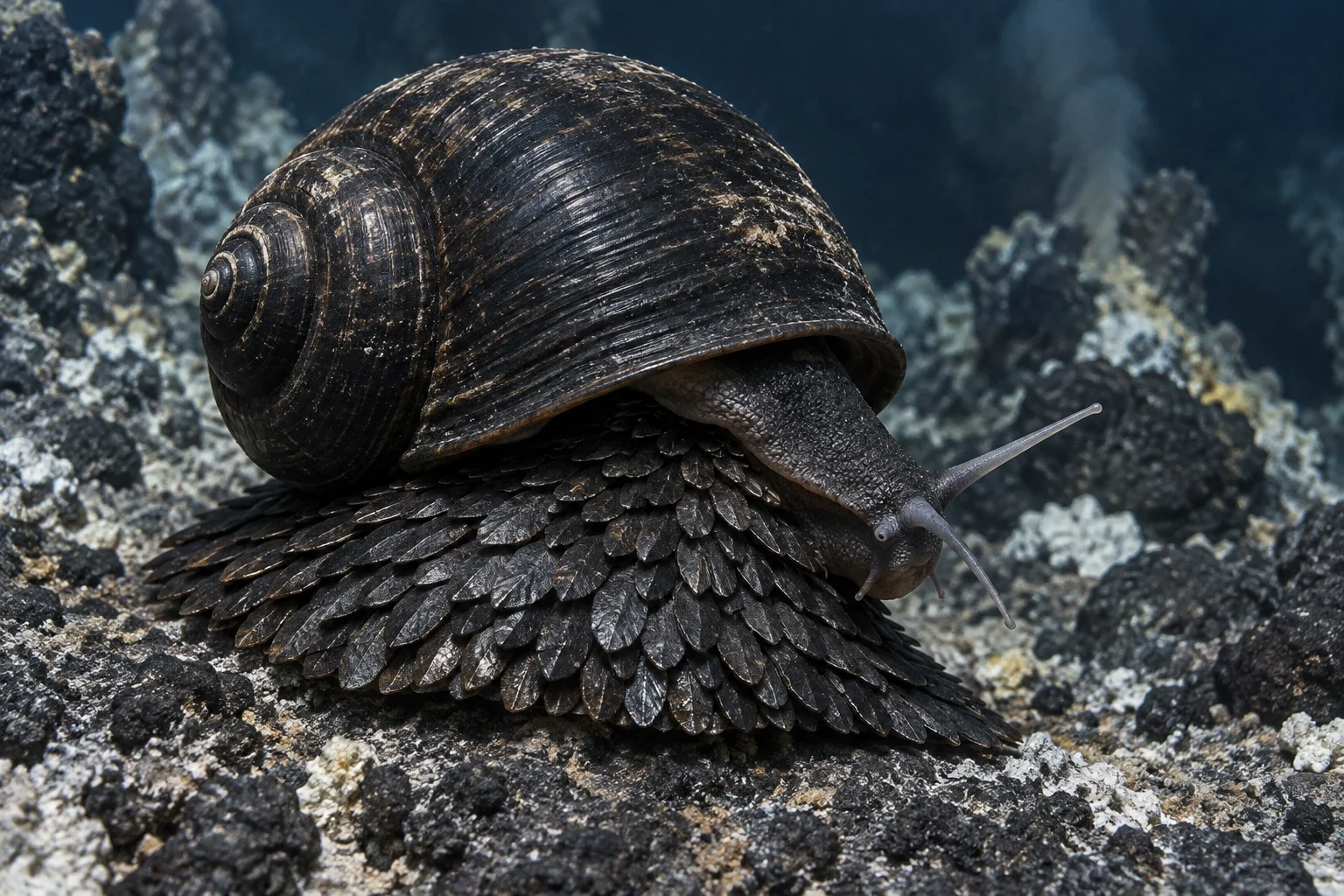
Chrysomallon squamiferum - AI-generated scientific interpretation.
Modern AI-generated scientific illustration; diagnostic features follow the cited research. Colour, pose and unpreserved fine details are interpretive; this image is not fossil or photographic evidence.
Overview
The scaly-foot snail inhabits Indian Ocean hydrothermal vents. In addition to its gastropod shell, it carries overlapping sclerites on the foot. Many populations incorporate iron sulfide into these hard parts, but this is not universal: the black Kairei form contrasts with the white Solitaire form, whose scales lack iron.
Its energy supply depends on sulfur-oxidizing bacteria living inside cells of an enlarged oesophageal gland. A 2020 genome study investigated the animal separately from those bacterial partners, removing endosymbiont genomes from downstream analyses. Tissue-specific expression comparisons indicated that shell and scale formation use different subsets of regulatory factors from an older biomineralization toolkit.
JAMSTEC reported population-genomic work in February 2026 spanning eight vent fields. The sampled populations formed five major genetic groups, and combined genetic reconstruction with ocean-current simulations suggested predominantly south-to-north dispersal and barriers near transform faults. Inferred unsampled or extinct populations may help explain connectivity. These models describe a sampled dispersal history, rather than direct observation of every larva crossing the deep ocean.
Origins & earliest records
This is a living vent specialist. Modern collection and genomic research reveal its biology; resemblance to fossil animals with shells and sclerites does not make it an unchanged survivor of an ancient species.
Evidence & interpretation
Collected specimens demonstrate the shell and foot scales, while sequencing and tissue expression support biomineralization comparisons. Population genomics and particle-tracing models provide complementary dispersal evidence; genetic groupings and historical ghost populations remain analytical inferences.
Selected bibliography
Documented works and useful reading. This is not a list of every appearance.
- 01
The Scaly-foot Snail genome and implications for the origins of biomineralised armour
Selected bibliography; bounded source account, not exhaustive coverage.
- 02
Scaly-foot snails from eight hydrothermal vents map invisible highways and roadblocks in the deep sea
Selected bibliography; bounded source account, not exhaustive coverage.
Family, evolution & connections
Taxonomic classification
A hierarchy of classified groups, not a chain of direct ancestors.
Source note: Selected secure ranks are retained. Biomineralization comparisons concern shared molecular mechanisms, not proof of direct descent from a particular armoured fossil taxon.
- kingdomAnimalia
- phylumMollusca
- classGastropoda
- genusChrysomallon
- speciesChrysomallon squamiferum
References
Sources supporting this profile. Linked pages have their own scope and editorial standards.
- ResearchThe Scaly-foot Snail genome and implications for the origins of biomineralised armourResearch access: 2026-10-10
- InstitutionalScaly-foot snails from eight hydrothermal vents map invisible highways and roadblocks in the deep seaResearch access: 2026-10-10
Image credits
AI-generated scientific interpretationChrysomallon squamiferum - AI-generated scientific interpretation.
Modern AI-generated scientific illustration; diagnostic features follow the cited research. Colour, pose and unpreserved fine details are interpretive; this image is not fossil or photographic evidence.