A sourced illustration has not yet been added. This gap is included in the coverage record.
Overview
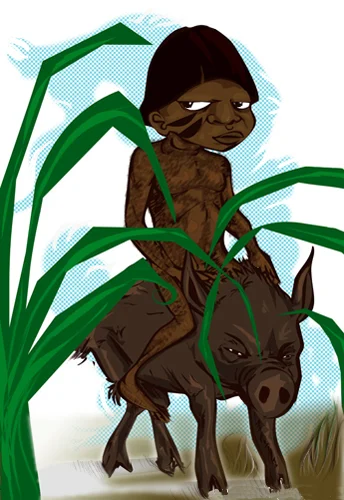
Chullachaqui's disguise makes trust itself part of the danger. A hunter or child may see someone they know, follow that apparent companion, and become lost. The revealing feature is the feet: MINCETUR's Iquitos account describes a human foot paired with a goat's, while Róger Rumrrill's literary retelling gives feet pointing in opposite directions. These are attributed versions rather than a single prescribed anatomy.
Rumrrill frames the being as a protector who frustrates excessive hunting and tree cutting. His fictional storyteller, Oroma, recounts an encounter with a supposed brother whose unequal feet expose the deception. This modern ecological presentation should be read alongside regional oral accounts, with room for differences in humour, danger and guardianship. A guide's familiar outline and unreliable tracks give the stories their distinctive way of imagining uncertainty in the forest.
In Yurimaguas, the figure also has an explicitly performed civic role. The Carnaval Ecológico del Achiote, organized by Patronato Cultural Shungos, casts Chullachaqui as the principal forest guardian in its Monday celebration, mediating between forest and settlement and prompting reflection on environmental damage. The programme includes body painting of Amazonian mythological figures, each accompanied by an explanation of its environmental significance, as well as music, dance and a parade. Loreto’s 2020 recognition and the 2023 tourism record document this public ecological presentation. They establish a particular organized celebration, rather than an ancient date for the creature or evidence that a performance was personally observed.
Origins & earliest records
The name is commonly explained through Quechua words for unequal and foot, but etymology does not establish a date of invention. The inspected MINCETUR directory appeared in 2017; Rumrrill's anthology first appeared in 2024, with an inspected second edition in 2026. These are publication witnesses, not beginnings of Amazonian storytelling.
Records & interpretation
Two institutional publications support the profile while disagreeing about the feet. The tourism directory summarizes an Iquitos version; the national-library anthology is identifiable authored literature with a fictional narrator. Neither is an exhaustive community survey. Their differences are retained rather than resolved into an invented canonical body or a universal Amazonian belief.
Selected bibliography
Documented works and useful reading. This is not a list of every appearance.
- 01
Arte Nativa: directorio de expositores 2017
Institutional directory's Iquitos account; the indexed Chullachaqui passage was inspected.
- 02
Narraciones de la Amazonía
Authored anthology; inspected second edition 2026, chapter El chullachaqui, dios ecológico del bosque, pp. 12–19.
- 03
Carnaval Ecológico Del Achiote
Complete record read; dated14 November2023. Patronato Cultural Shungos programme and cited2020 regional recognition.
Family & connections
A source-supported family tree or inspiration record has not yet been compiled for this profile. Related reading below indicates a connection in subject matter, not a proven lineage or creative influence.
References
Sources supporting this profile. Linked pages have their own scope and editorial standards.
- ReferenceMINCETUR Arte Nativa 2017Research access: 2026-10-05
- Primary textBiblioteca Nacional del Perú: Narraciones de la AmazoníaResearch access: 2026-10-05
- GovernmentMINCETUR inventory11910: Carnaval Ecológico Del AchioteResearch access: 2026-10-05
Image credits
A sourced illustration has not yet been added. This gap is included in the coverage record.