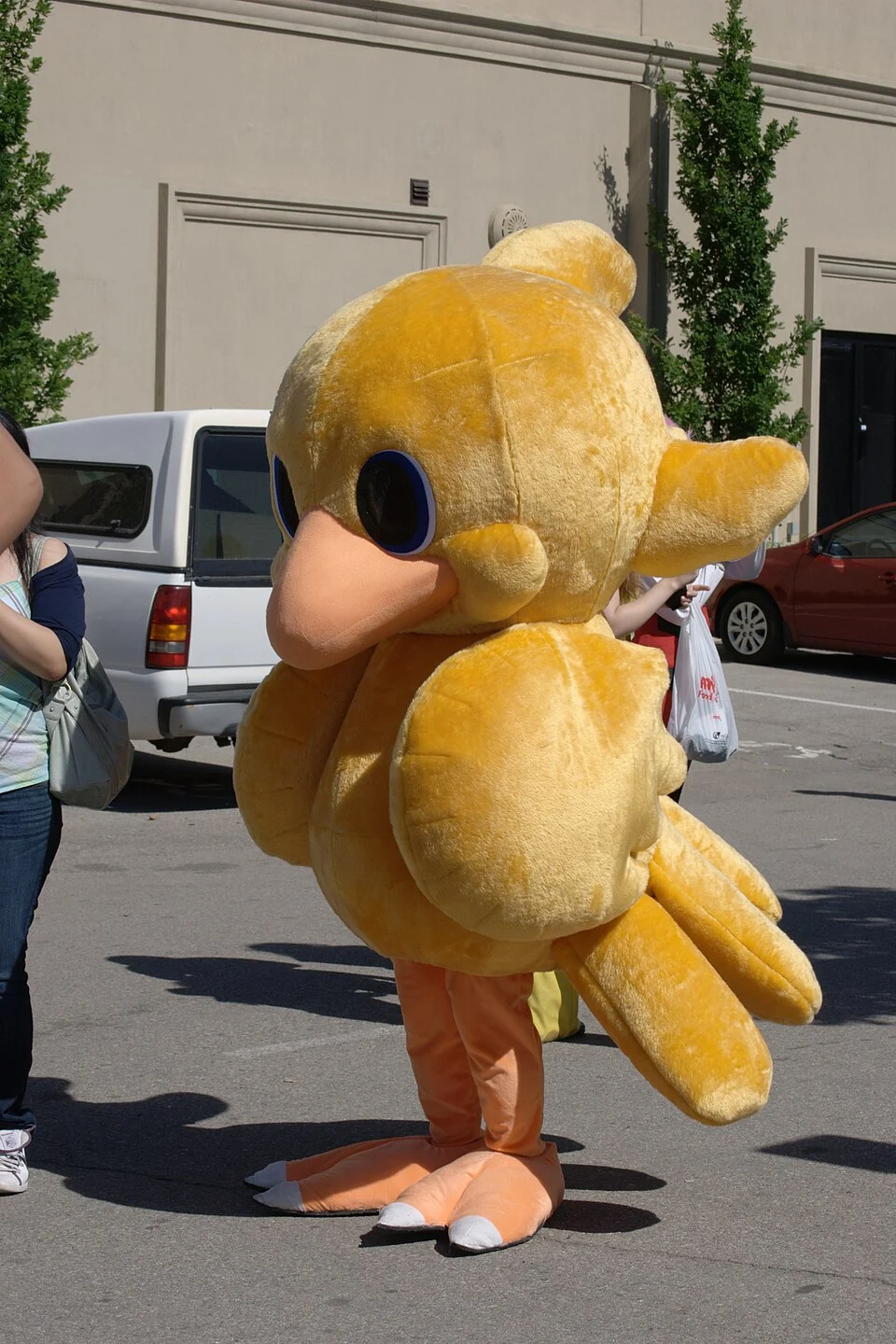
Chocobo costume photographed at a convention
Fan costume, not official artwork.
Overview
Chocobos combine a familiar yellow-plumed bird silhouette and distinctive call with roles that change between Final Fantasy worlds. Their debut as rideable birds in Final Fantasy II establishes transport as a central use; later games also make them racing partners, companions and a way to explore terrain that ordinary travel cannot cross. In the original Final Fantasy VII, catching, stabling, racing and breeding birds form an interconnected system, with specially coloured offspring opening otherwise inaccessible routes. These are properties of that game’s birds, not a biological rule for the entire series. Final Fantasy VII Rebirth instead emphasizes regional adaptations: a captured wild chocobo can be recalled within its home region and fitted with equipment. Mountain birds climb marked steep slopes with their talons, sky birds glide from launch points, ocean birds propel themselves with streams of water, and forest birds bounce from giant mushrooms and slide along branches.
Final Fantasy XIV’s Gold Saucer racing guide separates a bird’s training from its inherited potential. Racing raises its rank and attributes; feed improves selected attributes, while abilities can be hereditary or acquired. Speed and acceleration must be managed against stamina, and individual birds have weather preferences. A race chocobo retired at rank 40 or higher can participate in covering to produce a higher-pedigree fledgling. The parent’s praised ability becomes its hereditary contribution, and a retired racer cannot simply be registered again. This gives care, racing and breeding distinct consequences within that game’s system. World of Final Fantasy offers another deliberately different presentation: its Chocochick appears in Wellspring Woods and attacks by striking with an egg-topped head. Across these versions, the creature lets players relate to fictional wildlife through handling and movement as well as fighting; a hatchling, racing bird and regional mount are separate treatments of a recurring design.
First appearances & development
Chocobos first appear in Final Fantasy II (1988). Their continued use across numbered games and spin-offs preserves an identifiable bird motif while changing its fictional setting and gameplay. The original Final Fantasy VII breeding system, XIV’s race pedigrees and Rebirth’s regional traversal abilities belong to separate releases; one does not establish the natural history of another.
Canon & continuity
Square Enix’s Rebirth world page directly describes regional traversal, while the Lodestone racing guide supplies XIV’s training, inheritance and retirement rules. The May 2024 World of Final Fantasy retrospective identifies the Chocochick encounter. Original VII breeding is separately Reference-mediated through the inspected specialist guide, rather than inferred from the remake or online game.
Selected bibliography
Documented works and useful reading. This is not a list of every appearance.
- 01
Final Fantasy II
Original bird-mount debut; separate setting from later numbered games.
- 02
Final Fantasy VII
Catching, stabling, racing and breeding chocobos for special traversal.
- 03
Final Fantasy XIV: A Realm Reborn
Online-game baseline; later Gold Saucer racing system documented by its maintained official guide.
- 04
World of Final Fantasy
Wellspring Woods Chocochick treatment described in the publisher retrospective.
- 05
Final Fantasy VII Rebirth
Distinct regional chocobo abilities and equipment customization.
Family, evolution & connections
Dodo
Square Enix describes chocobos as feathered companions and mounts; the museum identifies the dodo as a real flightless pigeon. Their ground-bird silhouettes provide a useful comparison, but a chocobo's rideable size and game-specific powers are fictional. No cited creator statement establishes the dodo as the original design model, and dodos were not uniformly slow or clumsy.
Childhood pet chick
In the translated 2008 Ultimania interview, Ishii says he modeled the original chocobo on a chick he raised as a child and remembered after it was given away. This is a creator-attributed animal input, accessed through a fan translation with a photographed source page; the original Japanese edition has not been independently collated.
Thunderbolt in Kōya no Shōnen Isamu
Ishii’s translated Ultimania interview names Isamu’s horse Thunderbolt as an example of the non-speaking companion he wanted players to care about. The input concerns relationship and emotional function, not a horse-shaped chocobo body. The account is accessed through a clearly identified fan translation, rather than claimed as a newly checked official English interview.
Morinaga Choco Ball advertising jingle
In the translated Ultimania interview, Ishii connects the chocobo name with singing a Choco Ball advertising jingle while drawing its pixel art. This documents an attributed naming input rather than claiming the candy mascot supplies the whole creature design. The fan translation and pictured source page remain identified; the Japanese edition was not independently collated.
Chocochick
Square Enix’s World of Final Fantasy feature identifies Chocochick among baby versions of familiar creatures. The small-bird family association is useful within that title and the recurring Chocobo concept. It should not imply that every Chocobo entry across separate game worlds has an identical life cycle, transformation route or shared biological population.
Chocobo Racing motor-powered roller skates
Maeda says Chocobo GP retained Chocobo’s powered roller skates from Chocobo Racing. This documents continuity between racing character designs, not anatomy of every chocobo.
Encyclopedia background
An additional attributed reference, separate from the editorial profile above.
Read the open encyclopedia overview
Chocobo ( ; Japanese: チョコボ, Hepburn: Chokobo) are a fictional species created for the Final Fantasy franchise by Square Enix (originally Square). A galliform bird commonly having yellow feathers, they were first introduced in Final Fantasy II (1988), and have since featured in some capacity in nearly every Final Fantasy title, usually as a means of transport. Chocobos or chocobo-themed characters have played story roles in multiple titles, notably in Final Fantasy V and XIII. A recurring Chocobo also acts as protagonist of the Chocobo spin-off series.
The chocobo was created by designer and artist Koichi Ishii, inspired by childhood memories of raising a chick to adulthood. In Final Fantasy III it was going to be part of a trio of mascot characters alongside the Moogle, but the third planned mascot was scrapped. The chocobo has gone through multiple redesigns for each entry, with a notable contributing artist being Toshiyuki Itahana. In addition to Final Fantasy, the character has made cameo appearances in other video games. The chocobo has remained an icon of the series, recognised and noted by journalists and fans.
Text from Wikipedia contributors, “Chocobo”. CC BY-SA 4.0. Extracted introduction; formatting changed. Retrieved 5 October 2026. The source article may have changed since retrieval.
References
Sources supporting this profile. Linked pages have their own scope and editorial standards.
- OfficialSquare Enix: Final Fantasy VII Rebirth — WorldResearch access: 2026-10-05
- OfficialFinal Fantasy XIV Lodestone: Chocobo Racing play guideResearch access: 2026-10-05
- OfficialSquare Enix: FF Weekly, May 2nd Remember When (2024)Research access: 2026-10-05
- ReferenceFinal Fantasy Wiki: Chocobo breeding (Final Fantasy VII)Research access: 2026-10-05
Image credits
Cosplay interpretationChocobo costume photographed at a convention
Fan costume, not official artwork.