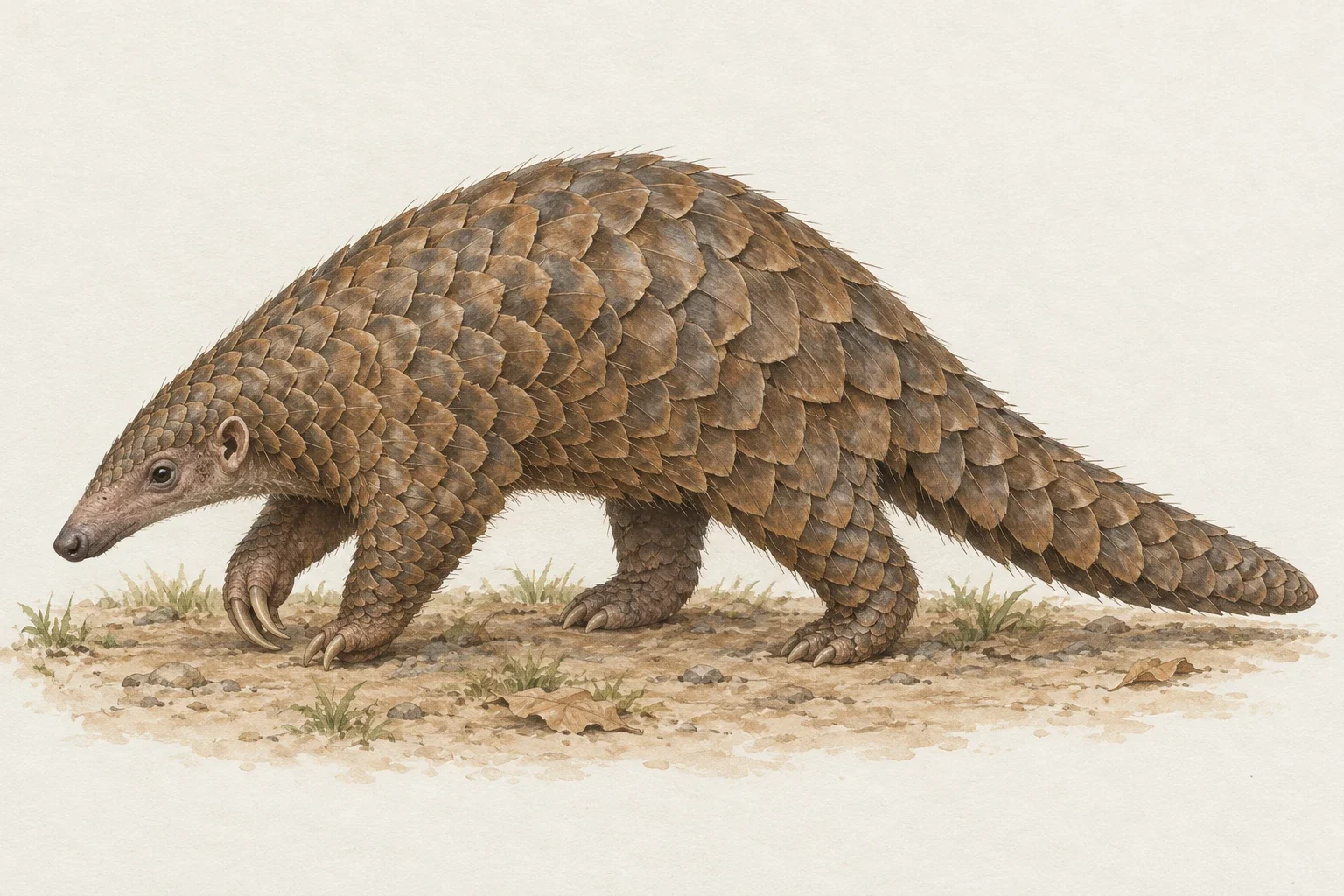
Chinese pangolin - AI-generated scientific interpretation.
Modern AI-generated scientific illustration. Diagnostic external features follow selected sources; pose, individual pattern and fine details are interpretive. Not photography or independent anatomical evidence.
Overview
The Chinese pangolin has overlapping keratin scales, a tapered head, small external ears and curved digging foreclaws. Its relatively short broad tail and sparse hairs among scales belong to a mammal rather than a reptile.
Claws expose ants and termites, gathered by a sticky tongue. Burrows offer refuge and curling protects vulnerable surfaces. Michigan’s older account supplies anatomy and feeding; legal and conservation-status fields are not adopted as current.
Choo and colleagues assembled Chinese and Malayan pangolin genomes and found changes involving olfaction, scales and immunity. Their connection between scale development and reduced injury or infection is a hypothesis. Other insect-feeding mammals share a diet without belonging to the same family.
Origins & earliest records
MDD lists Manis pentadactyla Linnaeus, 1758. Chinese and short-tailed pangolin are alternate common names here.
Evidence & interpretation
MDD verifies nomenclature, Michigan supports bounded anatomy, and Smithsonian’s primary abstract supports genome claims. No precise western range boundary or additional taxonomic split is asserted.
Selected bibliography
Documented works and useful reading. This is not a list of every appearance.
- 01
Manis pentadactyla
Selected bibliography; institutional account and study limits retained.
- 02
Manis pentadactyla
Selected bibliography; institutional account and study limits retained.
- 03
Pangolin genomes and the evolution of mammalian scales and immunity
Primary abstract; adaptive explanations remain hypotheses.
Family, evolution & connections
Taxonomic classification
A hierarchy of classified groups, not a chain of direct ancestors.
Source note: MDD accepted treatment used; old status fields omitted.
- ClassMammalia
- OrderPholidota
- FamilyManidae
- GenusManis
- SpeciesManis pentadactyla
References
Sources supporting this profile. Linked pages have their own scope and editorial standards.
- InstitutionalManis pentadactylaResearch access: 2026-10-10
- InstitutionalManis pentadactylaResearch access: 2026-10-10
- ResearchPangolin genomes and the evolution of mammalian scales and immunityResearch access: 2026-10-10
Image credits
AI-generated scientific interpretationChinese pangolin - AI-generated scientific interpretation.
Modern AI-generated scientific illustration. Diagnostic external features follow selected sources; pose, individual pattern and fine details are interpretive. Not photography or independent anatomical evidence.