Batten: the Children of Lir in human form
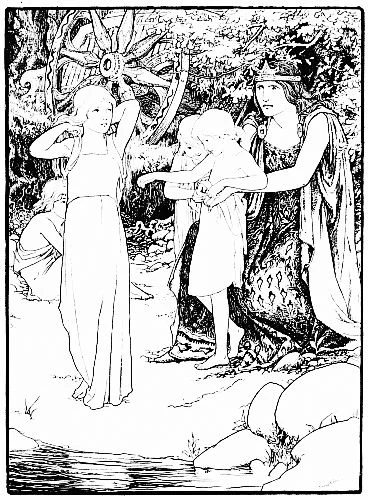
The Fate of the Children of Lir illustration depicts the four children beside a woman at the water. This is their human appearance, not their later swan form; woman not individually identified here. John Dickson Batten (1860–1932) credited by title page. Selected title-page edition 1895.
Overview
Jacobs names the siblings Fingula, Aod, Fiachra and Conn, children of Lir and Ove. After their mother dies, Lir marries her sister Oifa, whose affection turns to jealousy. Failed attempts to have the children killed lead to their transformation beside a lake. Their sentence lasts nine hundred years, with release linked to a marriage between a southern woman and northern man. The swans retain their voices and sing exceptionally beautiful laments. Fingula protects her brothers beneath her feathers during storm, cold and separation, making their continuing kinship central to the animal form. Ove and Oifa are daughters of Oilell and foster-children of Dearg, rather than Dearg’s biological daughters. Fingula’s warning dream precedes the journey, but does not prevent the spell. After hearing the swans, Lir learns their identity directly from their human speech. Their departure for the Moyle leads to a prohibition on killing swans throughout Erin in the narrative, showing that the transformation affects relations with other birds as well as the family’s private grief.
They eventually return to their father’s former home and find it desolate, with no surviving household that knows them. In the concluding Christian frame a cleric recognises and cares for the birds, but a prince seeking them for his intended bride tries to seize them. Their feathers fall away and reveal greatly aged people, rather than youthful restoration. They receive baptism, die and are buried in the arrangement Fingula requested, preserving her protective relation to the three brothers. The account’s saints and religious resolution are respectfully attributed to this selected telling. The manuscript age is more uncertain than the tale’s mythical chronology suggests: Jacobs specifically says O’Curry used Dublin manuscripts no earlier than the eighteenth century. During a tempest the siblings agree to reunite at the Rock of the Seals. Fingula eventually shelters Fiachra beneath her right wing, Conn beneath her left and Aod at her breast; this bodily arrangement anticipates her burial request. Mac Howg’s bell initially frightens the birds before Fingula interprets it as relief. He later links them with white-silver chains in two pairs. Deoch’s wish to possess the celebrated birds leads Lairgnen to seize them from the altar, triggering the aged human forms. Their names are placed on the burial cairn, but the text’s mention of runes is not a claim that the monument has been located and examined.
Origins & earliest records
Jacobs abridged the 1883 Society for the Preservation of the Irish Language text and translation following O’Curry’s version. His note expressly warns that its cited manuscripts were eighteenth-century or later. The selected 1895 print thus does not justify calling this exact tale an independently preserved eleventh-century manuscript narrative.
Records & interpretation
The spell, retained voices and swan exile are literary attestations. The nine-century duration is story time, not measured avian longevity. Manuscript and edition history establishes transmission while leaving oral antiquity and historical identifications open.
In the literature
“heard the swans speaking with human voices”
The Fate of the Children of Lir; p.5, Lir discovers their retained speech
Lir and Ove have Fingula, Aod, Fiachra and Conn. After Ove dies, her sister Oifa becomes their stepmother. Jealousy leads Oifa to turn all four into white swans; their human speech and exceptional music remain. Her announced duration and marriage condition are preserved as the selected story’s terms.
Selected bibliography
Documented works and useful reading. This is not a list of every appearance.
- 01
More Celtic Fairy Tales: The Fate of the Children of Lir
Full selected episode and relevant editorial source note inspected; cited earlier collections remain attributed, not falsely claimed as newly read.
- 02
More Celtic Fairy Tales — The Fate of the Children of Lir
Joseph Jacobs, More Celtic Fairy Tales, New York: G.P.Putnam’s Sons; London:D.Nutt,1895, selected title page verified. Compiler acknowledges simplification and insertion of parallel incidents; each relevant source note supplies transmission claims. Historical English text, modern transcription; original illustration rights separate.
Family, evolution & connections
Lir and Ove’s four children in Jacobs’s retelling
The four children born to Lir and Ove before his marriage to her sister Oifa.
Scroll sideways to see all branches. With a keyboard, focus the tree and use the arrow keys.
- Lir and Ove (joint parents)
- Fingula (twin)
- Aod (twin)
- Fiachra
- Conn
Explicit family statements in the named Jacobs retelling. Oifa is their maternal aunt and later stepmother, not biological mother. Dearg fosters Oilell’s daughters; fostering is not biological parentage. Historical spellings Ove/Oifa are retained for this witness.
Lir
Jacobs names Lir and Ove as the parents of Fingula, Aod, Fiachra and Conn.
Ove
The opening gives Ove two successive births before her death; Oifa is her sister and Lir’s later wife.
Located primary passages
Specific passages supporting details in this entry, grouped by their published witness.
More Celtic Fairy Tales — The Fate of the Children of Lir
Joseph Jacobs, More Celtic Fairy Tales, New York: G.P.Putnam’s Sons; London:D.Nutt,1895, selected title page verified. Compiler acknowledges simplification and insertion of parallel incidents; each relevant source note supplies transmission claims. Historical English text, modern transcription; original illustration rights separate.
- Lir and Ove have Fingula, Aod, Fiachra and Conn. After Ove dies, her sister Oifa becomes their stepmother. Jealousy leads Oifa to turn all four into white swans; their human speech and exceptional music remain. Her announced duration and marriage condition are preserved as the selected story’s terms.
The Fate of the Children of Lir; pp.2–5, family and transformation
- The siblings leave their father’s community for the Moyle, survive separation in a storm and regroup under Fingula’s wings. After their allotted wandering they return to find the family home deserted, then move to Glory Isle. The narrative contrasts magical endurance with the passage of human generations.
The Fate of the Children of Lir; pp.6–9, separation and return to an empty home
- Mac Howg receives and links the swans with silver chains. Lairgnen and Deoch demand the birds; when Lairgnen seizes them, their feathers fall and they become three aged men and an aged woman. Baptism, death and the specified burial follow. Restoration is not narrated as immediate rejuvenation at the first bell.
The Fate of the Children of Lir; pp.9–10, saint, silver chains and aged restoration
Complete named tale independently read. Named source paragraphs and preface checked; extensive comparative Lir commentary was only partly read and its conclusions are not adopted. No verse, prayers or ritual formulas reproduced. Earlier editions and manuscripts remain indirect.
Primary source witness
Joseph Jacobs, More Celtic Fairy Tales, New York: G.P.Putnam’s Sons; London:D.Nutt,1895, selected title page verified. Compiler acknowledges simplification and insertion of parallel incidents; each relevant source note supplies transmission claims. Historical English text, modern transcription; original illustration rights separate.
- Jacobs says he abridged the1883 Society for the Preservation of the Irish Language text and translation, itself following O’Curry’s AtlantisIV version. He reports three eighteenth-century Dublin manuscripts; these manuscript descriptions and his antiquity arguments remain attributed secondary reports, not independently inspected manuscripts.
Verifies the compiler’s stated source, not the uninspected cited edition or asserted earliest manuscript.
References
Sources supporting this profile. Linked pages have their own scope and editorial standards.
- Primary textJacobs, More Celtic Fairy Tales: The Fate of the Children of Lir and source noteResearch access: 2026-10-05
Image credits
Historical illustrationBatten: the Children of Lir in human form
The Fate of the Children of Lir illustration depicts the four children beside a woman at the water. This is their human appearance, not their later swan form; woman not individually identified here. John Dickson Batten (1860–1932) credited by title page. Selected title-page edition 1895.