A sourced illustration has not yet been added. This gap is included in the coverage record.
Overview
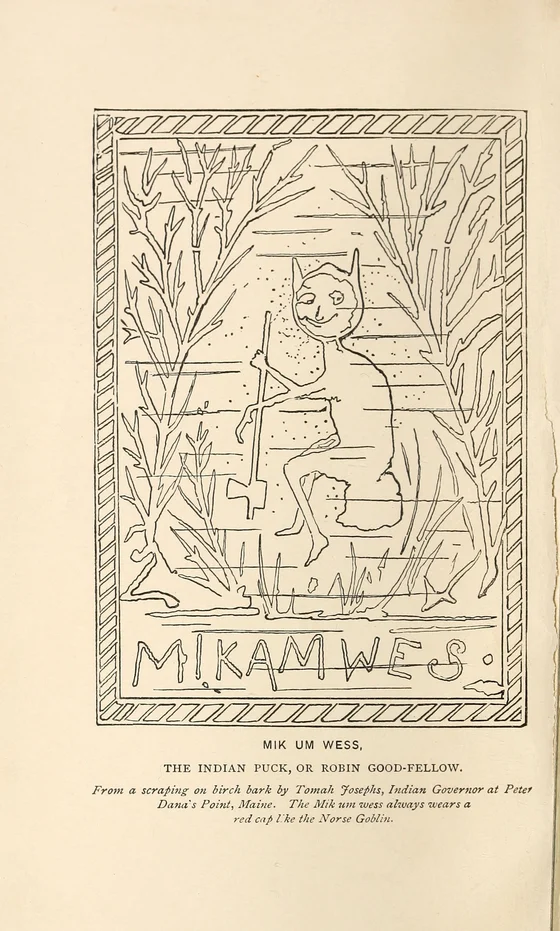
A chief sets the return of the serpent’s head as a marriage condition. The magical helper Mikumwess approaches its underground dwelling at night and places a large log across the opening. His dance brings the serpent out, moving its head to examine its surroundings. When it lays its neck on the log, he strikes with a hatchet and carries away the head by a shining yellow horn. The chief accepts this as the completion of the first trial but imposes additional contests.
In the separate Chenoo account transmitted through Louis Brooks and Rand, the friendly giant owns two dragon horns: one branched and one straight, both bright. A hunter drives the straight horn into an enemy giant’s ear. It grows through the head, takes root and coils around a tree to restrain her. These are powers of the detached horn within that story; the passage does not depict a living serpent using them in battle.
Origins & earliest records
Leland’s 1884 volume uses several spellings, including Chepichealm and Chepichcalm, within the marriage tale, and chepitchcalm in the Chenoo account. These are retained under one profile, rather than counted as separate animals.
Records & interpretation
The complete serpent-killing episode and the complete enclosing marriage tale were read, as was the full Chenoo narrative. Leland calls the being wingless and proposes identification with Weewillmekq’; that proposal is not made a settled cross-community synonym. The narrative does not establish any surviving zoological species.
In the literature
“one of the shining yellow horns”
How Glooskap made a Magician of a Young Man, who aided another to win a Wife and do Wonderful Deeds; complete enclosing chapter, first marriage trial · Leland English collected retelling; case-specific contributor mediation retained
A chief demands the horned serpent’s head before his daughter may marry. The magically transformed helper Mikumwess approaches its underground den; when the serpent emerges he decapitates it and carries the head by a shining yellow horn. Leland’s note calls Chepichealm an immense horned serpent or wingless dragon and proposes, without establishing, identity with Weewillmekq. The entire marriage-trial chapter and successful return were read, not only the killing.
“One of them has two branches; the other is straight and smooth.”
The Chenoo, or the Story of a Cannibal with an Icy Heart; detached horn in complete narrative · Leland English collected retelling; case-specific contributor mediation retained
The friendly Chenoo carries two bright dragon horns, one branched and one straight. The hunter uses the straight horn to pierce the female enemy’s head; it extends through the other ear, roots in the ground and coils around a tree to restrain her. These are detached-horn powers in this episode, not a narrated living serpent’s combat anatomy.
Selected bibliography
Documented works and useful reading. This is not a list of every appearance.
- 01
The Algonquin Legends of New England
How Glooskap made a Magician of a Young Man; first marriage trial; The Chenoo, or the Story of a Cannibal with an Icy Heart, dragon-horn combat.
- 02
The Algonquin Legends of New England — living serpent encounter and detached dragon-horn episode
Original work1884; selected Gutenberg6803 plain transcription, exact source print impression and printed pagination unidentified. Full author Preface and Authorities independently read.
Family & connections
A source-supported family tree or inspiration record has not yet been compiled for this profile. Related reading below indicates a connection in subject matter, not a proven lineage or creative influence.
Located primary passages
Specific passages supporting details in this entry, grouped by their published witness.
The Algonquin Legends of New England
Original work1884; selected Gutenberg6803 plain transcription, exact source print impression and printed pagination unidentified. Full author Preface and Authorities independently read.
- A chief demands the horned serpent’s head before his daughter may marry. The magically transformed helper Mikumwess approaches its underground den; when the serpent emerges he decapitates it and carries the head by a shining yellow horn. Leland’s note calls Chepichealm an immense horned serpent or wingless dragon and proposes, without establishing, identity with Weewillmekq. The entire marriage-trial chapter and successful return were read, not only the killing.
- The friendly Chenoo carries two bright dragon horns, one branched and one straight. The hunter uses the straight horn to pierce the female enemy’s head; it extends through the other ear, roots in the ground and coils around a tree to restrain her. These are detached-horn powers in this episode, not a narrated living serpent’s combat anatomy.
The Chenoo, or the Story of a Cannibal with an Icy Heart; detached horn in complete narrative
No entire volume, independently recorded oral performance or separate cited manuscript/comparative book read. Narrator credits and endings remain case-specific; editorial origin, medical and diffusion hypotheses are not established facts.
References
Sources supporting this profile. Linked pages have their own scope and editorial standards.
- ResearchLeland: located primary collection with source notesResearch access: 2026-10-05
Image credits
A sourced illustration has not yet been added. This gap is included in the coverage record.