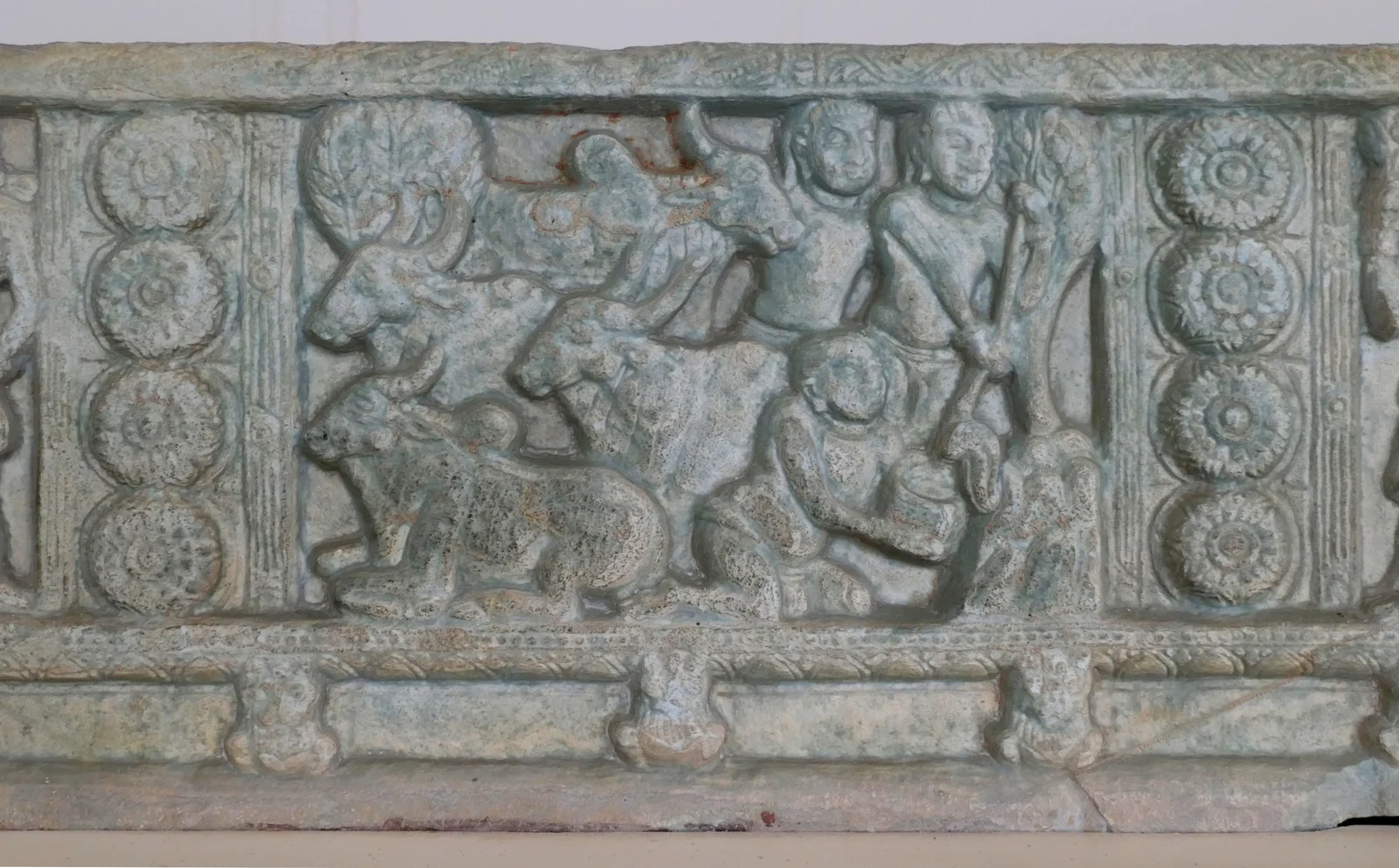
Weathered stone relief with cattle at left and human figures beneath trees at right, one crouching beside a vessel and the small serpent in the capture scene.
The photographer identifies this Nagarjunakonda relief as the capture of the serpent king Campeyya. Its historic artist and individual date are not supplied by this gallery.
Overview
Campeyya is the royal serpent Bodhisatta in Jātaka 506. His body is white like silver, his head compared to red wool, and his thickness to a plough-head. Seeking release from the pleasures of the nāga realm, he observes fasting vows on an anthill beside a road. He tells his consort Sumanā that a pond will become turbid if he is hurt, empty if a garuḍa carries him away, and blood-red if a snake-charmer captures him.
The charmer uses herbs and a spell to subdue him. Though his poisonous breath could destroy the man, Campeyya accepts torture rather than break his moral undertaking. In performances he changes colour, size and shape and spreads his hood in extraordinary multiples. Sumanā discovers the blood-red water and appeals to King Uggasena. Released from his basket, Campeyya resumes a richly adorned human form and invites the king to his underwater palace.
The pond supplies a domestic link between his solitary fasting and Sumanā’s rescue. She first inspects the water after his long absence, then follows the marks of his capture and the reports of villagers to Benares. Appearing above the royal courtyard, she identifies herself as a female serpent rather than a goddess or human. Her intervention is a petition to purchase liberty, with wealth, cattle and a village offered as appropriate compensation. The charmer ultimately agrees to release him without taking the reward.
The king does not immediately trust Campeyya’s promise of hospitality. Several exchanges concern whether a powerful venomous being can be believed, and Campeyya gives emphatic assurances that natural upheavals would be more likely than his speaking falsely. Thus the tale gives different reasons for restraint and trust: the captive does not retaliate because of his vowed conduct, his consort negotiates on his behalf, and the human king demands evidence of gratitude before accepting an invitation into the supernatural realm.
Origins & earliest records
South Asian Buddhist Jātaka narrative tradition
Records & interpretation
Historical primary-text translation directly read with printed page locators.
Selected bibliography
Documented works and useful reading. This is not a list of every appearance.
- 01
The Jātaka, Volume IV
Jātaka 506, pp. 281–291; hosted-volume publication date not independently verified. Narrative prose and verse distinguished from a first-attestation claim.
Family & connections
A source-supported family tree or inspiration record has not yet been compiled for this profile. Related reading below indicates a connection in subject matter, not a proven lineage or creative influence.
Primary records and illustrations
The Jātaka, Volume IV
Volume IV. Jātaka 506, pp. 281–291
Actual translated narrative directly read. Story number and printed English pagination retained; no object or image inferred.
The pond supplies a domestic link between his solitary fasting and Sumanā’s rescue. She first inspects the water after his long absence, then follows the marks of his capture and the reports of villagers to Benares. Appearing above the royal courtyard, she identifies herself as a female serpent rather than a goddess or human. Her intervention is a petition to purchase liberty, with wealth, cattle and a village offered as appropriate compensation. The charmer ultimately agrees to release him without taking the reward.,The king does not immediately trust Campeyya’s promise of hospitality. Several exchanges concern whether a powerful venomous being can be believed, and Campeyya gives emphatic assurances that natural upheavals would be more likely than his speaking falsely. Thus the tale gives different reasons for restraint and trust: the captive does not retaliate because of his vowed conduct, his consort negotiates on his behalf, and the human king demands evidence of gratitude before accepting an invitation into the supernatural realm.
References
Sources supporting this profile. Linked pages have their own scope and editorial standards.
- Historical primary-text translationThe Jātaka, Volume IV — Jātaka 506, pp. 281–291Research access: 2026-10-05
Image credits
Photograph of historical narrative reliefWeathered stone relief with cattle at left and human figures beneath trees at right, one crouching beside a vessel and the small serpent in the capture scene.
The photographer identifies this Nagarjunakonda relief as the capture of the serpent king Campeyya. Its historic artist and individual date are not supplied by this gallery.