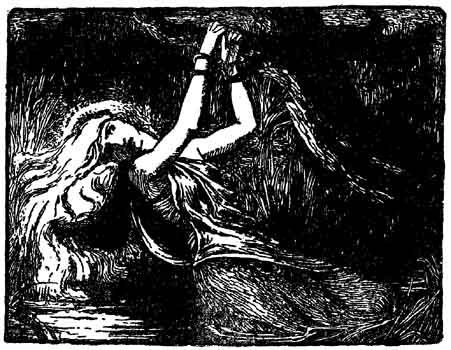
Personified Moon struggling in the bog, Batten
Actual pale-haired woman sprawls in dark water with raised arms, adjacent caption and chapter locate the trapped Moon episode.
Overview
Jacobs depicts the Moon as a woman concealed in a black cloak and hood, with yellow hair whose radiance can dispel darkness. Walking over marsh tussocks, she seizes a snag for balance and finds it wrapping around her wrists. A lost man approaches a dangerous pool; her struggle dislodges the hood and reveals enough light for him to escape. Concentrating on his safety, she forgets her own captivity. Exhaustion lets the hood fall back over her hair, and the surrounding beings return.
Witches, bogles and crawling horrors dispute how to destroy their enemy, then force her under the water and roll a stone over her before dawn. Watching lights guard the snag. When the expected Moon fails to appear, the marsh community becomes frightened; the rescued traveller eventually recalls the guiding light and gives them a lead. A wise woman interprets the concealed landmark through the forms of a coffin, candle and cross, and the villagers jointly move the stone. A brief glimpse of a grateful face is followed by the Moon shining in the sky again. The tale’s danger and restoration depend on darkness and collective rescue, while its collector warned that the young narrator’s imagination may have shaped the details.
Origins & earliest records
Jacobs abridged Balfour’s Legends of the Lincolnshire Cars in Folk-Lore volume II and removed dialect. Balfour’s child informant, named Bratton, said the story came from her grandmother. This recorded chain does not independently establish an ancient, uniform English lunar religion.
Records & interpretation
The source witnesses a personifying marsh narrative and its collection history. The Moon’s human appearance and imprisonment belong to that story; they are not astronomical observations. The hostile beings are not anatomically catalogued as separate verified creatures.
In the literature
“there was the full Moon in the sky”
The Buried Moon; The villagers lift the great stone in the marsh
The tale ends with restored moonlight and safe pathways.
Selected bibliography
Documented works and useful reading. This is not a list of every appearance.
- 01
More English Fairy Tales
Complete “The Buried Moon” and its source note inspected. Preface acknowledges rewritten and combined sources.
- 02
More English Fairy Tales — The Buried Moon
Joseph Jacobs, More English Fairy Tales; first publication1894, selected Gutenberg14241 witness explicitly Fourteenth Impression, undated. Jacobs’s preface acknowledges rewriting, combined sources and altered incidents. Exact heading/anchor used; no invented print pagination.
Family & connections
A source-supported family tree or inspiration record has not yet been compiled for this profile. Related reading below indicates a connection in subject matter, not a proven lineage or creative influence.
Located primary passages
Specific passages supporting details in this entry, grouped by their published witness.
More English Fairy Tales — The Buried Moon
Joseph Jacobs, More English Fairy Tales; first publication1894, selected Gutenberg14241 witness explicitly Fourteenth Impression, undated. Jacobs’s preface acknowledges rewriting, combined sources and altered incidents. Exact heading/anchor used; no invented print pagination.
- The Moon visits the marsh in a hood to investigate its harmful night beings. A snag traps her wrists; uncovering her bright hair saves a lost man, but he leaves before noticing her own peril. When the hood falls forward, the beings return, submerge her and secure a stone above her while will-o-the-wisps keep watch.
- After the Moon fails to return, villagers consult a wise woman. The saved man recalls the guiding light; her directions lead the villagers to a stone, snag and flickering light interpreted as coffin, cross and candle. Lifting the stone briefly reveals a face before the Moon returns to the sky and lights their paths.
The Buried Moon; Missing moon, remembered rescue and recovery
Complete selected tale and its source note read. Jacobs’s edited narrative is distinct from direct oral transcription. No song or ritual-formula excerpts; no invented print page or earliest date.
Primary source witness
Joseph Jacobs, More English Fairy Tales; first publication1894, selected Gutenberg14241 witness explicitly Fourteenth Impression, undated. Jacobs’s preface acknowledges rewriting, combined sources and altered incidents. Exact heading/anchor used; no invented print pagination.
- Jacobs cites Balfour's Lincolnshire Cars collection in Folk-LoreII, saying he abridged it and removed dialect. The note names a girl Bratton reporting her grandmother's telling, while Balfour considered the girl's imagination influential in the details.
Notes and References, LXVI The Buried Moon; Jacobs's stated source and degree of mediation
This verifies what Jacobs reports and changes; listed earlier works and informant claims are not independently verified by this note alone.
References
Sources supporting this profile. Linked pages have their own scope and editorial standards.
- Primary textJacobs, More English Fairy Tales: The Buried Moon and editorial noteResearch access: 2026-10-05
- ReferenceUniversity of Pennsylvania Online Books Page: Joseph Jacobs bibliographic listResearch access: 2026-10-05
Image credits
Historical illustrationPersonified Moon struggling in the bog, Batten
Actual pale-haired woman sprawls in dark water with raised arms, adjacent caption and chapter locate the trapped Moon episode.