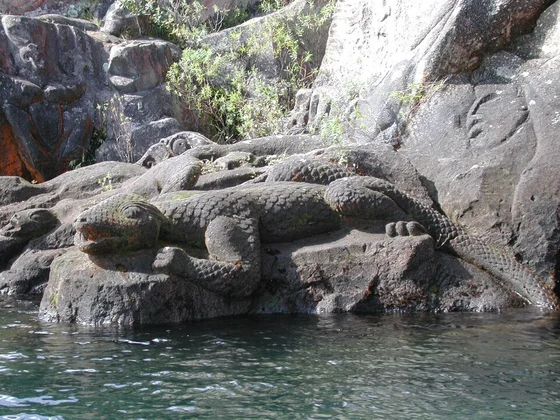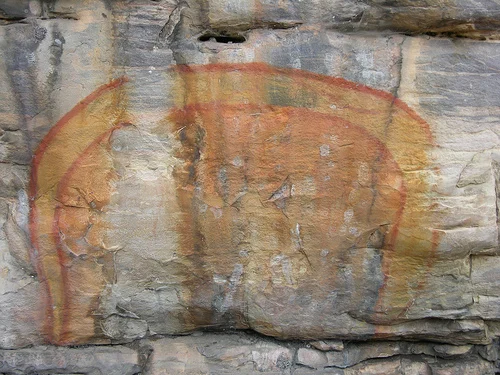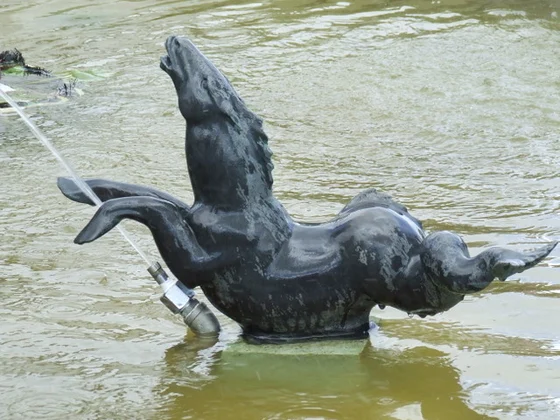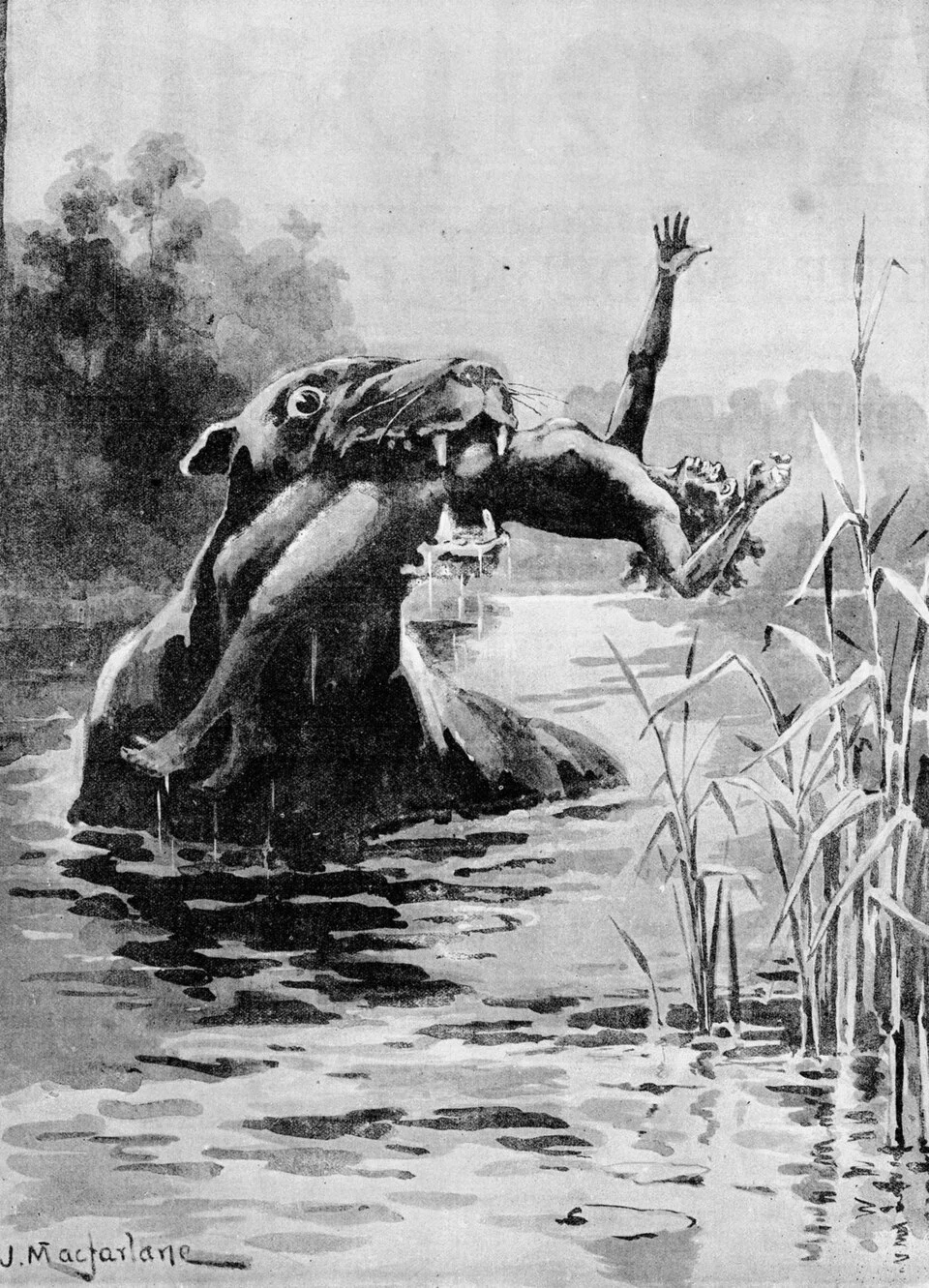
1890 Illustrated Australian News depiction of the Bunyip
Historical outsider illustration; not a definitive Indigenous representation.
Overview
Bunyip appears in Australian accounts of dangerous water beings, colonial attempts to identify an unfamiliar animal, and modern stories and illustrations. Those records do not describe one agreed body or a single tradition shared by every Aboriginal community. A named contemporary storyteller and the history of a disputed nineteenth-century skull offer different ways of understanding the subject.
Adam Duncan’s The Bunyip and the Stars, illustrated by Paul Lalo and published by the National Museum of Australia Press in April 2023, follows Wumbirr and his sister Ngariin. On a night without stars, the boy leaves the campfire’s safety and is captured; Ngariin must use her knowledge of Country to rescue him. Duncan is a Biripi author with ancestral ties to the Manning River region. The museum explains that he developed the story with children at Wiradjuri Preschool and Childcare in Canberra. This identified contemporary collaboration is a distinct literary witness, not a template for every water-being tradition.
Ronald C. Gunn’s earlier report draws its descriptions from correspondence with Charles La Trobe and especially Edward Curr. It combines a bullock-sized body, emu-like head and neck, horse-like mane and tail, downward tusks and seal-like feet. The reported animal enters a burrow underwater and reaches a chamber above the water level, where it deposits large, soft-shelled eggs. Crustaceans and roots are named as food alongside attacks on people. Gunn acknowledges that the descriptions and drawings disagree. The article does not name the individual Indigenous informants or reliably connect each reported feature with a particular community, so its composite description should remain attributed to this colonial correspondence.
The report then turns to a skull from the Murrumbidgee, brought to Melbourne by Athol Fletcher and lent through Curr for examination in Launceston. No other bones were found with it. James Grant describes thin, smooth, incompletely ossified bones and covered teeth, suggesting a very young or possibly fetal herbivore. He considers whether incomplete development could explain its unusual appearance; a young camel is mentioned as a suggestion rather than a settled identification. The missing lower skull structures and damaged front of the palate limit his reconstruction. The completed report supplies measurements and ends with Gunn still seeking a whole animal or evidence that the supposed creature is fabulous.
William Sharp Macleay later examined the same skull after Charles Nicholson received it. His letter, dated 5 July 1847 and reprinted in the journal, identifies the preserved milk molars as those of a young foal and compares other features with horses. He also describes a separate fetal horse skull from the Hawkesbury River, found in 1841. That comparison specimen has a single central eye socket, whereas the Murrumbidgee skull has widely separated orbits. Macleay argues that both represent unusual development within horses, rather than evidence of a new aquatic species. His comparison is an anatomical argument about two particular specimens. It does not make the Hawkesbury skull the original alleged Bunyip skull, and it does not establish a general origin for Aboriginal water-being stories.
Julian Holland’s Australian Natural History article, published in the summer 1990–91 issue, follows the Murrumbidgee skull through publicity and its July 1847 display at the Australian Museum. He distinguishes it from the Hawkesbury specimen preserved at the Macleay Museum and reports the later whereabouts of the Murrumbidgee skull as unknown. That is a dated account of collection history, not a current claim that the original is available for examination. The surviving descriptions and drawings are valuable evidence of the controversy; the identification dispute does not authenticate a supernatural animal.
The documents also require care with dates. The bound journal volume is dated 1849, while its individual parts appeared separately. Gunn’s article closes on 20 February 1847, but Grant’s included letter is printed as 19 February 1846. Plomley’s bibliographic study identifies the relevant part’s title-page date as 1847 and notes that its three plates were issued with the next part. These dates are kept visible instead of being silently converted into one precise publication or discovery date.
Origins & earliest records
The selected documentary history includes Gunn’s and Macleay’s nineteenth-century reports and Duncan’s 2023 contemporary public story. The Tasmanian Journal’s 1849 volume date is separate from individual part and letter dates. These are dates of recorded witnesses; they do not identify the beginning of the Indigenous traditions or establish the first use of every local name.
Records & interpretation
Named literary publication, colonial correspondence, anatomical reports, historical drawings and later museum research document distinct aspects of Bunyip reception. The Murrumbidgee skull was disputed and interpreted by Macleay as an abnormally developed fetal or young horse. Its uncertain later whereabouts, reported by Holland in 1990–91, limit direct re-examination through these sources. Neither a verified supernatural specimen nor one shared biological identity for every reported water being is established.
In the literature
“they do not all agree either in their drawings or details,”
Art. XIII, complete printed pp.147–149; PDF pp.171–173
Gunn reports disagreement among the descriptions and drawings transmitted to him.
“In my judgment, however, the animal is not new,”
Art. XXI, complete printed pp.275–278; PDF pp.305–308
Macleay states his historical judgment about the exhibited skull.
Selected bibliography
Documented works and useful reading. This is not a list of every appearance.
- 01
The Bunyip and the Stars
Named contemporary literary work; story outline and collaborative creation context verified through the publisher. The full picture book has not been read for this profile.
- 02
On the “Bunyip” of Australia Felix, Tasmanian Journal III, pp. 147–149
Complete article, including continuation p. 149. Grant’s letter is printed 19 February 1846; Gunn signs 20 February 1847. These printed dates are not silently harmonised.
- 03
On the Skull now exhibited at the Colonial Museum of Sydney, as that of the “Bunyip”, Tasmanian Journal III, pp. 275–278
Complete reprinted letter, comparing the Murrumbidgee specimen with the separate Hawkesbury fetal horse skull.
- 04
On the Trail of a Bunyip, Australian Natural History 23(7), pp. 520–521
Museum-history account of the examination, display and uncertain later whereabouts of the Murrumbidgee skull.
- 05
The Tasmanian Journal of Natural Science, Papers and Proceedings of the Royal Society of Tasmania 103, pp. 13–15
Publication-history reference; pp. 14–15 separate volume, part and plate dates. Not a new Bunyip narrative.
- 06
On the “Bunyip” of Australia Felix — Tasmanian Journal III
Tasmanian Journal of Natural Science III, complete Gunn pp.147–149 and Macleay pp.275–278 read in original-volume OCR; original printed147–149 and278 visually checked. Part-title1847 and bound-volume1849 distinguished in root-reviewed publication history; Grant letter printed19February1846, Gunn close20February1847, Macleay5July1847. No silent date harmonisation.
- 07
On the Skull now exhibited at the Colonial Museum of Sydney, as that of the “Bunyip” — Tasmanian Journal III
Tasmanian Journal of Natural Science III, complete Gunn pp.147–149 and Macleay pp.275–278 read in original-volume OCR; original printed147–149 and278 visually checked. Part-title1847 and bound-volume1849 distinguished in root-reviewed publication history; Grant letter printed19February1846, Gunn close20February1847, Macleay5July1847. No silent date harmonisation.
Family & connections
A source-supported family tree or inspiration record has not yet been compiled for this profile. Related reading below indicates a connection in subject matter, not a proven lineage or creative influence.
Located primary passages
Specific passages supporting details in this entry, grouped by their published witness.
On the “Bunyip” of Australia Felix — Tasmanian Journal III
Tasmanian Journal of Natural Science III, complete Gunn pp.147–149 and Macleay pp.275–278 read in original-volume OCR; original printed147–149 and278 visually checked. Part-title1847 and bound-volume1849 distinguished in root-reviewed publication history; Grant letter printed19February1846, Gunn close20February1847, Macleay5July1847. No silent date harmonisation.
- Gunn compares colonial-mediated reports supplied through C. J. La Trobe and Edward Curr, retaining several names and descriptions that disagree. Accounts describe a large water-dwelling being with varied head, neck, tusk, foot and tail details and an alleged chamber and egg; they do not establish one uniform regional anatomy. A skull found by Fletcher on the Murrumbidgee, without accompanying bones, reaches Melbourne and is loaned by Curr to Gunn. The incorporated Grant report examines its thin, asymmetric and incompletely ossified parts as a very young, possibly fetal herbivorous skull and considers imperfect development. Measurements and three drawings accompany the report. Gunn closes with the living animal or fabulous-being question unresolved.
These are nineteenth-century mediated reports and specimen opinions, not a present-day Indigenous community census. Grant’s tentative camel comparison is not a verified camel identification; the printed1846/1847 date discrepancy is retained. Drawings and names are not treated as a single biological species.
On the Skull now exhibited at the Colonial Museum of Sydney, as that of the “Bunyip” — Tasmanian Journal III
Tasmanian Journal of Natural Science III, complete Gunn pp.147–149 and Macleay pp.275–278 read in original-volume OCR; original printed147–149 and278 visually checked. Part-title1847 and bound-volume1849 distinguished in root-reviewed publication history; Grant letter printed19February1846, Gunn close20February1847, Macleay5July1847. No silent date harmonisation.
- Macleay examines the patched and incomplete Murrumbidgee skull, found in1846, as a malformed young horse or foal using milk teeth, tooth crowns and surviving skull anatomy. He compares it with a separate Hawkesbury fetal horse skull obtained in1841 and prepared by Stewart: the latter has convergent eyes forming one orbit, whereas the Murrumbidgee specimen has excessively separated and depressed eyes. He favours abnormal development over a new species; even his conditional hypothetical horse-and-llama animal would not match the reported aquatic solitary Bunyip. The letter closes at Elizabeth Bay on5July1847.
The two specimens remain distinct: the single-orbit Hawkesbury fetus does not establish one-eyed Bunyip anatomy. This complete historical comparative opinion is not a new examination of the surviving specimen and does not settle all living traditions. No modern Holland or Plomley prose excerpted.
References
Sources supporting this profile. Linked pages have their own scope and editorial standards.
- MuseumNational Museum of Australia Press: The Bunyip and the StarsResearch access: 2026-10-05
- Primary historical reportAIATSIS digitized excerpt: Gunn, On the Bunyip, Tasmanian Journal IIIResearch access: 2026-10-05
- Primary historical reportsComplete Tasmanian Journal III, Gunn and Macleay articlesResearch access: 2026-10-05
- Primary historical scanDigitized original volume, including pp. 147–149 and 275–278Research access: 2026-10-05
- Museum historyHolland, On the Trail of a Bunyip, museum archiveResearch access: 2026-10-05
- Bibliographic researchPlomley 1969, journal publication historyResearch access: 2026-10-05
Image credits
Historical illustration1890 Illustrated Australian News depiction of the Bunyip
Historical outsider illustration; not a definitive Indigenous representation.