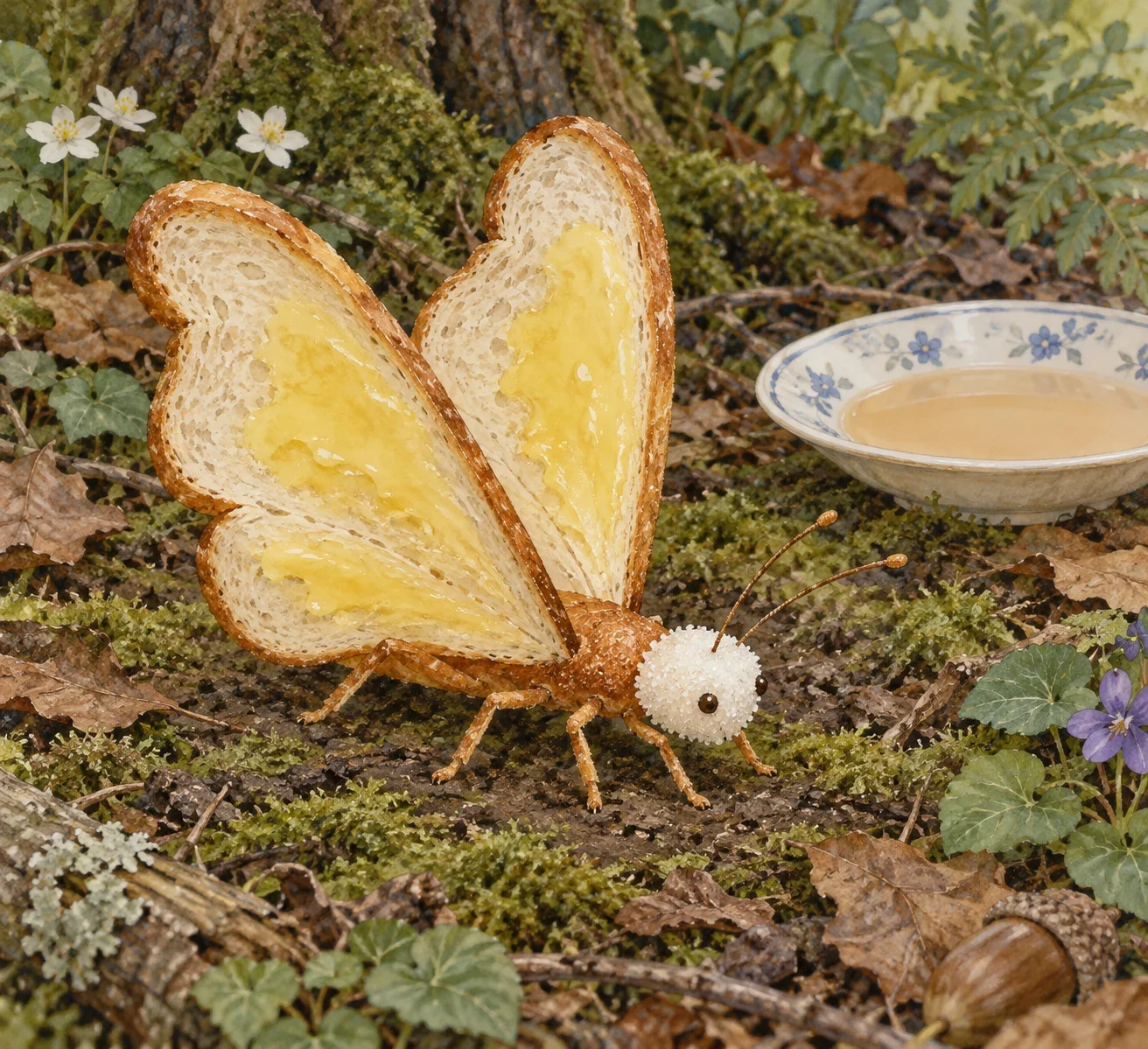
Unofficial AI interpretation of Carroll’s Bread-and-butter-fly: buttered bread wings, crust body and sugar-lump head. Limbs, facial details, pose, woodland and tea saucer are imagined; the tea recalls its stated diet.
Unofficial AI interpretation of Carroll’s Bread-and-butter-fly: buttered bread wings, crust body and sugar-lump head. Limbs, facial details, pose, woodland and tea saucer are imagined; the tea recalls its stated diet. Full-frame display derivative; no upscaling.
Overview
The Bread-and-butter-fly appears in Alice’s conversation with the Gnat in chapter III of Through the Looking-Glass. Alice lists the names of insects from her own world, and the Gnat supplies unfamiliar counterparts. When she mentions butterflies, it directs her attention to a creature crawling at her feet. Alice draws her feet back in alarm. The Gnat describes thin slices of bread and butter forming the wings, a crust forming the body, and a lump of sugar forming the head. These are the passage’s defining material features; it does not specify leg count, facial markings or a system of flight.
Asked what the creature eats, the Gnat answers that it lives on weak tea containing cream. Alice immediately tests the practicality of this diet by asking what happens when none can be found. The Gnat says that the creature would die, and when Alice suggests that this must happen frequently, it replies that it always does. This is a troubling assertion within the dialogue, followed by Alice’s thoughtful silence. The passage does not show a particular insect dying, explain how a population persists, or provide a further life cycle. Those missing explanations should remain missing rather than being filled with an invented species biology.
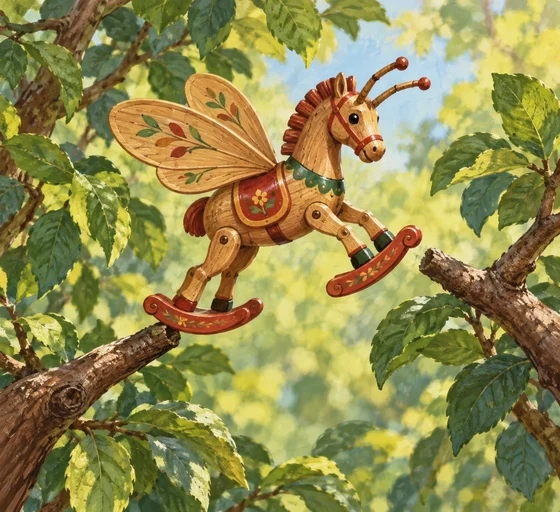
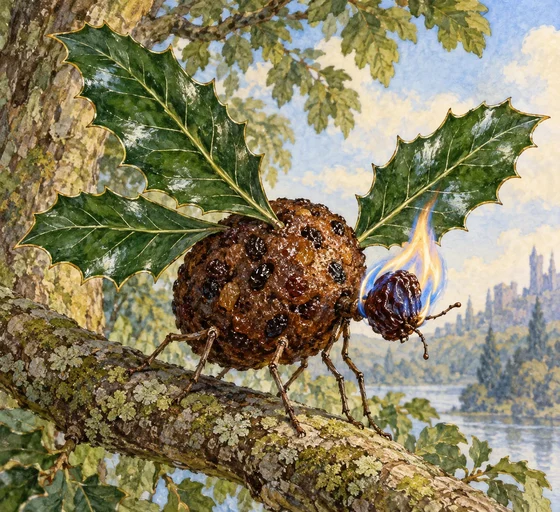
The creature belongs to a sequence built around altered insect names. The Rocking-horse-fly follows Alice’s horse-fly, while the Snap-dragon-fly follows her dragonfly and combines festive food with burning brandy. The Bread-and-butter-fly likewise makes edible objects into the structure of an insect. This is a comparison demonstrable in Carroll’s own sequence, not an independently documented account of his creative inspiration. Its apparently domestic diet also gives Alice a practical question that the Gnat’s answers turn into an unsettling conclusion.
The encounter is framed by a discussion of why things have names when they do not answer to them. Alice says that names help the people who use them, while the Gnat points toward a nearby wood where names disappear. After the insect descriptions it returns to jokes about Alice losing her name. The Bread-and-butter-fly is therefore a brief but distinct part of an episode connecting names, objects and consequences. It is not given a personal name, dialogue of its own or an extended adventure beyond the observation at Alice’s feet.
First appearances & development
Lewis Carroll’s Through the Looking-Glass (1871), chapter III, “Looking-Glass Insects,” supplies the literary creature. The butterfly/bread-and-butter connection is explicit in the Gnat’s response to Alice’s list. This profile does not infer an earlier folklore species or claim a documented external source for the design.
Canon & continuity
The complete primary insect conversation was read and retained. Morphology and diet are reported through the Gnat’s explanation, and the death assertion is distinguished from an event the narrator depicts. Gutenberg’s retained catalogue identifies the original book as public domain in the USA. The proposed illustration is newly generated and does not reuse its historical plates.
Selected bibliography
Documented works and useful reading. This is not a list of every appearance.
- 01
Through the Looking-Glass, and What Alice Found There, chapter III, Looking-Glass Insects
Selected primary passage: Alice’s complete conversation with the Gnat about names and Looking-Glass insects. The catalogue supplies the publication year and public-domain witness.
Family & connections
A source-supported family tree or inspiration record has not yet been compiled for this profile. Related reading below indicates a connection in subject matter, not a proven lineage or creative influence.
References
Sources supporting this profile. Linked pages have their own scope and editorial standards.
- Primary literary textThrough the Looking-Glass, chapter III — primary textResearch access: 2026-10-11
- Bibliographic and rights recordProject Gutenberg catalogue: Through the Looking-GlassResearch access: 2026-10-11
Image credits
Unofficial modern AI interpretationUnofficial AI interpretation of Carroll’s Bread-and-butter-fly: buttered bread wings, crust body and sugar-lump head. Limbs, facial details, pose, woodland and tea saucer are imagined; the tea recalls its stated diet.
Unofficial AI interpretation of Carroll’s Bread-and-butter-fly: buttered bread wings, crust body and sugar-lump head. Limbs, facial details, pose, woodland and tea saucer are imagined; the tea recalls its stated diet. Full-frame display derivative; no upscaling.