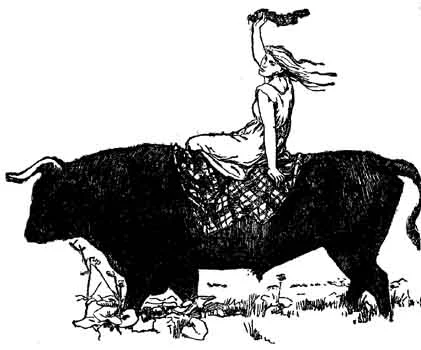
Girl riding the Black Bull of Norroway, Batten
Actual girl mounted on large black bull, printed chapter heading directly identifies the tale.
Overview
Unlike an ordinary bull, this traveller speaks, carries his companion across great distances and supplies food from his right ear and drink from his left. His three brothers receive the pair in successive castles and give the woman an apple, pear and plum against future distress. At a dark glen he leaves her seated on a stone while he fights the Old One, explaining that blue surroundings will signal his victory and red his defeat. When the landscape turns blue she crosses one foot over the other in happiness. This small movement breaks his condition, and he returns unable to find her.
The woman eventually reaches a glass hill and serves a smith for seven years to obtain iron shoes that will carry her over it. Beyond the hill she alone can wash the blood from a young knight’s clothes, but a washerwoman falsely credits her daughter and arranges their marriage. The three fruits contain jewels with which the traveller purchases successive nights beside the knight. Sleeping drinks defeat her first two attempts; on the third he secretly discards the drink and hears her account. Jacobs identifies this as a Beast-and-Beauty narrative while noting gaps in its motivation. The printed tale does not explain every stage of the bull’s transformation or identify the Old One’s anatomy.
Origins & earliest records
Jacobs’s source note names Chambers’s Popular Rhymes of Scotland and says he substantially Anglicised its language. He also points to earlier references to the story title; these do not establish that every incident in the selected retelling was present in those earlier works.
Records & interpretation
Speech, food-bearing ears and the lost-bridegroom sequence are literary evidence within this particular tale. They neither describe cattle biology nor demonstrate that a supernatural bull inhabited Norway; the regional title and Scottish transmission require separate treatment.
In the literature
“he poured out the drink”
Black Bull of Norroway; The knight prepares for the third purchased night
Avoiding the draught enables him to hear the woman's account.
Selected bibliography
Documented works and useful reading. This is not a list of every appearance.
- 01
More English Fairy Tales
Complete “The Black Bull of Norroway” and its source note inspected. Preface acknowledges rewritten and combined sources.
- 02
More English Fairy Tales — Black Bull of Norroway
Joseph Jacobs, More English Fairy Tales; first publication1894, selected Gutenberg14241 witness explicitly Fourteenth Impression, undated. Jacobs’s preface acknowledges rewriting, combined sources and altered incidents. Exact heading/anchor used; no invented print pagination.
Family & connections
A source-supported family tree or inspiration record has not yet been compiled for this profile. Related reading below indicates a connection in subject matter, not a proven lineage or creative influence.
Located primary passages
Specific passages supporting details in this entry, grouped by their published witness.
More English Fairy Tales — Black Bull of Norroway
Joseph Jacobs, More English Fairy Tales; first publication1894, selected Gutenberg14241 witness explicitly Fourteenth Impression, undated. Jacobs’s preface acknowledges rewriting, combined sources and altered incidents. Exact heading/anchor used; no invented print pagination.
- The youngest daughter follows a witch's direction and rides a black bull. His right and left ears supply food and drink. They visit castles belonging to his elder, second and younger brothers, where she receives an apple, pear and plum reserved for extreme need.
Black Bull of Norroway; Mounted journey, nourishment and brothers' castles
- Before fighting the Old One, the Bull requires her to remain motionless on a stone; blue surroundings mean victory and red defeat. She moves her foot in joy at the blue change, and the returning Bull cannot find her. The tale does not explain the opponent's identity or the condition's mechanism.
- She serves a smith seven years for iron shoes to climb a glass hill. Washing a knight's bloodstained clothes succeeds where the washerwife and daughter failed, but they claim the achievement. Jewellery from the fruits buys three nights; the knight avoids the third sleeping drink and recognizes her history. The narrative implies the Bull/knight connection without describing a transformation.
Black Bull of Norroway; Seven-year climb and reunion with the knight
Complete selected tale and its source note read. Jacobs’s edited narrative is distinct from direct oral transcription. No song or ritual-formula excerpts; no invented print page or earliest date.
Primary source witness
Joseph Jacobs, More English Fairy Tales; first publication1894, selected Gutenberg14241 witness explicitly Fourteenth Impression, undated. Jacobs’s preface acknowledges rewriting, combined sources and altered incidents. Exact heading/anchor used; no invented print pagination.
- Jacobs identifies Chambers's Popular Rhymes of Scotland as his source, saying it was much Anglicised but otherwise unaltered. His note considers the story insufficiently motivated; it does not supply a documented curse mechanism missing from the narrative.
Notes and References, XLVIII Black Bull of Norroway; Jacobs's language adaptation and source
This verifies what Jacobs reports and changes; listed earlier works and informant claims are not independently verified by this note alone.
References
Sources supporting this profile. Linked pages have their own scope and editorial standards.
- Primary textJacobs, More English Fairy Tales: The Black Bull of Norroway and editorial noteResearch access: 2026-10-05
- ReferenceUniversity of Pennsylvania Online Books Page: Joseph Jacobs bibliographic listResearch access: 2026-10-05
Image credits
Historical illustrationGirl riding the Black Bull of Norroway, Batten
Actual girl mounted on large black bull, printed chapter heading directly identifies the tale.