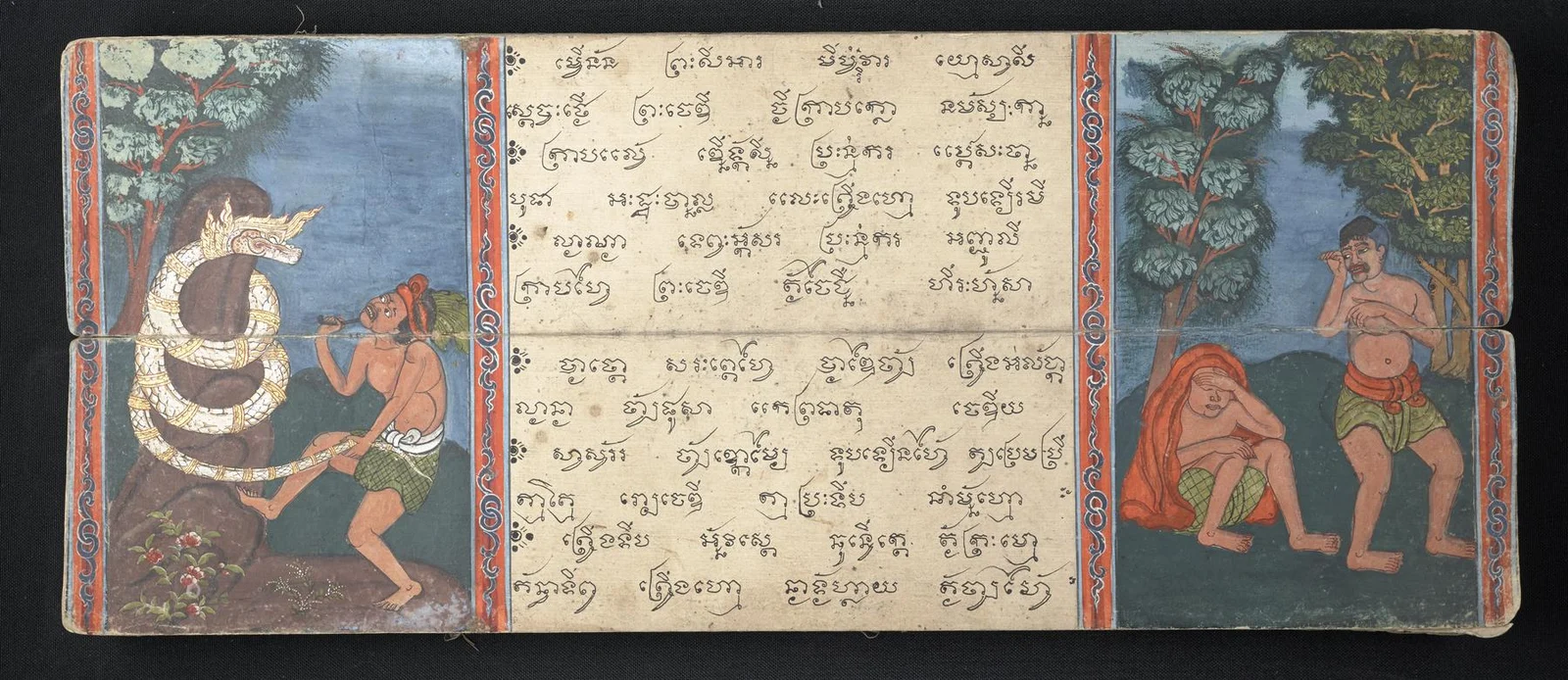
Bhuridatta in snake form, Phra Malai manuscript,B12 left
Actual pale coiled naga beside snake-charmer in LEFT image, exact OPenn B12 snake-form identification. Right figures uncertain between Bhuridatta or Alambayana/hunter; not asserted. Folio image link read from B12 DOM heading, not calculated index.
Overview
Bhūridatta, a son of Nāga King Dhataraṭṭha, seeks a higher heavenly birth in Jātaka 543. Finding the entertainment of the nāga palace disruptive to his fast, he goes to an anthill beside the Yamunā and offers his body while keeping moral observances. A human guest whom he has honoured betrays his location to the snake-charmer Ālambāyana for a precious gem.
The charmer captures and forces him to perform. Bhūridatta refuses food during captivity and does not use his venom to retaliate. His family searches for him; at the royal exhibition Sudassana and the frog-transformed Accimukhī demonstrate a different, devastating poison. Terrified by its heat, the charmer releases Bhūridatta, who returns to an ornamented supernatural form. Back in the nāga realm he needs rest after the month in a basket.
The scene of betrayal explicitly contrasts his earlier hospitality with the guest’s greed. Bhūridatta recognises the visitor accompanying the charmer but resolves that neither dismemberment nor cooking should provoke him into anger. The visitor’s hoped-for gem slips into the earth and returns to the nāga world, leaving him without the prize, the friendship or his son’s approval. The text consequently gives a separate failed bargain beside the prince’s captivity.
The performance is remarkably specific. At command Bhūridatta enlarges or contracts his body, forms one hood or many up to a hundred, changes among several colours, becomes visible or invisible, and produces water or water with smoke. He initially complies because a profitable show might persuade his owner to free him. The profits instead increase the charmer’s ambition. His mother’s alarming dream and his relatives’ search place these public displays within a family narrative, ending with reunion and the exhausted prince’s recovery rather than a simple heroic fight.
Origins & earliest records
South Asian Buddhist Jātaka narrative tradition
Records & interpretation
Historical primary-text translation directly read with printed page locators.
Selected bibliography
Documented works and useful reading. This is not a list of every appearance.
- 01
The Jātaka, Volume VI
Jātaka 543, especially pp. 87–105; hosted-volume publication date not independently verified. Narrative prose and verse distinguished from a first-attestation claim.
Family & connections
A source-supported family tree or inspiration record has not yet been compiled for this profile. Related reading below indicates a connection in subject matter, not a proven lineage or creative influence.
Primary records and illustrations
The Jātaka, Volume VI
Volume VI. Jātaka 543, especially pp. 87–105
Actual translated narrative directly read. Story number and printed English pagination retained; no object or image inferred.
The scene of betrayal explicitly contrasts his earlier hospitality with the guest’s greed. Bhūridatta recognises the visitor accompanying the charmer but resolves that neither dismemberment nor cooking should provoke him into anger. The visitor’s hoped-for gem slips into the earth and returns to the nāga world, leaving him without the prize, the friendship or his son’s approval. The text consequently gives a separate failed bargain beside the prince’s captivity.,The performance is remarkably specific. At command Bhūridatta enlarges or contracts his body, forms one hood or many up to a hundred, changes among several colours, becomes visible or invisible, and produces water or water with smoke. He initially complies because a profitable show might persuade his owner to free him. The profits instead increase the charmer’s ambition. His mother’s alarming dream and his relatives’ search place these public displays within a family narrative, ending with reunion and the exhausted prince’s recovery rather than a simple heroic fight.
References
Sources supporting this profile. Linked pages have their own scope and editorial standards.
- Historical primary-text translationThe Jātaka, Volume VI — Jātaka 543, especially pp. 87–105Research access: 2026-10-05
Image credits
Historical manuscript illustrationBhuridatta in snake form, Phra Malai manuscript,B12 left
Actual pale coiled naga beside snake-charmer in LEFT image, exact OPenn B12 snake-form identification. Right figures uncertain between Bhuridatta or Alambayana/hunter; not asserted. Folio image link read from B12 DOM heading, not calculated index.