
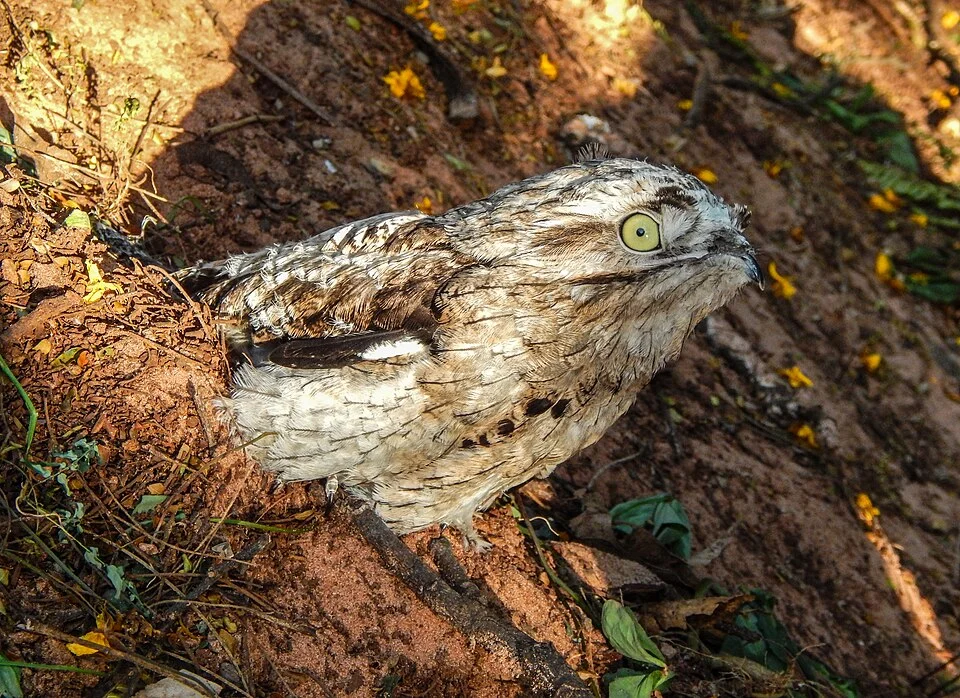
Potoo bird photograph, contextual reference for the Ayaymama tale
Photograph of a real potoo bird, contextual to the tale association. It does not depict the transformed children or establish their biological identification.
Overview
In the Awajún story Auju nantujai, translated as La ayaymama y el luna, the moon, Nantu, is married to Ayaymama. She tells him the pumpkins are still green and serves him unripe ones, but he discovers her secretly preparing and drinking from a hidden jar. He tells their child to announce his departure and climbs a rope to the sky. Ayaymama follows after the child gives her the message, but the rope breaks halfway up. Her pumpkin-filled belly bursts when she falls; Etsa declares that the spilled pumpkin will become clay. She becomes a bird and flies away, lamenting for her husband whenever the moon appears.
This account is distinct from the abandoned-children narrative in Róger Rumrrill's anthology. There, mistreated children seek their mother and become birds. The shared name and lamenting voice do not make the plots interchangeable. Naming the Awajún collector and the modern author preserves those differences, while allowing readers to compare how family relationships and transformation explain a striking nocturnal call.
Origins & earliest records
A 2019 Awajún school-and-FONDEP collection credits Jhon Jairo Danducho Paati as collector and translator of the moon-spouse story. That publication records a transmitted narrative rather than dating its origin. Rumrrill's inspected 2026 anthology is a separate literary witness; its children's transformation should not be substituted for the Awajún account.
Records & interpretation
The bilingual collection provides an Awajún title, a Spanish rendering and individual contributor attribution on printed pages 61–62. Rumrrill supplies an independently identifiable retelling. Their narrative differences are explicit. The real bird's common name is not evidence that a supernatural transformation occurred, nor grounds for assigning the story figure a biological species.
Selected bibliography
Documented works and useful reading. This is not a list of every appearance.
- 01
Relatos ancestrales del pueblo Awajún: Cuentos, mitos y leyendas
Auju nantujai / La ayaymama y el luna, printed pp. 61–62; community-linked bilingual school collection.
- 02
Narraciones de la Amazonía
Inspected 2026 edition; Los ayaymaman buscan a su madre en el bosque is an attributed modern retelling.
Family & connections
A source-supported family tree or inspiration record has not yet been compiled for this profile. Related reading below indicates a connection in subject matter, not a proven lineage or creative influence.
References
Sources supporting this profile. Linked pages have their own scope and editorial standards.
- CommunityFONDEP: Relatos ancestrales del pueblo AwajúnResearch access: 2026-10-05
- Primary textBNP: Narraciones de la AmazoníaResearch access: 2026-10-05
Image credits
Thematic illustrationPotoo bird photograph, contextual reference for the Ayaymama tale
Photograph of a real potoo bird, contextual to the tale association. It does not depict the transformed children or establish their biological identification.