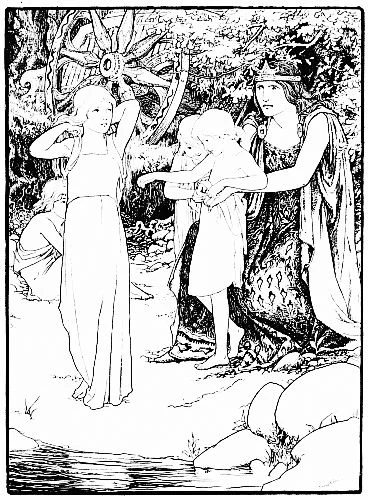
A crowned woman gestures beside two children near a chariot, with two swans in the foreground.
Batten depicts Oifa/Aoife with Lir’s children during the swan enchantment, before her later transformation into an air-demon.
Overview
In the selected text she is called Oifa, sister of Ove and the second wife of Lir. Her jealousy develops as he continues showing affection to his four children. When attendants refuse to kill them and she cannot perform the killing herself, she uses a magical wand to impose swan bodies and prolonged exile. She nevertheless leaves them speech and music when remorse troubles her. Her mixture of hostility and regret belongs to the narrative, without an independently known historical woman being classified as a monster.
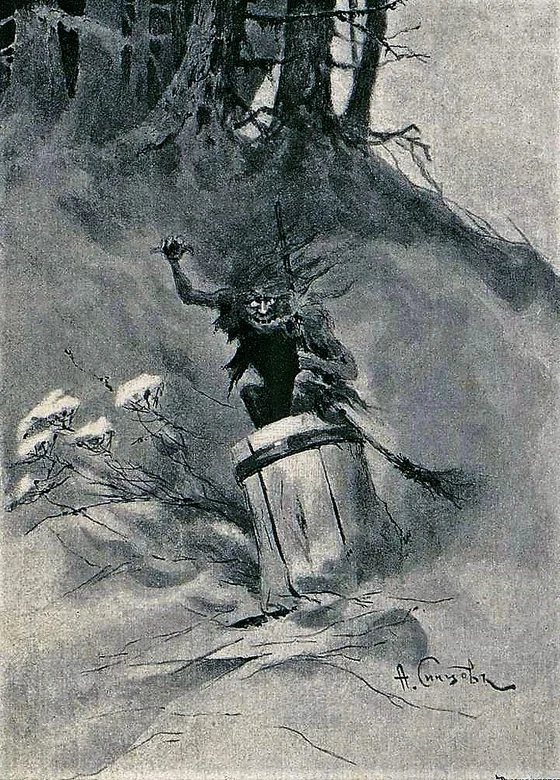
After Lir learns the truth from his transformed children, he reports to Dearg. That ruler compels Oifa to name the form she considers worst, and she chooses an air-demon. He turns her into that form with his wand, and she flies away; the narrator claims the state will last forever. This is a punishment scene, not a detailed description of a naturally occurring demonic species. No wings, horns, weather powers or subsequent encounters are supplied, so the profile does not construct them from the word air. Her sister relationship and stepmother role are explicitly textual. The permanent departure differs from the eventual restoration of the children she cursed.
Origins & earliest records
Jacobs’s 1895 witness uses the 1883 Irish-language-preservation publication following O’Curry, whose cited manuscripts are eighteenth-century or later. Oifa is the selected spelling; Aoife is the familiar modern heading. The legendary punishment does not establish a historical transformation date.
Records & interpretation
The wand transformation and aerial flight are narrative evidence. The claimed permanence belongs to the storyteller’s ending, without an observed spirit body or zoological classification. Explicit literary family relationships can be documented without inventing physiology or religious practice.
In the literature
“she is still an air-demon, and shall be so for ever”
The Fate of the Children of Lir; p.6, the narrator states the punishment’s duration
Dearg compels Oifa to name the earthly form she regards as worst. She selects an air-demon; he strikes her with a Druid’s wand and changes her into that form. She flies away and the narrator declares the condition permanent, giving no bodily anatomy or later cure.
Selected bibliography
Documented works and useful reading. This is not a list of every appearance.
- 01
More Celtic Fairy Tales: The Fate of the Children of Lir
Full selected episode and relevant editorial source note inspected; cited earlier collections remain attributed, not falsely claimed as newly read.
- 02
More Celtic Fairy Tales — The Fate of the Children of Lir
Joseph Jacobs, More Celtic Fairy Tales, New York: G.P.Putnam’s Sons; London:D.Nutt,1895, selected title page verified. Compiler acknowledges simplification and insertion of parallel incidents; each relevant source note supplies transmission claims. Historical English text, modern transcription; original illustration rights separate.
Family, evolution & connections
Lir and Ove’s four children in Jacobs’s retelling
The four children born to Lir and Ove before his marriage to her sister Oifa.
Scroll sideways to see all branches. With a keyboard, focus the tree and use the arrow keys.
- Lir and Ove (joint parents)
- Fingula (twin)
- Aod (twin)
- Fiachra
- Conn
Explicit family statements in the named Jacobs retelling. Oifa is their maternal aunt and later stepmother, not biological mother. Dearg fosters Oilell’s daughters; fostering is not biological parentage. Historical spellings Ove/Oifa are retained for this witness.
Children of Lir
Jacobs’s Oifa is Ove’s sister. Marriage to Lir makes her stepmother while her maternal-aunt relationship remains distinct.
Oilell of Aran
The daughters of Oilell are fostered by Dearg. Their biological father and foster-parent are expressly distinct in the opening.
Dearg (foster-parent)
Dearg calls Oilell’s three daughters his nurslings; the narrator describes them as his foster-children. This is not biological descent.
Located primary passages
Specific passages supporting details in this entry, grouped by their published witness.
More Celtic Fairy Tales — The Fate of the Children of Lir
Joseph Jacobs, More Celtic Fairy Tales, New York: G.P.Putnam’s Sons; London:D.Nutt,1895, selected title page verified. Compiler acknowledges simplification and insertion of parallel incidents; each relevant source note supplies transmission claims. Historical English text, modern transcription; original illustration rights separate.
- Oifa’s attempted killing is refused by her attendants; she instead enchants her sister’s children into swans, then claims Lir refused to send them to Dearg. Messengers reveal the discrepancy and Lir hears the transformed children’s account. The witness spells this character Oifa.
The Fate of the Children of Lir; pp.3–5, Oifa’s deception exposed
- Dearg compels Oifa to name the earthly form she regards as worst. She selects an air-demon; he strikes her with a Druid’s wand and changes her into that form. She flies away and the narrator declares the condition permanent, giving no bodily anatomy or later cure.
The Fate of the Children of Lir; p.6, punishment as chosen worst form
Complete named tale independently read. Named source paragraphs and preface checked; extensive comparative Lir commentary was only partly read and its conclusions are not adopted. No verse, prayers or ritual formulas reproduced. Earlier editions and manuscripts remain indirect.
Primary source witness
Joseph Jacobs, More Celtic Fairy Tales, New York: G.P.Putnam’s Sons; London:D.Nutt,1895, selected title page verified. Compiler acknowledges simplification and insertion of parallel incidents; each relevant source note supplies transmission claims. Historical English text, modern transcription; original illustration rights separate.
- Jacobs says he abridged the1883 Society for the Preservation of the Irish Language text and translation, itself following O’Curry’s AtlantisIV version. He reports three eighteenth-century Dublin manuscripts; these manuscript descriptions and his antiquity arguments remain attributed secondary reports, not independently inspected manuscripts.
Verifies the compiler’s stated source, not the uninspected cited edition or asserted earliest manuscript.
References
Sources supporting this profile. Linked pages have their own scope and editorial standards.
- Primary textJacobs, More Celtic Fairy Tales: The Fate of the Children of Lir and source noteResearch access: 2026-10-05
Image credits
Original narrative illustration, human-form episode before Aoife’s air-demon transformation.A crowned woman gestures beside two children near a chariot, with two swans in the foreground.
Batten depicts Oifa/Aoife with Lir’s children during the swan enchantment, before her later transformation into an air-demon.