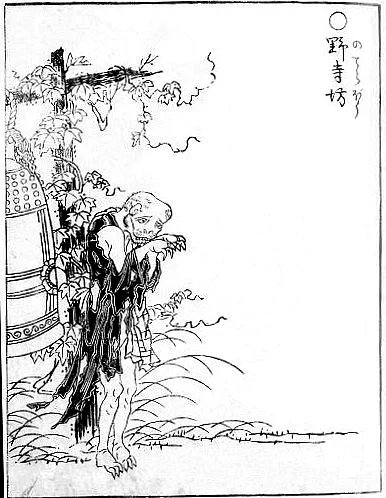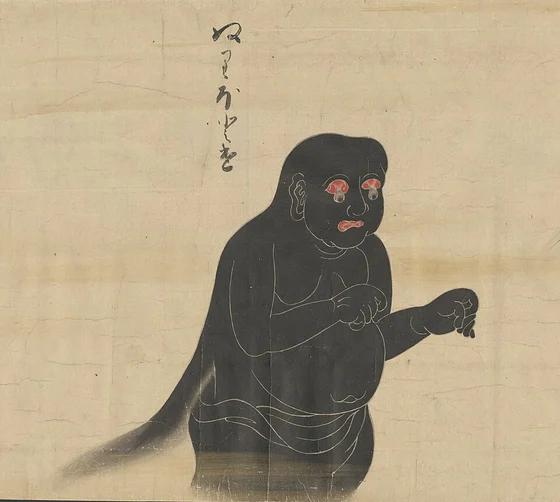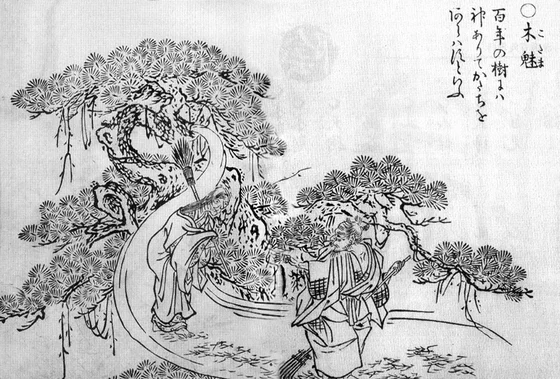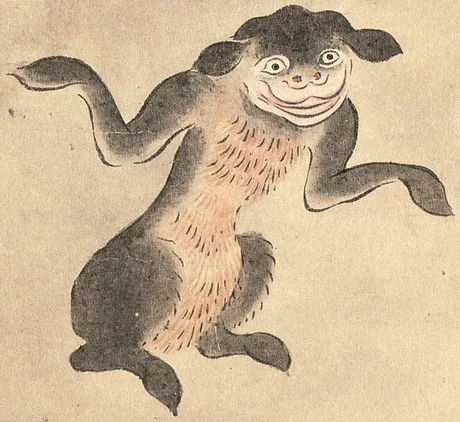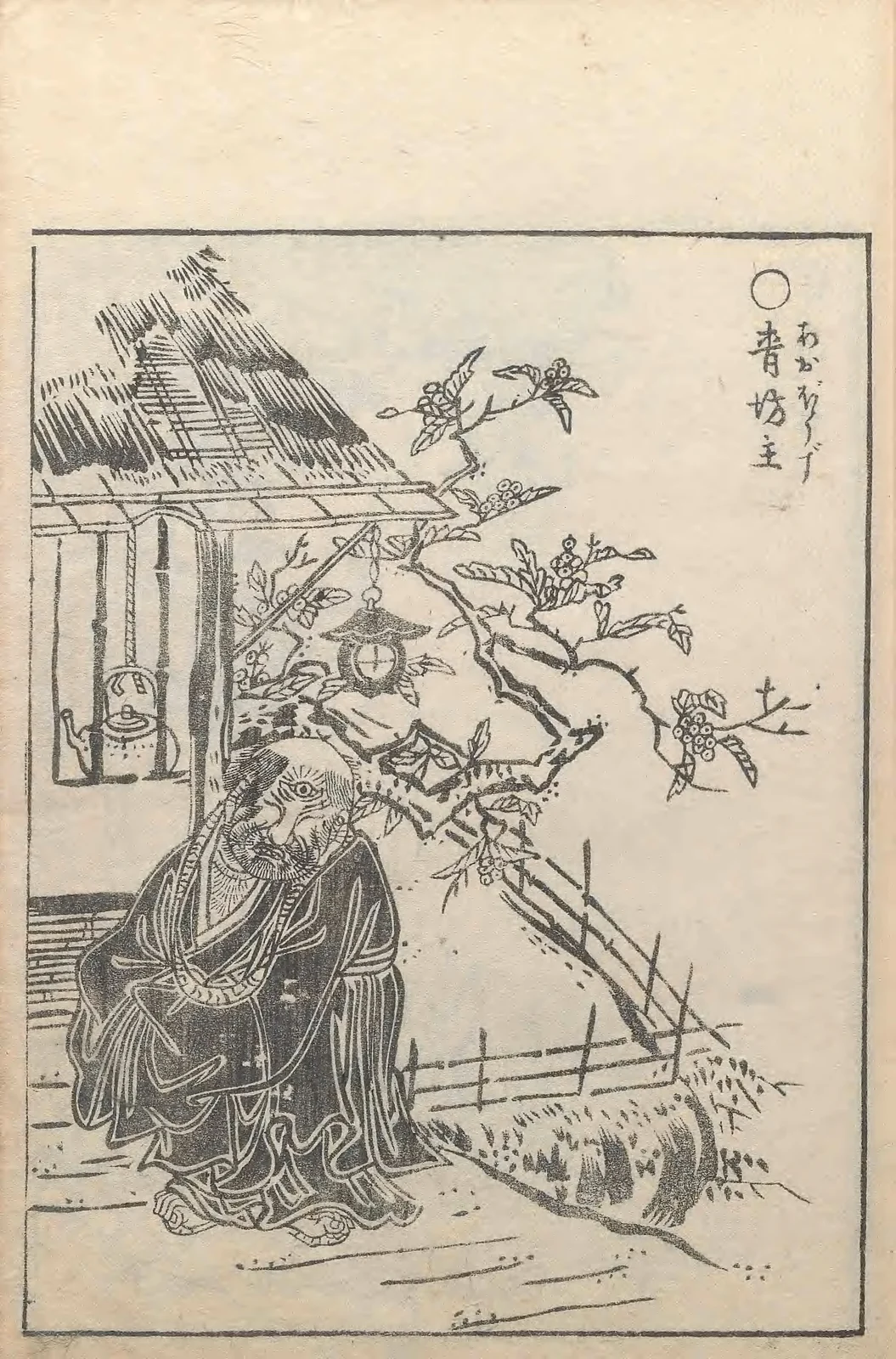
Aobōzu, named plate by Toriyama Sekien
Named 青坊主; a single-eyed, robed priestlike figure stands beside a thatched building. Visual inspection of the digitized plate and its printed label; image URL is copied from the actual IIIF manifest, not a guessed leaf reference.
Overview
Aobōzu, commonly rendered blue priest, names a monk-like apparition with widely varying local descriptions. Some accounts concern a large humanoid presence, while others associate the form with an animal in disguise or a mountain being. Sekien includes an aobōzu in his first encyclopedia, supplying one recognizable visual witness. The range of stories means that the name should not be treated as a single uniform creature category.
Regional narratives differ in danger, setting and interaction with people, and a colour in the name does not settle every historical representation's appearance. This profile compares the priest-like form with the broader use of religious costume in yōkai imagery. It avoids inventing an institution or doctrine behind the apparition, and distinguishes the imagined figure from actual Buddhist clergy. A particular local encounter can be added only with its own geographic and textual attribution.
Origins & earliest records
Selected historical witness: Gazu Hyakki Yagyō (1776) by Toriyama Sekien. The linked library record identifies a surviving printed edition; it does not establish when the belief first arose.
Records & interpretation
The historical illustration and individual contextual reference support this profile. Named motifs, local narratives and later explanations are distinguished; image-to-plate matching still needs review.
Selected bibliography
Documented works and useful reading. This is not a list of every appearance.
- 01
Gazu Hyakki Yagyō
Selected historical witness; individual illustration now checked in the separately linked primary scan. This edition is not a claim of the earliest oral attestation.
Family & connections
A source-supported family tree or inspiration record has not yet been compiled for this profile. Related reading below indicates a connection in subject matter, not a proven lineage or creative influence.
Primary records and illustrations
Gazu Hyakki Yagyō
Volume 3, Wind (風); digitized Smithsonian Libraries copy, 1805 edition. IIIF canvas index 16 (zero-based); GazuHyakkiyagyo3Tori_0017.jp2
Named 青坊主; a single-eyed, robed priestlike figure stands beside a thatched building. Visual inspection of the digitized plate and its printed label; image URL is copied from the actual IIIF manifest, not a guessed leaf reference.
Encyclopedia background
An additional attributed reference, separate from the editorial profile above.
Read the open encyclopedia overview
Aobōzu (青(あお)坊(ぼ)主(うず), "Blue priest") is a Japanese yōkai (spirit) found in a number of Japanese legends. Stories about aobōzu, in particular the exact details of the spirit, vary widely.
As well as appearing in Japanese folklore, the aobōzu has also been depicted numerous times in traditional Japanese art; examples include one depiction of aobōzu found in Toriyama Sekien's e-hon tetralogy Gazu Hyakki Yagyō.
Text from Wikipedia contributors, “Aobōzu”. CC BY-SA 4.0. Extracted introduction; formatting changed. Retrieved 5 October 2026. The source article may have changed since retrieval.
References
Sources supporting this profile. Linked pages have their own scope and editorial standards.
- Primary illustration / library recordGazu Hyakki Yagyō — historical library editionResearch access: 2026-10-05
- Secondary referenceAobōzu — contextual overview and bibliographyResearch access: 2026-10-05
- Primary illustrated plate / institutional digitizationGazu Hyakki Yagyō — directly inspected IIIF canvas index 16 (zero-based); GazuHyakkiyagyo3Tori_0017.jp2Research access: 2026-10-05
Image credits
Historical illustrationAobōzu, named plate by Toriyama Sekien
Named 青坊主; a single-eyed, robed priestlike figure stands beside a thatched building. Visual inspection of the digitized plate and its printed label; image URL is copied from the actual IIIF manifest, not a guessed leaf reference.