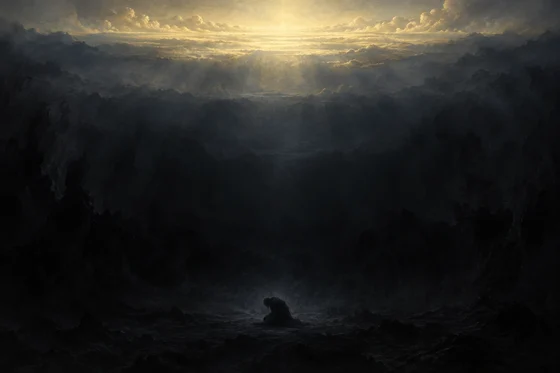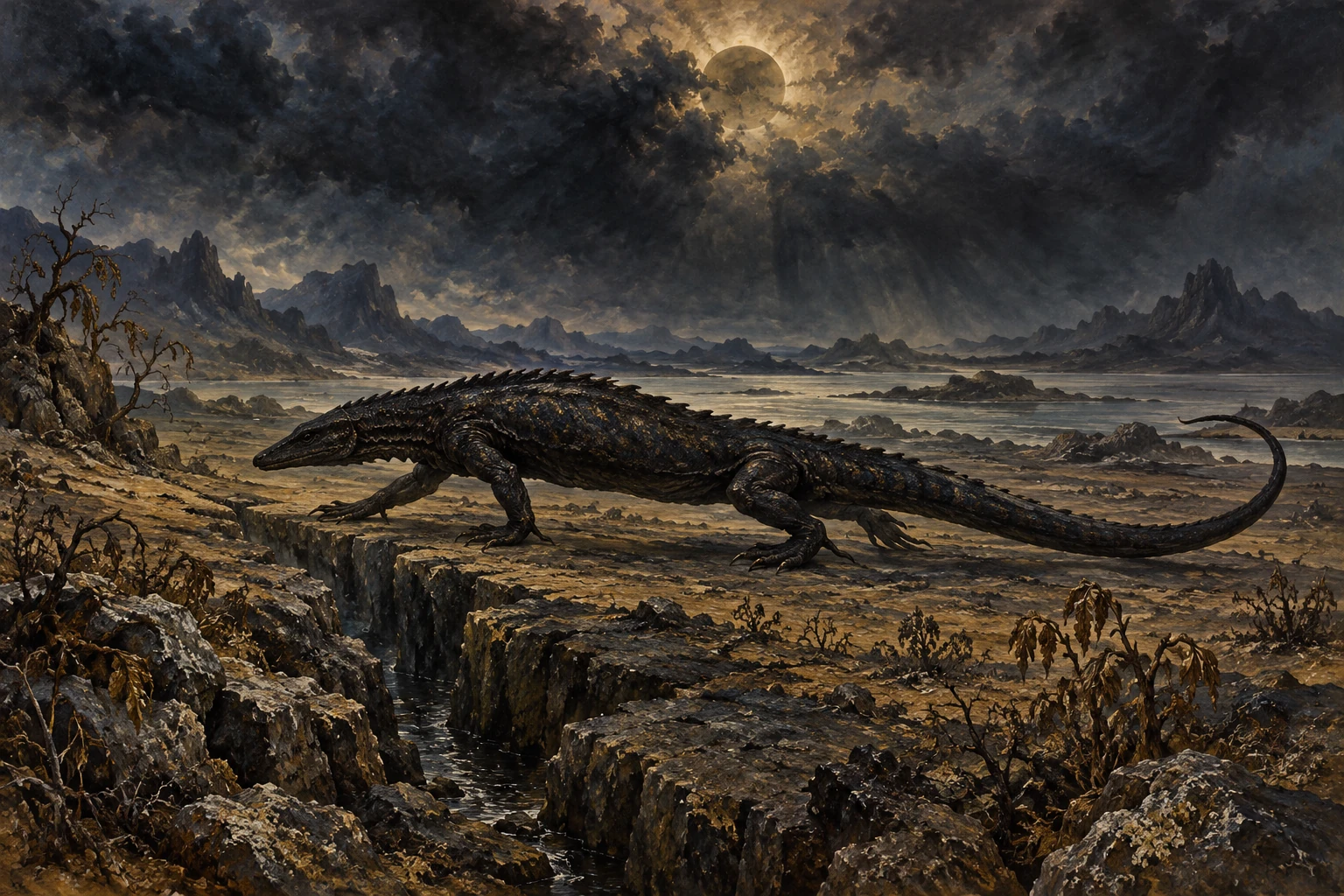
AI-generated symbolic interpretation of Ahriman’s invasion in West’s Bundahishn chapter 3. The lizardlike form, darkened midday and blighted vegetation draw on the text; the body’s exact shape, spines, scale, colouring and landscape are artistic choices. This is a religious narrative interpretation, not a claim about real animals or the appearance of Final Fantasy’s Ahriman.
The image isolates a nonhuman aspect of the account; its different bodily descriptions and movement comparisons are not one universal form.
Overview
The third chapter of the Bundahishn continues the destructive spirit’s confusion after the opening confrontation with Ohrmazd. His demons repeatedly try to rouse him, but the promises of Jeh finally persuade him to act. The narrative associates Jeh with what it labels menstrual pollution; that valuation belongs to this historical religious cosmology and is not a contemporary medical claim or a generalisation about living communities. The selected chapter usually calls the adversary the evil spirit; the name Ahriman is established in the same translation’s opening chapter.
He leads his confederate demons toward the luminaries, then springs from the inside of the sky to earth like a snake. The chapter places the assault at noon on the named day and month, describing the sky’s terror through the comparison of a sheep confronted by a wolf. He reaches the water beneath the earth, pierces the earth’s middle, and moves against vegetation, the ox, Gayomard and fire. The snake and fly comparisons describe his movement in this narrative. They are not a rule that every representation of Ahriman must have one fixed animal body.
The invasion makes midday dark as night. Creatures the text classifies as noxious spread across the earth, while blight withers vegetation and afflictions are directed against the ox and Gayomard. This is a religious account of the corruption of creation, not a biological judgment that ordinary frogs or lizards are morally evil. Ohrmazd prepares a healing substance to lessen the ox’s suffering before it dies. The ox speaks of the cattle and their future work, so destruction is narrated alongside the continued purposes of creation rather than as a complete erasure of its future.
The adversary sends Astwihad and a thousand death-causing demons against Gayomard, but the appointed time prevents them from taking him immediately. He lives for thirty years after the attack, and his speech looks forward to mankind descending from his race and performing duty and good works. The narrative then returns to fire, which the destructive spirit mixes with smoke and darkness, and to a disturbance of the celestial sphere. These passages assign different acts to the adversary, his named agents and Ohrmazd; they do not make every demon an interchangeable form of Ahriman.
For ninety days and nights the heavenly angels contend with the confederate demons and finally hurl them, confounded, to hell. A rampart of the sky is formed to prevent the adversary from mingling with it. The final paragraph locates hell at the point where the earth was pierced and describes the resulting conflict and duality within the world. This closes the chapter’s invasion and resistance episode. It does not narrate Ahriman’s final destruction here or replace the opening chapter’s longer cosmic timetable. Final Fantasy’s separately documented Ahriman remains a fictional namesake, without this source supplying its enormous eye, wings or game-world powers.
Origins & earliest records
Bundahishn, complete chapter 3, paragraphs 1–27, in E. W. West’s historical English translation. The host attributes it to the 1897 Oxford Sacred Books of the East volume 5; that printing is not independently collated here.
Records & interpretation
Complete cached chapter 3 with all inline glosses, host title and name framing read. No attached footnote links found in the hosted chapter container; no claim to the printed edition’s complete apparatus or original Pahlavi text.
Selected bibliography
Documented works and useful reading. This is not a list of every appearance.
- 01
Bundahishn — chapter 3, paragraphs 1–27
Complete physical invasion and counter-conflict chapter; host edition attribution not independently collated.
Family, evolution & connections
Ahriman (Final Fantasy)
Final Fantasy uses Ahriman for its separately documented fictional monsters. West’s Bundahishn chapter 3 instead narrates the destructive spirit’s invasion of creation and resistance by the heavenly defenders. The shared name permits a bounded historical religious comparison; this passage does not supply the game’s winged-eye anatomy, establish a common species or prove that its developers consulted West.
References
Sources supporting this profile. Linked pages have their own scope and editorial standards.
- Historical primary religious-text translationWest translation: Bundahishn, complete chapter 3Research access: 2026-10-26
Image credits
Modern interpretation of a historical literary accountAI-generated symbolic interpretation of Ahriman’s invasion in West’s Bundahishn chapter 3. The lizardlike form, darkened midday and blighted vegetation draw on the text; the body’s exact shape, spines, scale, colouring and landscape are artistic choices. This is a religious narrative interpretation, not a claim about real animals or the appearance of Final Fantasy’s Ahriman.
The image isolates a nonhuman aspect of the account; its different bodily descriptions and movement comparisons are not one universal form.