
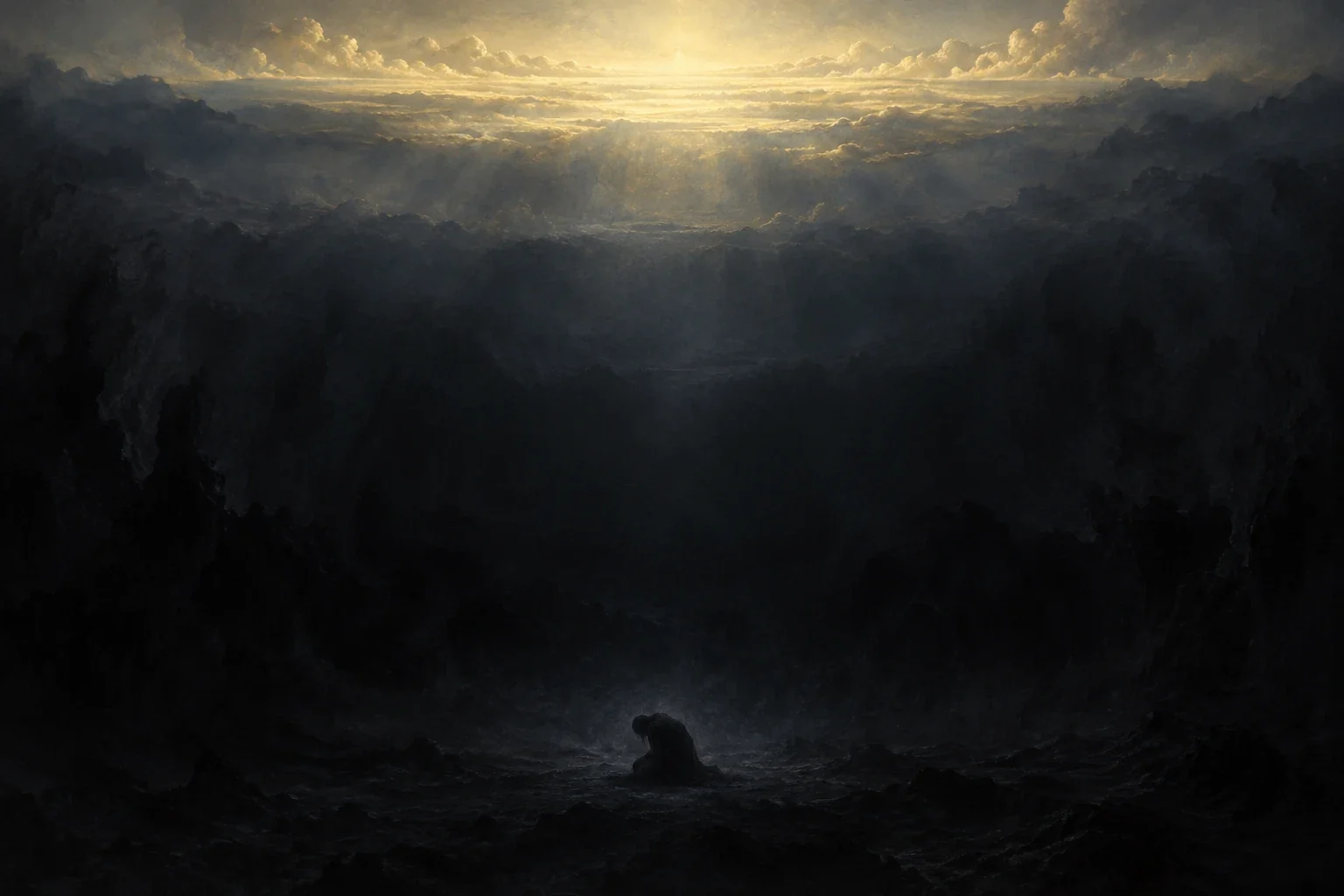
AI-generated symbolic interpretation of Ahriman’s retreat in the selected Bundahishn account; visible form and setting are imagined, not an authenticated religious image.
The small indistinct figure, rocky abyss, distant light, colour and spatial arrangement are artistic inventions. This symbolic narrative image is neither an authenticated sacred icon nor a reconstruction of contemporary religious practice. No historical source art or game anatomy used.
Overview
Ahriman is the destructive spirit opposed to Ohrmazd in the opening chapter of the Bundahishn, as rendered in E. W. West’s historical English translation. The account places Ohrmazd in endless light and Ahriman in an abyss described as endlessly dark, with empty space between them. Its contrast involves knowledge as well as intention: Ohrmazd knows the approaching conflict, whereas the destructive spirit initially does not know that Ohrmazd exists. These are relationships within the text’s religious cosmology, rather than an anatomical description of an animal or a game monster.
When Ahriman rises and sees the light, he rushes against it with destructive intent. Finding its glory greater than his own, he retreats to darkness and forms demons and fiends. The account then describes an encounter over the created world. Ohrmazd proposes assistance and praise in return for an immortal life without hunger or thirst. Ahriman refuses, threatens destruction and promises to turn the creatures’ allegiance away from their creator. The speaker explains that he mistakes the peace offer for helplessness. His refusal is therefore presented as a failure of understanding within the narrative, not simply as superior military strength.
Ohrmazd next proposes a fixed period of conflict lasting nine thousand years, knowing that a bounded contest will undo the adversary. Ahriman accepts without understanding its consequence. The chapter divides the appointed time into three periods: Ohrmazd’s will prevails first, the opposing wills intermingle next, and the destructive spirit is disabled in the last. When Ohrmazd recites the Ahunwar and reveals the final triumph and restoration of the creatures, Ahriman contracts in fear, falls to his knees and returns confused to darkness. The account assigns three thousand years of confusion to that retreat.
The closing paragraphs name opposing creations, including falsehood and evil thought on the destructive side, and list the ordered stages of Ohrmazd’s world. This profile confines those labels and claims to the selected religious chapter. West’s hosted translation is attributed to Sacred Books of the East volume 5 and an 1897 Oxford edition; that editorial date is distinct from the Pahlavi compilation and its older traditions. No universal account of present-day Zoroastrian belief is asserted. Final Fantasy’s winged-eye Ahrimans remain separate fictional creatures: a shared name supports comparison, while this chapter supplies neither that anatomy nor proof of a developer’s borrowing route.
Origins & earliest records
The opening religious-cosmological account of the Bundahishn, selected West translation, complete chapter 1 paragraphs 0–28. No earliest oral chronology established.
Records & interpretation
Complete chapter 1 read continuously, including all dialogue and closing creation lists. Complete hosted page retained; chapters2–6 not claimed fully read for this draft.
Selected bibliography
Documented works and useful reading. This is not a list of every appearance.
- 01
Bundahishn — chapter 1, paragraphs 0–28
Host attributes Sacred Books of the East volume 5, Oxford University Press 1897; retained as host attribution, not an independently collated printing.
Family, evolution & connections
Ahriman (Final Fantasy)
Ahrimans are recurring Final Fantasy monsters whose designs commonly center on one enormous eye, a mouth and a pair of wings. West’s Bundahishn chapter1 describes Ahriman as a destructive spirit in conflict with Ohrmazd. The shared name supports comparison; the selected religious chapter does not supply the game monster’s anatomy or establish a creator-consulted source.
References
Sources supporting this profile. Linked pages have their own scope and editorial standards.
- Historical primary religious-text translationWest translation: Bundahishn, complete chapter 1Research access: 2026-10-24
Image credits
AI-generated narrative interpretationAI-generated symbolic interpretation of Ahriman’s retreat in the selected Bundahishn account; visible form and setting are imagined, not an authenticated religious image.
The small indistinct figure, rocky abyss, distant light, colour and spatial arrangement are artistic inventions. This symbolic narrative image is neither an authenticated sacred icon nor a reconstruction of contemporary religious practice. No historical source art or game anatomy used.