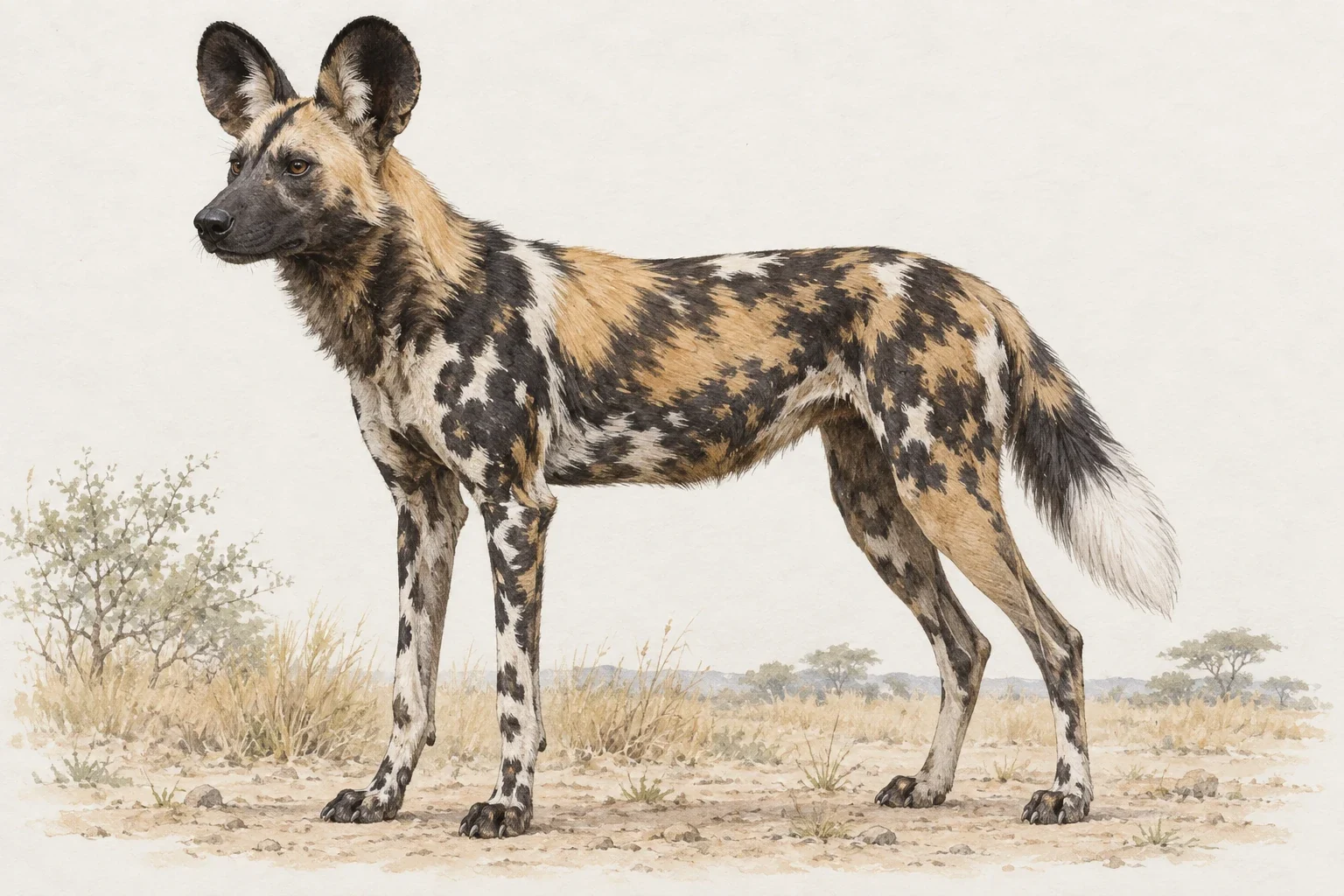
African wild dog - AI-generated scientific interpretation.
Modern AI-generated scientific illustration. Diagnostic features follow selected sources; pose, individual markings and fine details are interpretive. Not photography or independent anatomical evidence.
Overview
The African wild dog is a long-legged canid with large rounded ears and an individually variable patchwork of dark, tan and white fur. Four forefoot digits distinguish it from the five-digit condition familiar in many other dogs. Coat patterns in this illustration are invented at the individual level.
Pack members cooperate in hunting and provisioning. Regurgitated food supports pups and other dependent members, and dens shelter the young. San Diego describes open and more wooded habitats; a stereotyped savanna scene does not represent every setting.
Chavez and colleagues’ comparative genomes identify candidate changes associated with digit reduction, tooth form and pigmentation. Selection signals and amino-acid deletions suggest mechanisms, but they do not experimentally demonstrate that one mutation created the living species. The sampled canid tree links Lycaon with other lineages through ancestry, rather than making any living dhole its ancestor.
Origins & earliest records
A canid in Lycaon, distinct from Hyaenidae despite occasional visual confusion. African painted dog and African hunting dog are alternate names.
Evidence & interpretation
Institutional anatomy and social observations are combined with the 2019 primary genomic study. Hunting success rates and modelled divergence dates are not adopted as universal facts.
Selected bibliography
Documented works and useful reading. This is not a list of every appearance.
- 01
Painted Dog (African Hunting Dog)
Selected bibliography; institutional account and study limits retained.
- 02
Comparative genomics provides new insights into the remarkable adaptations of the African wild dog
Indexed primary methods and abstract; genetic mechanisms remain candidates.
Family, evolution & connections
Taxonomic classification
A hierarchy of classified groups, not a chain of direct ancestors.
Source note: Lycaon pictus follows both sources; existing sampled tree is contextual, not a duplicate species profile.
- ClassMammalia
- OrderCarnivora
- FamilyCanidae
- GenusLycaon
- SpeciesLycaon pictus
References
Sources supporting this profile. Linked pages have their own scope and editorial standards.
- InstitutionalPainted Dog (African Hunting Dog)Research access: 2026-10-10
- ResearchComparative genomics provides new insights into the remarkable adaptations of the African wild dogResearch access: 2026-10-10
Image credits
AI-generated scientific interpretationAfrican wild dog - AI-generated scientific interpretation.
Modern AI-generated scientific illustration. Diagnostic features follow selected sources; pose, individual markings and fine details are interpretive. Not photography or independent anatomical evidence.