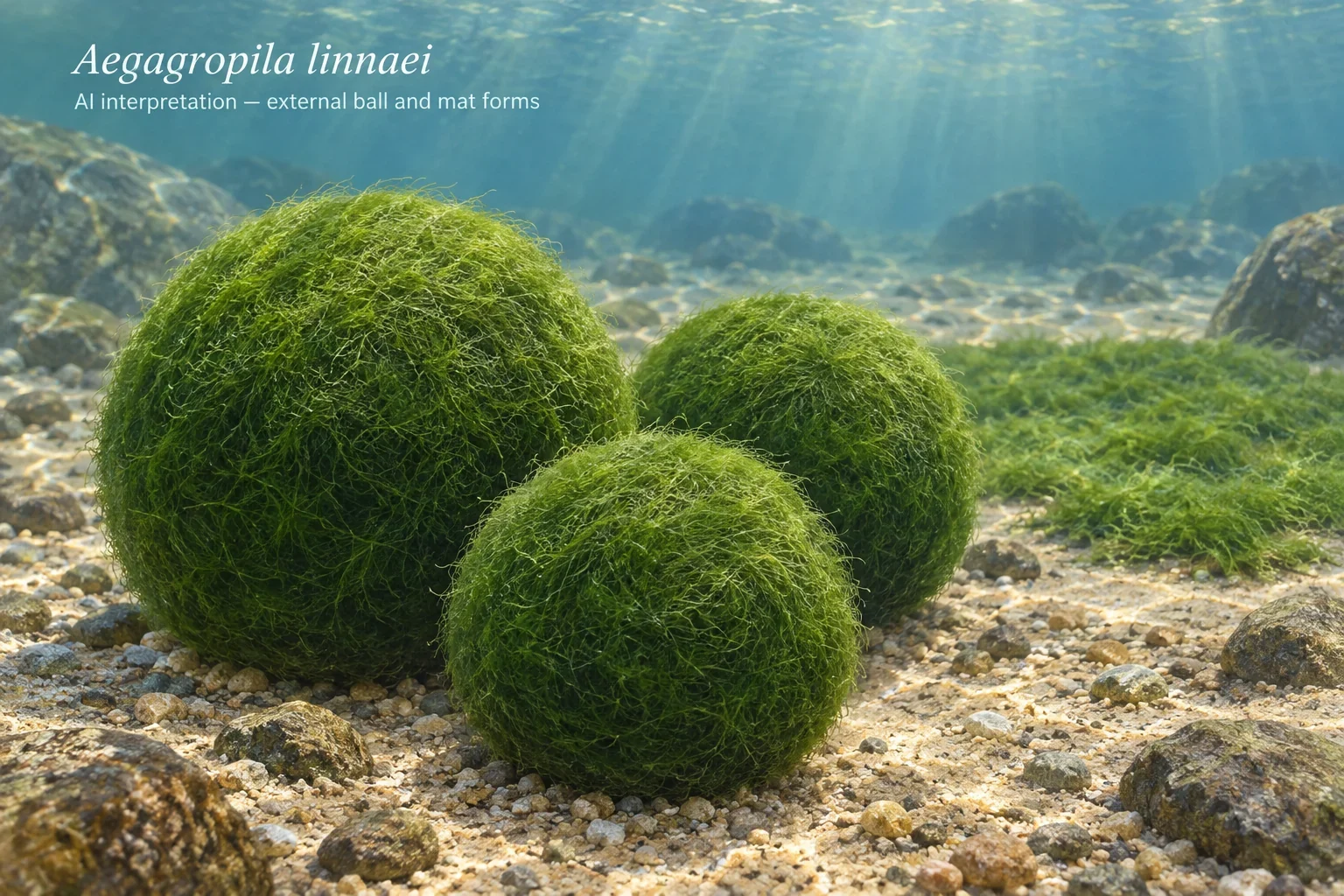
AI algal ball and mat colonies.
AI interpretation of external ball and mat forms; lake setting imagined.
Overview
Marimo are spherical aggregates of branched algal filaments, not individual moss plants. The same species also forms mats. Geometry predicts higher biomass for ball colonies than mats under suitable size and layering conditions.
A later Lake Akan study combined underwater video, wave measurements and magnetic resonance imaging. It found that wave-driven rotation polishes the balls and enhances exchange between their interiors and surrounding water. The paper reports internal annual rings; these are not shown as invented microscopic details in the illustration.
The physical interpretation depends on Lake Akan’s water movement and colony structure. It does not imply that every population forms giant spheres or that spherical shape identifies a genetic lineage.
Origins & earliest records
Two primary studies examine the form and physical environment of Japanese lake-ball colonies.
Evidence & interpretation
The 2014 paper retains geometry and field comparisons; the 2021 paper retains its observational methods and formation model.
Selected bibliography
Documented works and useful reading. This is not a list of every appearance.
- 01
- 02
Family, evolution & connections
Taxonomic classification
A hierarchy of classified groups, not a chain of direct ancestors.
Source note: Cladophorales placement follows the 2014 paper; colony shape is not a species tree.
- OrderCladophorales
- GenusAegagropila
References
Sources supporting this profile. Linked pages have their own scope and editorial standards.
- Primary researchLake-ball geometryResearch access: 2026-10-11
- Indexed primary researchLake Akan formationResearch access: 2026-10-11
Image credits
AI-generated interpretationAI algal ball and mat colonies.
AI interpretation of external ball and mat forms; lake setting imagined.