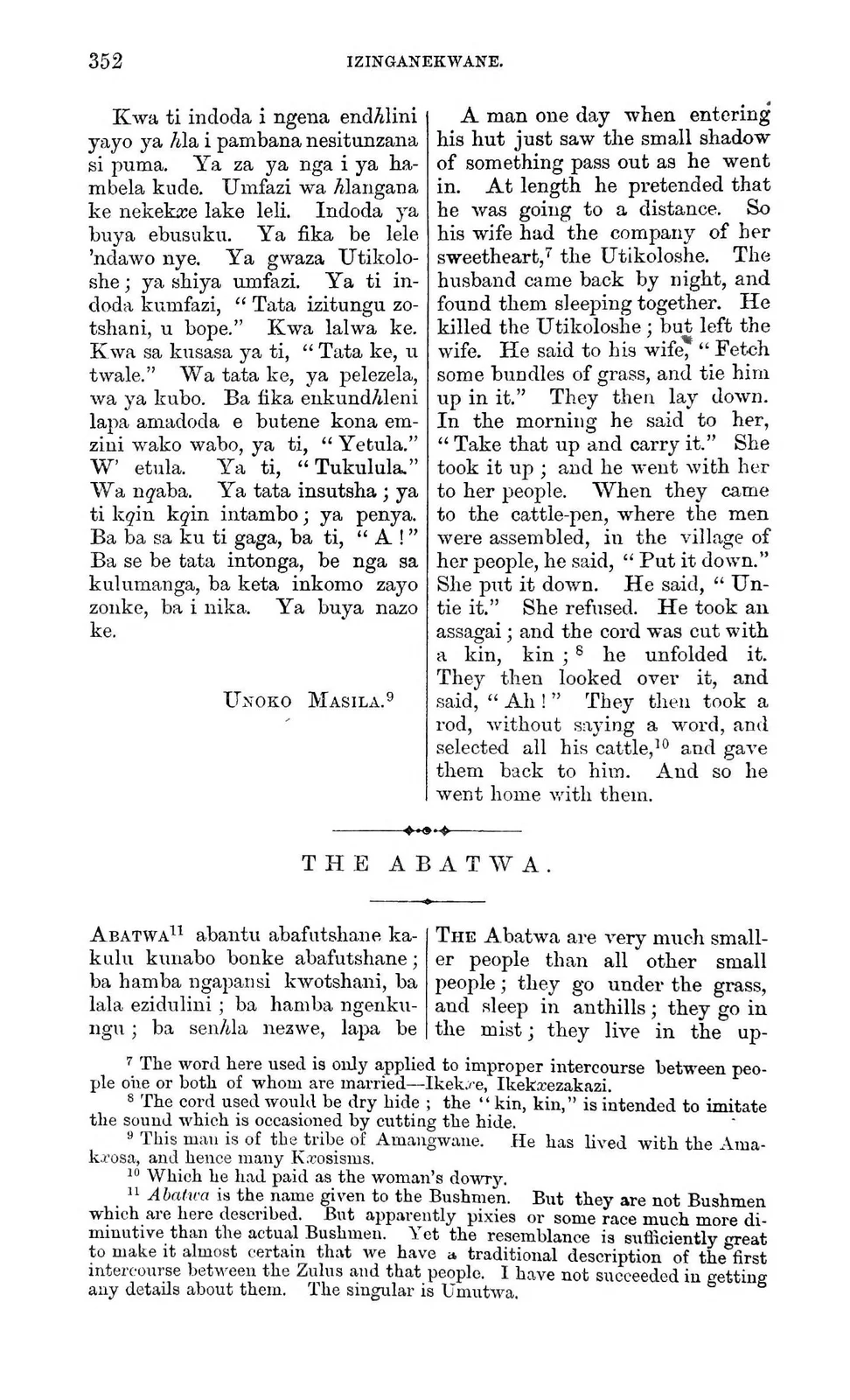
Abatwa in Umpengula Mbanda’s Account: documentary text witness, Callaway 1868, printed page 352; documentary source-page facsimile
Lower-page The Abatwa heading and tiny legendary people among grass and anthills; not a portrait of living Indigenous people. Upper text is another tale. Individually inspected original bilingual Zulu/English scanned page; documentary text, no creature illustration claimed. Physical edition 1868; translator/editor distinguished from traditional narrators. Public-domain publication and expired Callaway lifetime.
Overview
Umpengula Mbanda describes the Abatwa as smaller than any other small people. They move under grass, sleep in anthills, travel in mist and inhabit upland rocks. They have no permanent village: a place where they kill game becomes their home until they consume it and move on. When travelling they sit one behind another on a horse, from its neck to its tail. If no game is found, the account says that they eat the horse.
A traveller meeting an Umutwa is asked where he first saw him. Answering that he saw him only at that spot provokes anger and a fatal arrow, because the small person understands the answer as contempt. A safer greeting claims to have seen him from a distant mountain. He takes this as evidence of his greatness and is pleased. The tale makes the encounter’s verbal etiquette as important as the travellers’ differing sizes.
The companion account explains their feared advantage as concealment. A traveller may feel an arrow before seeing anyone to fight, since grass hides the archer. Fleas provide a comparison for this frustrating smallness, rather than an asserted transformation or insect body. Poisoned arrowheads are part of the attributed account. Callaway’s note 11 also discusses the historical use of the name for real Indigenous people, then offers an origin theory; that speculative equation is not used to characterize living communities here.
Origins & earliest records
The selected account credits Umpengula Mbanda. Callaway supplies the English translation and editorial notes; his comparative interpretations are distinguished from the contributor’s account.
Records & interpretation
Complete selected account and ending read: The Abatwa and The Dreadfulness of the Abatwa, pp. 352–355; name discussion note 11, p. 352.
In the literature
“they eat the horse”
The Abatwa, printed p.353 · Henry Callaway
The miniature riders eat their shared horse if they cannot find game.
Selected bibliography
Documented works and useful reading. This is not a list of every appearance.
- 01
Nursery Tales, Traditions, and Histories of the Zulus, in Their Own Words, volume I
The Abatwa and The Dreadfulness of the Abatwa, pp. 352–355; name discussion note 11, p. 352
- 02
Nursery Tales, Traditions, and Histories of the Zulus, Volume I
Henry Callaway, Nursery Tales, Traditions, and Histories of the Zulus, Volume I, Springvale, Natal: John A. Blair, 1868; bilingual Zulu/English edition, selected Princeton scan. Complete individual accounts read; narrator credits retained at section boundaries.
Family & connections
A source-supported family tree or inspiration record has not yet been compiled for this profile. Related reading below indicates a connection in subject matter, not a proven lineage or creative influence.
Located primary passages
Specific passages supporting details in this entry, grouped by their published witness.
Nursery Tales, Traditions, and Histories of the Zulus, in Their Own Words, volume I
Henry Callaway, Nursery Tales, Traditions, and Histories of the Zulus, Volume I, Springvale, Natal: John A. Blair, 1868; bilingual Zulu/English edition, selected Princeton scan. Complete individual accounts read; narrator credits retained at section boundaries.
- These narrated miniature people sleep in anthills, move under grass and in mist, and live by hunting rather than a permanent village. A traveller’s truthful nearby sighting insults their smallness and leads to his shooting; a later flattering claim to have seen them from a distant mountain placates them. A travelling group rides one horse in a row from neck to tail, eating it if game cannot be found.
- Concealment beneath tall grass lets unseen archers attack people who cannot identify an opponent. The narrator compares their troublesome power with fleas and attributes the arrows’ deadly effect to poison.
Abatwa ukwesabeka kwabo / The Dreadfulness of the Abatwa, printed pp.354–355
Callaway distinguishes the fabulous miniatures from real people bearing the same label. His proposed historical encounter origin is an editorial conjecture, not established ethnogenesis. The flea passage is an analogy, not literal shape-changing. This historical account does not substantiate modern medical or toxicological efficacy.
References
Sources supporting this profile. Linked pages have their own scope and editorial standards.
- Attributed primary account with translation; digitized bilingual editionCallaway bilingual edition — The Abatwa and The Dreadfulness of the Abatwa, pp. 352–355; name discussion note 11, p. 352Research access: 2026-10-05
Image credits
Historical text facsimileAbatwa in Umpengula Mbanda’s Account: documentary text witness, Callaway 1868, printed page 352; documentary source-page facsimile
Lower-page The Abatwa heading and tiny legendary people among grass and anthills; not a portrait of living Indigenous people. Upper text is another tale. Individually inspected original bilingual Zulu/English scanned page; documentary text, no creature illustration claimed. Physical edition 1868; translator/editor distinguished from traditional narrators. Public-domain publication and expired Callaway lifetime.