
NATURAL HISTORY · CATALOGUE RECORD
Sclater's Guenon
Cercopithecus sclateri Pocock, 1904
Source-backed taxonomic record
Accepted species in Catalogue of Life’s 11 September 2026 base release. This preserves the source classification and available supporting data; it is not a completed species monograph.
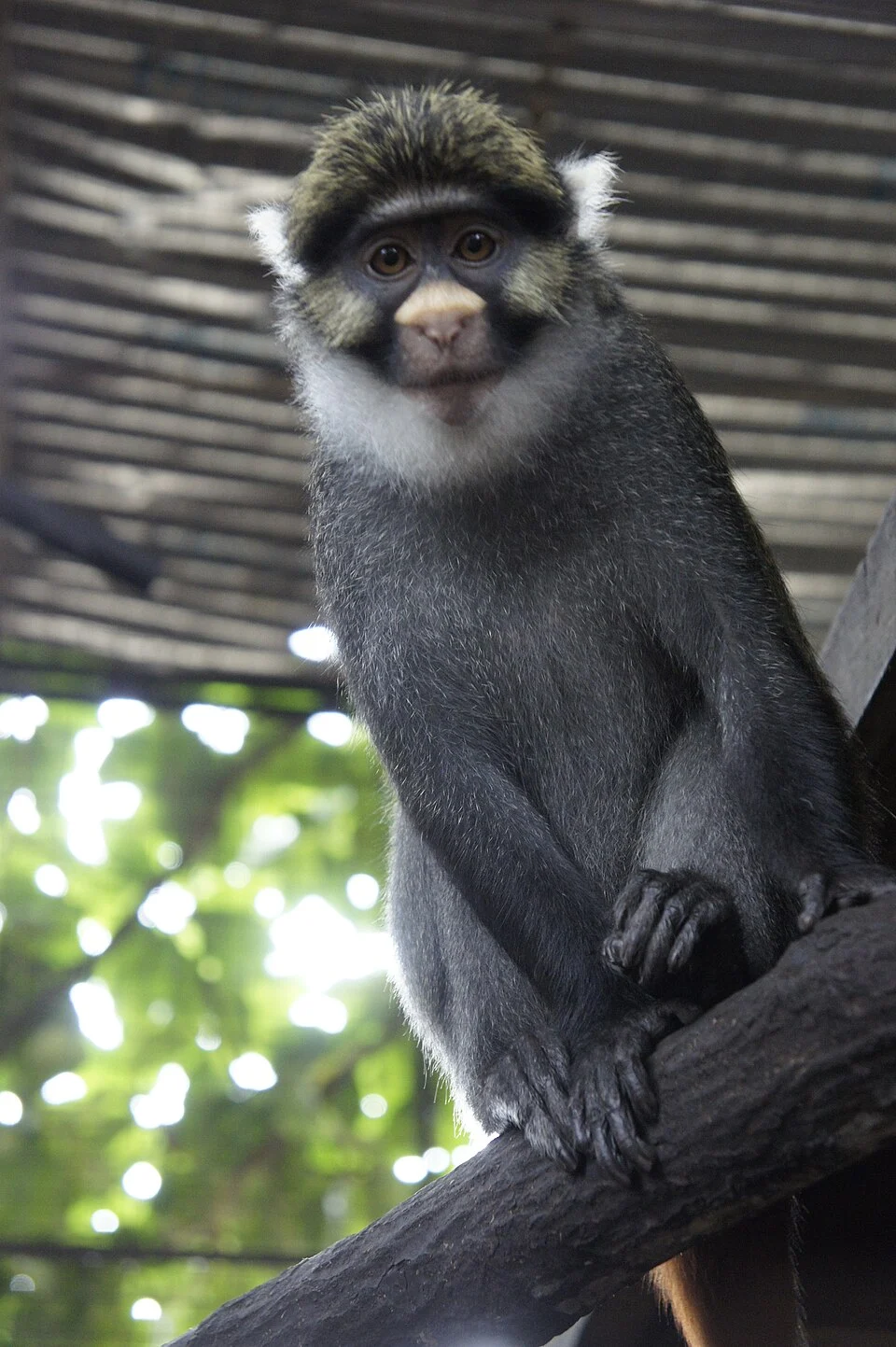
This is a female Sclater's guenon (Cercopithecus sclateri) who was rescued by CERCOPAN primate sanctuary in Nigeria (www.cercopan.org)
LaetitiaC · CC BY-SA 3.0 · Image sourceProvider-generated thumbnail requested at 800 pixels; no local editing Local WebP display rendition; resized without cropping.
Open encyclopedia reference
Sclater's guenon (Cercopithecus sclateri), also known as Sclater's monkey and the Nigerian monkey, is an Old World monkey that was first described by Reginald Innes Pocock in 1904 and named after Philip Sclater. It is an arboreal and diurnal primate that lives in the forests of southern Nigeria. It should not be confused with the closely related species, the white-throated guenon (Cercopithecus erythrogaster), which occurs in Nigeria and Benin. Sclater's guenon was formerly classified as a subspecies of the red-eared guenon (C. erythrotis). The diet of Sclater's guenon is unknown. The species is likely primarily a frugivore that supplements its diet with other plant parts and insects, based on data from closely related species. Sclater's guenon was thought to be nearly extinct until the late 1980s. The species is now known to occur in several isolated populations between the Niger and Cross Rivers in southern Nigeria. This region falls in the Guinean Forests of the West Africa biodiversity hotspot.
Wikipedia contributors, Sclater's guenon; see linked history · CC BY-SA 4.0 . Plain-text lead excerpt, at most 180 words; no infobox or later sections Retrieved 2026-10-05T05:22:20.984098+00:00. This reference remains separate from the taxonomic record.
Identity & source status
- Scientific name
- Cercopithecus sclateri Pocock, 1904
- Name authority
- Pocock, 1904
- Common name
- Sclater's Guenon
- Rank
- species
- Accepted status
- accepted
- Kingdom
- Animalia
- Phylum
- Chordata
- Class
- Mammalia
- Order
- Primates
- Family
- Cercopithecidae
- Genus
- Cercopithecus
- Extinction status
- Recorded extant
Classification family tree
Nested taxonomic groups from the source. This is not a direct-ancestor chain, a dated evolutionary tree or a phylogenetic reconstruction.
- domainEukaryota (Chatton, 1925) Whittaker & Margulis, 1978
- kingdomAnimalia
- phylumChordata
- subphylumVertebrata
- infraphylumGnathostomata
- parvphylumOsteichthyes
- megaclassTetrapoda
- classMammalia Linnaeus, 1758
- subclassTheria Parker & Haswell, 1897
- infraclassEutheria Gill, 1872
- orderPrimates Linnaeus, 1758
- suborderHaplorrhini Pocock, 1918
- infraorderSimiiformes Haeckel, 1866
- superfamilyCercopithecoidea Gray, 1821
- familyCercopithecidae Gray, 1821
- subfamilyCercopithecinae Gray, 1821
- tribeCercopithecini
- genusCercopithecus Linnaeus, 1758
- speciesCercopithecus sclateri Pocock, 1904
Close classified relatives
These entries share the source’s genus, Cercopithecus. They are not necessarily the closest relatives established by molecular evidence.
| Species | Classification | Source status |
|---|---|---|
| Red-bellied MonkeyCercopithecus erythrogaster Gray, 1866 | CercopithecidaeChordata | Accepted speciesRecorded extant |
| Moustached GuenonCercopithecus cephus (Linnaeus, 1758) | CercopithecidaeChordata | Accepted speciesRecorded extant |
| Lowe's Mona MonkeyCercopithecus lowei Thomas, 1923 | CercopithecidaeChordata | Accepted speciesRecorded extant |
| Red-eared GuenonCercopithecus erythrotis Waterhouse, 1838 | CercopithecidaeChordata | Accepted speciesRecorded extant |
| Dent's Mona MonkeyCercopithecus denti Thomas, 1907 | CercopithecidaeChordata | Accepted speciesRecorded extant |
| Hamlyn's MonkeyCercopithecus hamlyni Pocock, 1907 | CercopithecidaeChordata | Accepted speciesRecorded extant |
| Black-cheeked White-nosed MonkeyCercopithecus ascanius (Audebert, 1799) | CercopithecidaeChordata | Accepted speciesRecorded extant |
| LesulaCercopithecus lomamiensis Hart, Detwiler, Gilbert, Burrell, Fuller, Emetshu, Hart, Vosper, Sargis & Tosi, 2012 | CercopithecidaeChordata | Accepted speciesRecorded extant |
| Mona MonkeyCercopithecus mona (Schreber, 1775) | CercopithecidaeChordata | Accepted speciesRecorded extant |
| Lesser Spot-nosed MonkeyCercopithecus petaurista (Schreber, 1774) | CercopithecidaeChordata | Accepted speciesRecorded extant |
| Crested Mona MonkeyCercopithecus pogonias Bennett, 1833 | CercopithecidaeChordata | Accepted speciesRecorded extant |
| Wolf's Mona MonkeyCercopithecus wolfi Meyer, 1891 | CercopithecidaeChordata | Accepted speciesRecorded extant |
Documented distribution
Source distribution statements, not a complete range map. A listed locality is not necessarily a place of origin.
Source literature & publication evidence
References attached to this source record, including nomenclatural citations where supplied. This is a selected bibliography; abbreviated citations remain in the source’s form.
- https://www.itis.gov/servlet/SingleRpt/SingleRpt?search_topic=TSN&search_value=573014 Source fields: Taxon.tsv dwc:namePublishedIn, Taxon.tsv dcterms:references
Origins, evidence & remaining research
Name authority and publication references document nomenclature where the source supplies it. They do not establish evolutionary origins or the earliest fossil occurrence.
Specimen-level evidence, morphology, ecological research, phylogenetic studies, a comprehensive bibliography and a located literary passage have not yet been compiled for this record.
Dataset citation & attribution
This exact taxon in ChecklistBank · Catalogue of Life 2026-09-11
Catalogue of Life 2026-09-11; dataset 316321; doi:10.48580/dgz5n. https://creativecommons.org/licenses/by/4.0/ . Retrieved 5 October 2026.
Stable key: col:STGF. Classification follows source parent identifiers. English common names may vary by region.