
NATURAL HISTORY · CATALOGUE RECORD
Red-bellied Monkey
Cercopithecus erythrogaster Gray, 1866
Source-backed taxonomic record
Accepted species in Catalogue of Life’s 11 September 2026 base release. This preserves the source classification and available supporting data; it is not a completed species monograph.
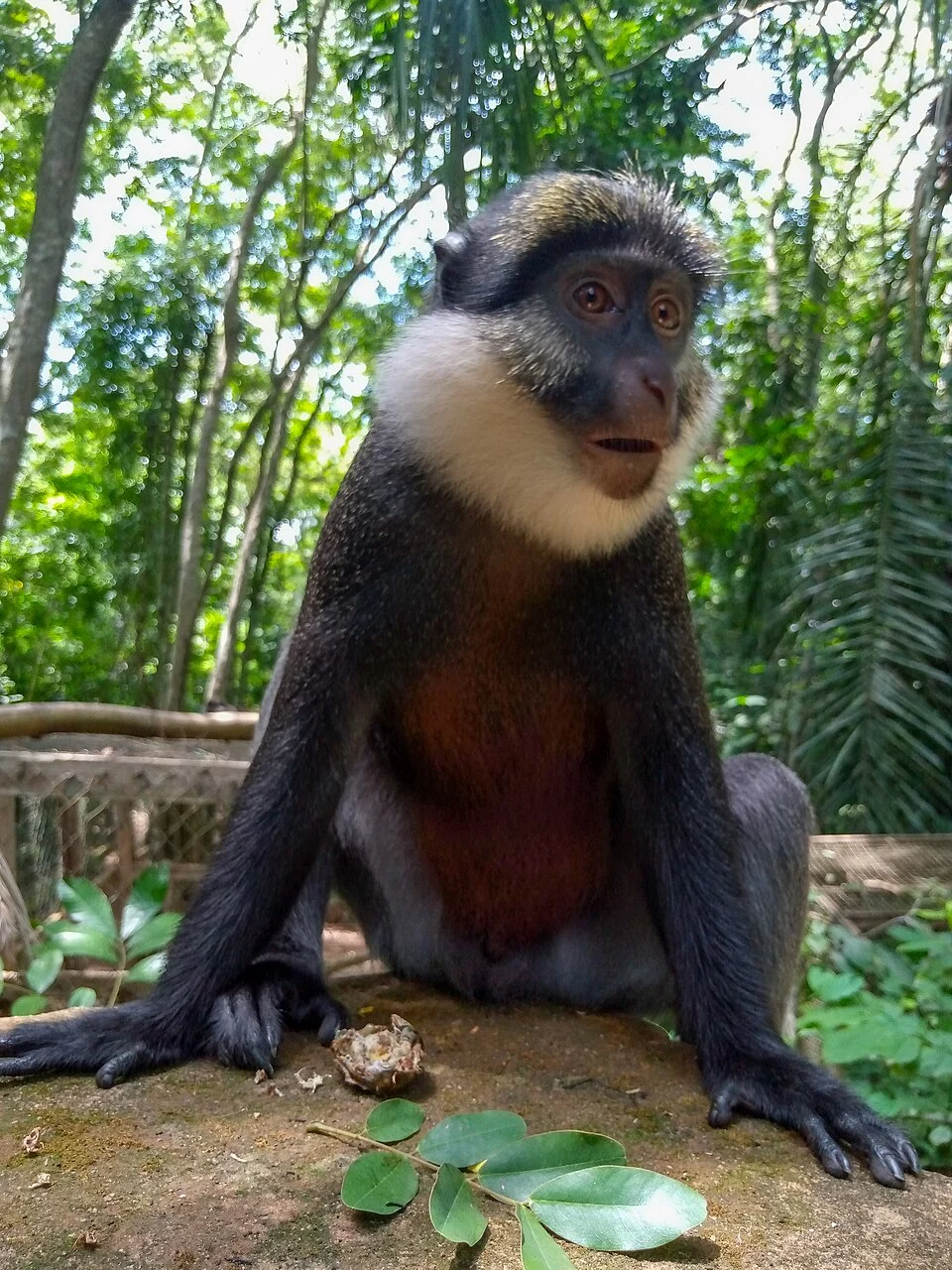
Le singe à ventre rouge au sanctuaire des Singes Drabo Gbo à Togba dans la commune d'Abomey-Calavi au Bénin.2
Freed Armel · CC BY-SA 4.0 · Image sourceProvider-generated thumbnail requested at 800 pixels; no local editing Local WebP display rendition; resized without cropping.
Open encyclopedia reference
The white-throated guenon (Cercopithecus erythrogaster), also known as the red-bellied monkey and the red-bellied guenon, is a diurnal primate that lives on trees of rainforests or tropical areas of Nigeria and Benin. The white-throated guenon is usually a frugivore but insects, leaves, and crops are also in its diet. It usually lives in small groups of four to five individual monkeys however, there have been groups of 30 discovered, and in cases, some males wander alone. It is arboreal, living in moist tropical forest and the wettest parts of dry tropical forest, however it can also be found in secondary bush and old farmland. Males weigh from 3.5–4.5 kg and females weigh 2–4 kg. Females give birth to one offspring, which is a factor of decreasing population. The white-throated guenon was once considered extinct due to constant hunting for the fur of its unique red belly and white front legs. Yet, a small group was found near the Niger River in 1988. The white-throated guenon is still considered an endangered species due to its decreasing population.
Wikipedia contributors, White-throated guenon; see linked history · CC BY-SA 4.0 . Plain-text lead excerpt, at most 180 words; no infobox or later sections Retrieved 2026-10-05T06:57:15.818586+00:00. This reference remains separate from the taxonomic record.
Identity & source status
- Scientific name
- Cercopithecus erythrogaster Gray, 1866
- Name authority
- Gray, 1866
- Common name
- Red-bellied Monkey
- Rank
- species
- Accepted status
- accepted
- Kingdom
- Animalia
- Phylum
- Chordata
- Class
- Mammalia
- Order
- Primates
- Family
- Cercopithecidae
- Genus
- Cercopithecus
- Extinction status
- Recorded extant
Classification family tree
Nested taxonomic groups from the source. This is not a direct-ancestor chain, a dated evolutionary tree or a phylogenetic reconstruction.
- domainEukaryota (Chatton, 1925) Whittaker & Margulis, 1978
- kingdomAnimalia
- phylumChordata
- subphylumVertebrata
- infraphylumGnathostomata
- parvphylumOsteichthyes
- megaclassTetrapoda
- classMammalia Linnaeus, 1758
- subclassTheria Parker & Haswell, 1897
- infraclassEutheria Gill, 1872
- orderPrimates Linnaeus, 1758
- suborderHaplorrhini Pocock, 1918
- infraorderSimiiformes Haeckel, 1866
- superfamilyCercopithecoidea Gray, 1821
- familyCercopithecidae Gray, 1821
- subfamilyCercopithecinae Gray, 1821
- tribeCercopithecini
- genusCercopithecus Linnaeus, 1758
- speciesCercopithecus erythrogaster Gray, 1866
Close classified relatives
These entries share the source’s genus, Cercopithecus. They are not necessarily the closest relatives established by molecular evidence.
| Species | Classification | Source status |
|---|---|---|
| Moustached GuenonCercopithecus cephus (Linnaeus, 1758) | CercopithecidaeChordata | Accepted speciesRecorded extant |
| Lowe's Mona MonkeyCercopithecus lowei Thomas, 1923 | CercopithecidaeChordata | Accepted speciesRecorded extant |
| Red-eared GuenonCercopithecus erythrotis Waterhouse, 1838 | CercopithecidaeChordata | Accepted speciesRecorded extant |
| Dent's Mona MonkeyCercopithecus denti Thomas, 1907 | CercopithecidaeChordata | Accepted speciesRecorded extant |
| Hamlyn's MonkeyCercopithecus hamlyni Pocock, 1907 | CercopithecidaeChordata | Accepted speciesRecorded extant |
| Black-cheeked White-nosed MonkeyCercopithecus ascanius (Audebert, 1799) | CercopithecidaeChordata | Accepted speciesRecorded extant |
| LesulaCercopithecus lomamiensis Hart, Detwiler, Gilbert, Burrell, Fuller, Emetshu, Hart, Vosper, Sargis & Tosi, 2012 | CercopithecidaeChordata | Accepted speciesRecorded extant |
| Mona MonkeyCercopithecus mona (Schreber, 1775) | CercopithecidaeChordata | Accepted speciesRecorded extant |
| Lesser Spot-nosed MonkeyCercopithecus petaurista (Schreber, 1774) | CercopithecidaeChordata | Accepted speciesRecorded extant |
| Crested Mona MonkeyCercopithecus pogonias Bennett, 1833 | CercopithecidaeChordata | Accepted speciesRecorded extant |
| Sclater's GuenonCercopithecus sclateri Pocock, 1904 | CercopithecidaeChordata | Accepted speciesRecorded extant |
| Wolf's Mona MonkeyCercopithecus wolfi Meyer, 1891 | CercopithecidaeChordata | Accepted speciesRecorded extant |
Documented distribution
Source distribution statements, not a complete range map. A listed locality is not necessarily a place of origin.
Source literature & publication evidence
References attached to this source record, including nomenclatural citations where supplied. This is a selected bibliography; abbreviated citations remain in the source’s form.
- https://www.itis.gov/servlet/SingleRpt/SingleRpt?search_topic=TSN&search_value=573001 Source fields: Taxon.tsv dwc:namePublishedIn, Taxon.tsv dcterms:references
Origins, evidence & remaining research
Name authority and publication references document nomenclature where the source supplies it. They do not establish evolutionary origins or the earliest fossil occurrence.
Specimen-level evidence, morphology, ecological research, phylogenetic studies, a comprehensive bibliography and a located literary passage have not yet been compiled for this record.
Dataset citation & attribution
This exact taxon in ChecklistBank · Catalogue of Life 2026-09-11
Catalogue of Life 2026-09-11; dataset 316321; doi:10.48580/dgz5n. https://creativecommons.org/licenses/by/4.0/ . Retrieved 5 October 2026.
Stable key: col:5XKBG. Classification follows source parent identifiers. English common names may vary by region.