
NATURAL HISTORY · CATALOGUE RECORD
Panamanian White-faced Capuchin
Cebus imitator Thomas, 1903
Source-backed taxonomic record
Accepted species in Catalogue of Life’s 11 September 2026 base release. This preserves the source classification and available supporting data; it is not a completed species monograph.
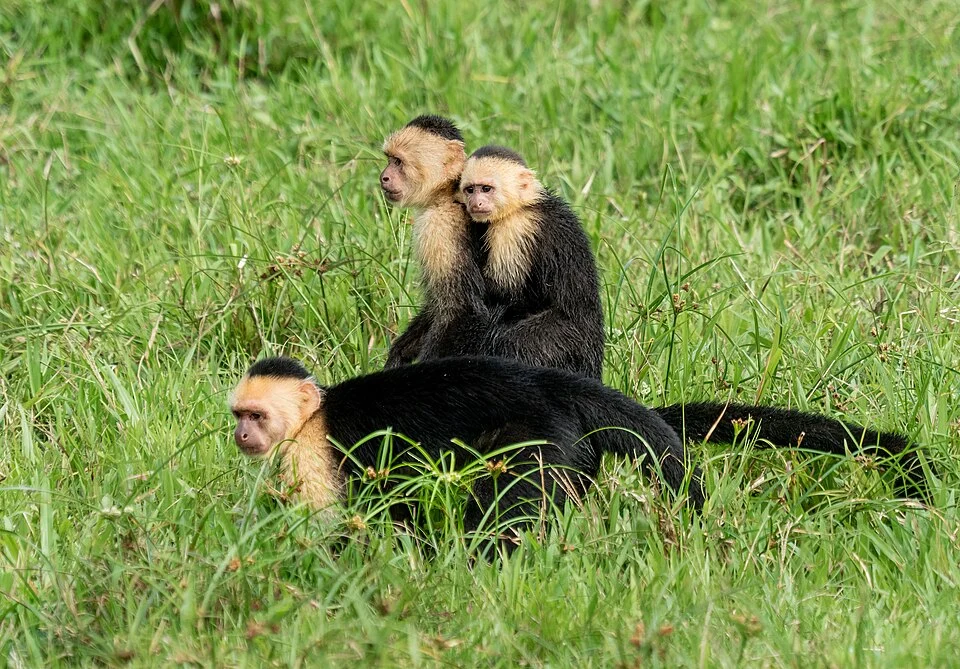
Panamanian white-faced capuchin female, male, and baby
Rhododendrites · CC BY-SA 4.0 · Image sourceProvider-generated thumbnail requested at 800 pixels; no local editing Local WebP display rendition; resized without cropping.
Open encyclopedia reference
The Panamanian white-faced capuchin (Cebus imitator), also known as the Panamanian white-headed capuchin or Central American white-faced capuchin, is a medium-sized New World monkey of the family Cebidae, subfamily Cebinae. Native to the forests of Central America, the white-faced capuchin is important to rainforest ecology for its role in dispersing seeds and pollen. The Panamanian white-faced capuchin is versatile, living in many different types of forest, and eating many different types of food, including fruit, other plant material, invertebrates, and small vertebrates. It lives in troops that can exceed 20 animals and include both males and females. It is noted for its tool use, including rubbing plants over its body in an apparent use of herbal medicine, and also using tools as weapons and for getting to food. It is a long-lived monkey, with a maximum recorded age of over 54 years. The white-faced capuchin is a medium-sized monkey, weighing up to 3.9 kg (8 lb 10 oz).
Wikipedia contributors, Panamanian white-faced capuchin; see linked history · CC BY-SA 4.0 . Plain-text lead excerpt, at most 180 words; no infobox or later sections Retrieved 2026-10-05T12:17:13.161647+00:00. This reference remains separate from the taxonomic record.
Identity & source status
- Scientific name
- Cebus imitator Thomas, 1903
- Name authority
- Thomas, 1903
- Common name
- Panamanian White-faced Capuchin
- Rank
- species
- Accepted status
- accepted
- Kingdom
- Animalia
- Phylum
- Chordata
- Class
- Mammalia
- Order
- Primates
- Family
- Cebidae
- Genus
- Cebus
- Extinction status
- Recorded extant
Classification family tree
Nested taxonomic groups from the source. This is not a direct-ancestor chain, a dated evolutionary tree or a phylogenetic reconstruction.
- domainEukaryota (Chatton, 1925) Whittaker & Margulis, 1978
- kingdomAnimalia
- phylumChordata
- subphylumVertebrata
- infraphylumGnathostomata
- parvphylumOsteichthyes
- megaclassTetrapoda
- classMammalia Linnaeus, 1758
- subclassTheria Parker & Haswell, 1897
- infraclassEutheria Gill, 1872
- orderPrimates Linnaeus, 1758
- suborderHaplorrhini Pocock, 1918
- infraorderSimiiformes Haeckel, 1866
- familyCebidae Bonaparte, 1831
- subfamilyCebinae Bonaparte, 1831
- genusCebus Erxleben, 1777
- speciesCebus imitator Thomas, 1903
Close classified relatives
These entries share the source’s genus, Cebus. They are not necessarily the closest relatives established by molecular evidence.
| Species | Classification | Source status |
|---|---|---|
| Chestnut Weeper CapuchinCebus castaneus I. Geoffroy Saint-Hilaire, 1851 | CebidaeChordata | Accepted speciesRecorded extant |
| Ecuadorian White-fronted CapuchinCebus aequatorialis J. A. Allen, 1914 | CebidaeChordata | Accepted speciesRecorded extant |
| Guianan Weeper CapuchinCebus olivaceus Schomburgk, 1848 | CebidaeChordata | Accepted speciesRecorded extant |
| Spix's White-fronted CapuchinCebus unicolor Spix, 1823 | CebidaeChordata | Accepted speciesRecorded extant |
Documented distribution
Source distribution statements, not a complete range map. A listed locality is not necessarily a place of origin.
Source literature & publication evidence
References attached to this source record, including nomenclatural citations where supplied. This is a selected bibliography; abbreviated citations remain in the source’s form.
- https://www.itis.gov/servlet/SingleRpt/SingleRpt?search_topic=TSN&search_value=944168 Source fields: Taxon.tsv dwc:namePublishedIn, Taxon.tsv dcterms:references
Origins, evidence & remaining research
Name authority and publication references document nomenclature where the source supplies it. They do not establish evolutionary origins or the earliest fossil occurrence.
Specimen-level evidence, morphology, ecological research, phylogenetic studies, a comprehensive bibliography and a located literary passage have not yet been compiled for this record.
Dataset citation & attribution
This exact taxon in ChecklistBank · Catalogue of Life 2026-09-11
Catalogue of Life 2026-09-11; dataset 316321; doi:10.48580/dgz5n. https://creativecommons.org/licenses/by/4.0/ . Retrieved 5 October 2026.
Stable key: col:RYZL. Classification follows source parent identifiers. English common names may vary by region.