
NATURAL HISTORY · CATALOGUE RECORD
Dalmatian Pelican
Pelecanus crispus Bruch, 1832
Source-backed taxonomic record
Accepted species in Catalogue of Life’s 11 September 2026 base release. This preserves the source classification and available supporting data; it is not a completed species monograph.
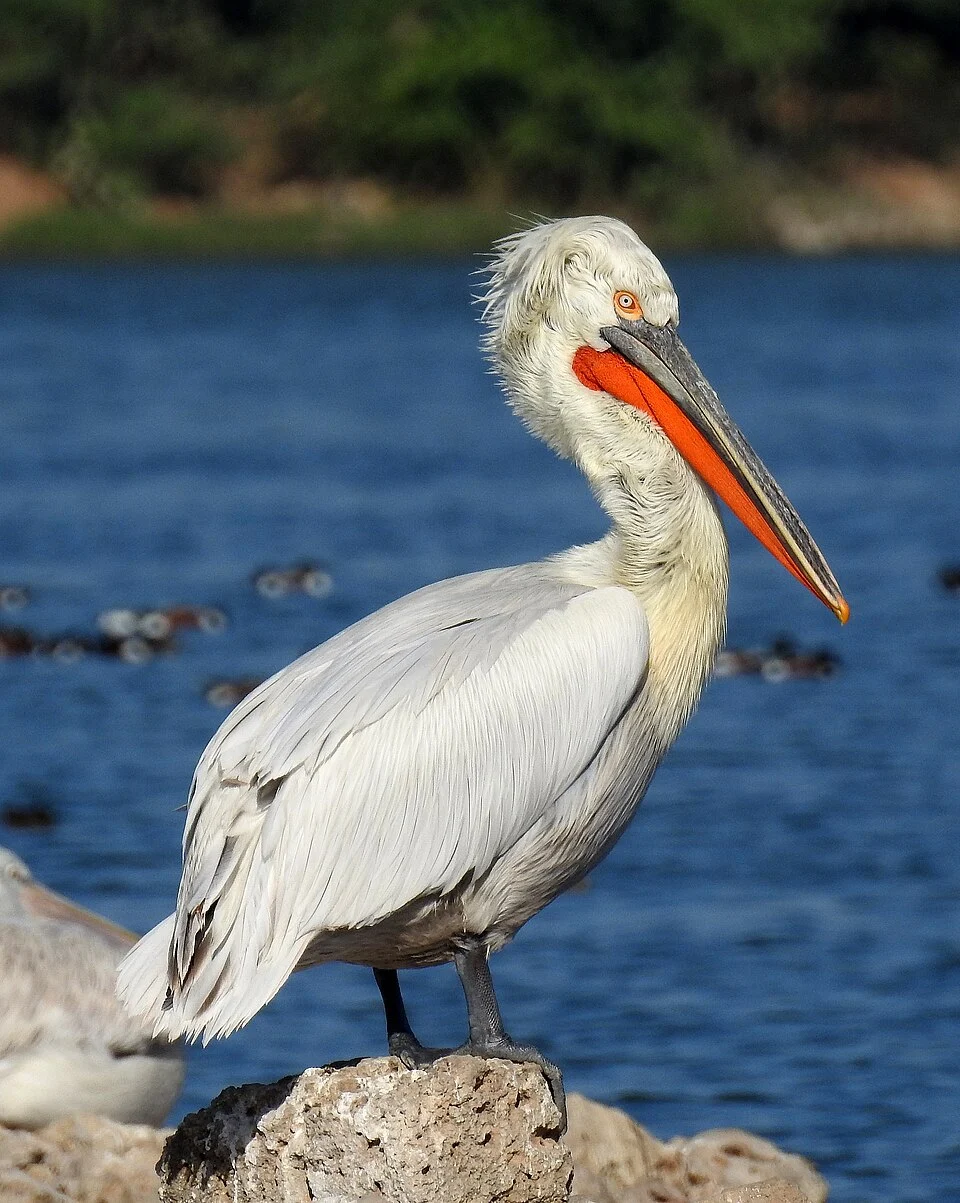
Dalmatian Pelican Pelecanus crispus. Photo by Dr. Raju Kasambe taken at Porbandar, Gujarat.
Dr. Raju Kasambe · CC BY-SA 4.0 · Image sourceProvider-generated thumbnail requested at 800 pixels; no local editing Local WebP display rendition; resized without cropping.
Open encyclopedia reference
The Dalmatian pelican (Pelecanus crispus), also known as the curly-headed pelican, is the largest member of the pelican family and among the heaviest flying birds in the world. With a wingspan typically ranging between 2.7 and 3.2 metres (8 ft 10 in and 10 ft 6 in), it ranks among the largest soaring birds. These pelicans are known for their graceful flight and often travel in synchronised flocks. With a range spanning across much of Central Eurasia, from the eastern Mediterranean in the west to the Taiwan Strait in the east, and from the Persian Gulf in the south to Siberia in the north, it is a short-to-medium-distance migrant between breeding and overwintering areas. As with other pelicans, its diet is mainly fish, and the males are larger than the females. Its curly nape feathers, grey legs and silvery-white plumage are distinguishing features, and the wings appear solid grey in flight. The adults acquire a drabber plumage in winter, however, making them look more similar to the great white pelican.
Wikipedia contributors, Dalmatian pelican; see linked history · CC BY-SA 4.0 . Plain-text lead excerpt, at most 180 words; no infobox or later sections Retrieved 2026-10-05T06:21:13.661612+00:00. This reference remains separate from the taxonomic record.
Identity & source status
- Scientific name
- Pelecanus crispus Bruch, 1832
- Name authority
- Bruch, 1832
- Common name
- Dalmatian Pelican
- Rank
- species
- Accepted status
- accepted
- Kingdom
- Animalia
- Phylum
- Chordata
- Class
- Aves
- Order
- Pelecaniformes
- Family
- Pelecanidae
- Genus
- Pelecanus
- Extinction status
- Recorded extant
Classification family tree
Nested taxonomic groups from the source. This is not a direct-ancestor chain, a dated evolutionary tree or a phylogenetic reconstruction.
- domainEukaryota (Chatton, 1925) Whittaker & Margulis, 1978
- kingdomAnimalia
- phylumChordata
- subphylumVertebrata
- infraphylumGnathostomata
- parvphylumOsteichthyes
- megaclassTetrapoda
- classAves
- orderPelecaniformes
- familyPelecanidae Rafinesque, 1815
- genusPelecanus Linnaeus, 1758
- speciesPelecanus crispus Bruch, 1832
Close classified relatives
These entries share the source’s genus, Pelecanus. They are not necessarily the closest relatives established by molecular evidence.
| Species | Classification | Source status |
|---|---|---|
| Pink-backed PelicanPelecanus rufescens J. F. Gmelin, 1789 | PelecanidaeChordata | Accepted speciesRecorded extant |
| Brown PelicanPelecanus occidentalis Linnaeus, 1766 | PelecanidaeChordata | Accepted speciesRecorded extant |
| Peruvian PelicanPelecanus thagus Molina, 1782 | PelecanidaeChordata | Accepted speciesRecorded extant |
| Australian PelicanPelecanus conspicillatus Temminck, 1824 | PelecanidaeChordata | Accepted speciesRecorded extant |
| Spot-billed PelicanPelecanus philippensis J. F. Gmelin, 1789 | PelecanidaeChordata | Accepted speciesRecorded extant |
Documented distribution
Source distribution statements, not a complete range map. A listed locality is not necessarily a place of origin.
Southern Asia
Source literature & publication evidence
References attached to this source record, including nomenclatural citations where supplied. This is a selected bibliography; abbreviated citations remain in the source’s form.
- Bruch, & Carl Friedrich. (1832). Ornithologische Mittheilungen. Isis von Oken, 1832, Vol. 10. Source fields: Taxon.tsv dwc:namePublishedIn, Taxon.tsv dcterms:references
Origins, evidence & remaining research
Name authority and publication references document nomenclature where the source supplies it. They do not establish evolutionary origins or the earliest fossil occurrence.
Specimen-level evidence, morphology, ecological research, phylogenetic studies, a comprehensive bibliography and a located literary passage have not yet been compiled for this record.
Dataset citation & attribution
This exact taxon in ChecklistBank · Catalogue of Life 2026-09-11
Catalogue of Life 2026-09-11; dataset 316321; doi:10.48580/dgz5n. https://creativecommons.org/licenses/by/4.0/ . Retrieved 5 October 2026.
Stable key: col:75Z8F. Classification follows source parent identifiers. English common names may vary by region.