
NATURAL HISTORY · CATALOGUE RECORD
Brown Pelican
Pelecanus occidentalis Linnaeus, 1766
Source-backed taxonomic record
Accepted species in Catalogue of Life’s 11 September 2026 base release. This preserves the source classification and available supporting data; it is not a completed species monograph.
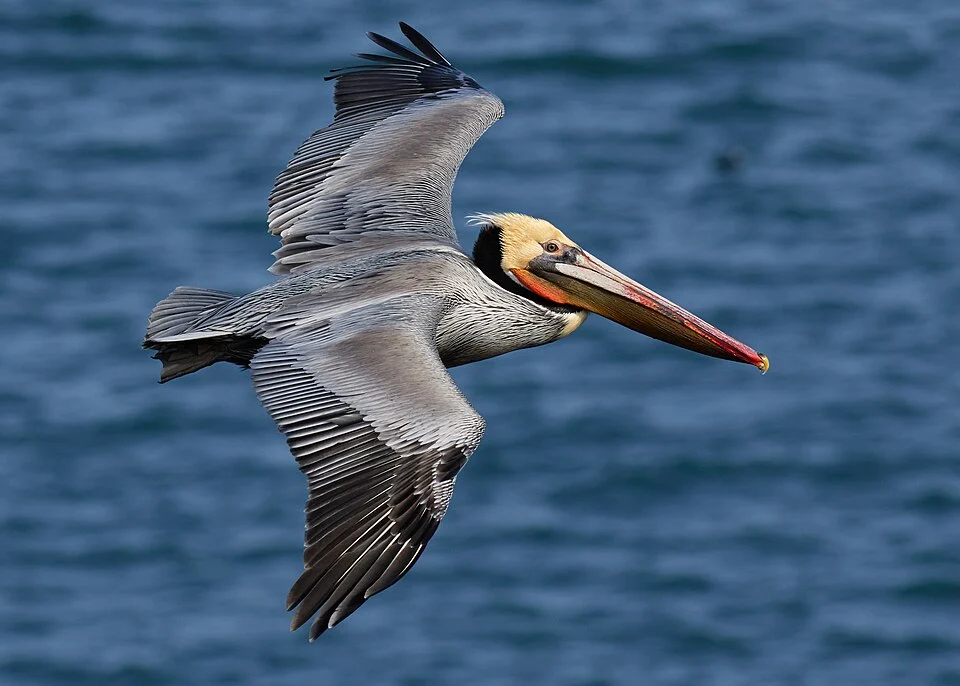
Brown pelican (Pelecanus occidentalis) in flight at Bodega Bay, Sonoma County, California.
Frank Schulenburg · CC BY-SA 4.0 · Image sourceProvider-generated thumbnail requested at 800 pixels; no local editing Local WebP display rendition; resized without cropping.
Open encyclopedia reference
The brown pelican (Pelecanus occidentalis) is a bird of the pelican family, Pelecanidae, one of three species found in the Americas and one of two that feed by diving into water. It is found on the Atlantic Coast from New Jersey to the mouth of the Amazon River, and along the Pacific Coast from British Columbia to Peru, including the Galapagos Islands. The nominate subspecies in its breeding plumage has a white head with a yellowish wash on the crown. The nape and neck are dark maroon–brown. The upper sides of the neck have white lines along the base of the gular pouch, and the lower fore neck has a pale yellowish patch. The male and female are similar, but the female is slightly smaller. The nonbreeding adult has a white head and neck. The pink skin around the eyes becomes dull and gray in the nonbreeding season. It lacks any red hue, and the pouch is strongly olivaceous ochre-tinged and the legs are olivaceous gray to blackish-gray.
Wikipedia contributors, Brown pelican; see linked history · CC BY-SA 4.0 . Plain-text lead excerpt, at most 180 words; no infobox or later sections Retrieved 2026-10-05T03:16:06.978226+00:00. This reference remains separate from the taxonomic record.
Identity & source status
- Scientific name
- Pelecanus occidentalis Linnaeus, 1766
- Name authority
- Linnaeus, 1766
- Common name
- Brown Pelican
- Rank
- species
- Accepted status
- accepted
- Kingdom
- Animalia
- Phylum
- Chordata
- Class
- Aves
- Order
- Pelecaniformes
- Family
- Pelecanidae
- Genus
- Pelecanus
- Extinction status
- Recorded extant
Classification family tree
Nested taxonomic groups from the source. This is not a direct-ancestor chain, a dated evolutionary tree or a phylogenetic reconstruction.
- domainEukaryota (Chatton, 1925) Whittaker & Margulis, 1978
- kingdomAnimalia
- phylumChordata
- subphylumVertebrata
- infraphylumGnathostomata
- parvphylumOsteichthyes
- megaclassTetrapoda
- classAves
- orderPelecaniformes
- familyPelecanidae Rafinesque, 1815
- genusPelecanus Linnaeus, 1758
- speciesPelecanus occidentalis Linnaeus, 1766
Close classified relatives
These entries share the source’s genus, Pelecanus. They are not necessarily the closest relatives established by molecular evidence.
| Species | Classification | Source status |
|---|---|---|
| Pink-backed PelicanPelecanus rufescens J. F. Gmelin, 1789 | PelecanidaeChordata | Accepted speciesRecorded extant |
| Peruvian PelicanPelecanus thagus Molina, 1782 | PelecanidaeChordata | Accepted speciesRecorded extant |
| Australian PelicanPelecanus conspicillatus Temminck, 1824 | PelecanidaeChordata | Accepted speciesRecorded extant |
| Dalmatian PelicanPelecanus crispus Bruch, 1832 | PelecanidaeChordata | Accepted speciesRecorded extant |
| Spot-billed PelicanPelecanus philippensis J. F. Gmelin, 1789 | PelecanidaeChordata | Accepted speciesRecorded extant |
Documented distribution
Source distribution statements, not a complete range map. A listed locality is not necessarily a place of origin.
Middle America
North America
South America
Source literature & publication evidence
References attached to this source record, including nomenclatural citations where supplied. This is a selected bibliography; abbreviated citations remain in the source’s form.
- Linné, Carl von. (1766). Systema Naturae per Regna Tria Naturae, Secundum Classes, Ordines, Genera, Species, Cum Characteribus, Differentiis, Synonymis, Locis, 12th Edition, Vol. 1. Source fields: Taxon.tsv dwc:namePublishedIn, Taxon.tsv dcterms:references
Origins, evidence & remaining research
Name authority and publication references document nomenclature where the source supplies it. They do not establish evolutionary origins or the earliest fossil occurrence.
Specimen-level evidence, morphology, ecological research, phylogenetic studies, a comprehensive bibliography and a located literary passage have not yet been compiled for this record.
Dataset citation & attribution
This exact taxon in ChecklistBank · Catalogue of Life 2026-09-11
Catalogue of Life 2026-09-11; dataset 316321; doi:10.48580/dgz5n. https://creativecommons.org/licenses/by/4.0/ . Retrieved 5 October 2026.
Stable key: col:6TZ8G. Classification follows source parent identifiers. English common names may vary by region.