
NATURAL HISTORY · CATALOGUE RECORD
Shaw's Jird
Meriones (Pallasiomys) shawi (Duvernoy, 1842)
Source-backed taxonomic record
Accepted species in Catalogue of Life’s 11 September 2026 base release. This preserves the source classification and available supporting data; it is not a completed species monograph.
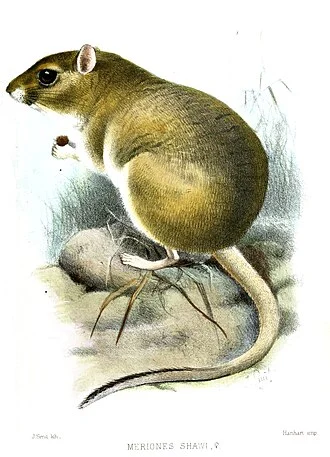
Meriones shawi (Female)
Joseph Smit · Public domain · Image sourceProvider-generated thumbnail requested at 320 pixels; no local editing Local WebP display rendition; resized without cropping.
Open encyclopedia reference
Shaw's jird (Meriones shawi) is a species of rodent in the family Muridae. It is found in Algeria, Egypt, Libya, Morocco, and Tunisia. Its natural habitats are arable land, pastureland, and rural gardens. The Shaw's jird is a relatively large, gerbil-like rodent about the size of a rat. An adult male may grow to 14 inches (36 cm) long including the tail, which comprises about half this length. Males tend to be slightly larger and more heavily built (up to 6 ounces (170 g)) than females (5 ounces (140 g). The animal has a sandy base coat that is usually quite dark, although it can be found in lighter shades. Occasionally there is a white head spot. Jirds have larger, less hairy ears than a Mongolian gerbil. The Shaw's jird is able to survive long periods of dehydration in semi-desert regions where it lives, in part because of its well-developed kidneys. A Shaw's jird can mate 224 times in two hours. During the rainy season, Shaw's jirds breed more than in the summer when there is less rain.
Wikipedia contributors, Shaw's jird; see linked history · CC BY-SA 4.0 . Plain-text lead excerpt, at most 180 words; no infobox or later sections Retrieved 2026-10-05T02:16:38.702583+00:00. This reference remains separate from the taxonomic record.
Identity & source status
- Scientific name
- Meriones (Pallasiomys) shawi (Duvernoy, 1842)
- Name authority
- (Duvernoy, 1842)
- Common name
- Shaw's Jird
- Rank
- species
- Accepted status
- accepted
- Kingdom
- Animalia
- Phylum
- Chordata
- Class
- Mammalia
- Order
- Rodentia
- Family
- Muridae
- Genus
- Meriones
- Extinction status
- Recorded extant
Classification family tree
Nested taxonomic groups from the source. This is not a direct-ancestor chain, a dated evolutionary tree or a phylogenetic reconstruction.
- domainEukaryota (Chatton, 1925) Whittaker & Margulis, 1978
- kingdomAnimalia
- phylumChordata
- subphylumVertebrata
- infraphylumGnathostomata
- parvphylumOsteichthyes
- megaclassTetrapoda
- classMammalia Linnaeus, 1758
- subclassTheria Parker & Haswell, 1897
- infraclassEutheria Gill, 1872
- orderRodentia Bowdich, 1821
- suborderMyomorpha Brandt, 1855
- superfamilyMuroidea Illiger, 1811
- familyMuridae Illiger, 1811
- subfamilyGerbillinae Gray, 1825
- genusMeriones Illiger, 1811
- subgenusPallasiomys Heptner, 1933
- speciesMeriones (Pallasiomys) shawi (Duvernoy, 1842)
Close classified relatives
These entries share the source’s genus, Meriones. They are not necessarily the closest relatives established by molecular evidence.
| Species | Classification | Source status |
|---|---|---|
| Tristram's JirdMeriones (Pallasiomys) tristrami Thomas, 1892 | MuridaeChordata | Accepted speciesRecorded extant |
| Buxton's JirdMeriones (Pallasiomys) sacramenti Thomas, 1922 | MuridaeChordata | Accepted speciesRecorded extant |
| Libyan JirdMeriones (Pallasiomys) libycus Lichtenstein, 1823 | MuridaeChordata | Accepted speciesRecorded extant |
| Moroccan JirdMeriones (Pallasiomys) grandis Cabrera, 1907 | MuridaeChordata | Accepted speciesRecorded extant |
| King JirdMeriones (Parameriones) rex Yerbury & Thomas, 1895 | MuridaeChordata | Accepted speciesRecorded extant |
| Indian Desert GerbilMeriones (Cheliones) hurrianae Jordon, 1867 | MuridaeChordata | Accepted speciesRecorded extant |
| Clawed JirdMeriones (Pallasiomys) unguiculatus (Milne-Edwards, 1867) | MuridaeChordata | Accepted speciesRecorded extant |
| Vinogradov's JirdMeriones (Pallasiomys) vinogradovi Heptner, 1931 | MuridaeChordata | Accepted speciesRecorded extant |
| Zarudny's JirdMeriones (Pallasiomys) zarudnyi Heptner, 1937 | MuridaeChordata | Accepted speciesRecorded extant |
| Cheng's JirdMeriones (Pallasiomys) chengi Wang, 1964 | MuridaeChordata | Accepted speciesRecorded extant |
Names & synonyms
Names explicitly linked to this accepted taxon in the source. Synonymy can change with revision.
| Recorded name | Source status |
|---|---|
| Gerbillus savii Loche, 1867 Loche, 1867 | synonym |
| Gerbillus sellysii Pomel, 1856 Pomel, 1856 | synonym |
| Meriones isis Thomas, 1919 Thomas, 1919 | synonym |
| Meriones trouessarti Lataste, 1882 Lataste, 1882 | synonym |
| Meriones shawi laticeps Lataste, 1885 Lataste, 1885 | synonym |
| Gerbillus richardii Loche, 1867 Loche, 1867 | synonym |
| Meriones albipes Lataste, 1882 Lataste, 1882 | synonym |
| Meriones auziensis Lataste, 1882 Lataste, 1882 | synonym |
| Meriones shawi crassibulla Lataste, 1885 Lataste, 1885 | synonym |
| Meriones shawi longiceps Lataste, 1885 Lataste, 1885 | synonym |
Documented distribution
Source distribution statements, not a complete range map. A listed locality is not necessarily a place of origin.
Source literature & publication evidence
References attached to this source record, including nomenclatural citations where supplied. This is a selected bibliography; abbreviated citations remain in the source’s form.
- https://www.itis.gov/servlet/SingleRpt/SingleRpt?search_topic=TSN&search_value=632985 Source fields: Taxon.tsv dwc:namePublishedIn, Taxon.tsv dcterms:references
Origins, evidence & remaining research
Name authority and publication references document nomenclature where the source supplies it. They do not establish evolutionary origins or the earliest fossil occurrence.
Specimen-level evidence, morphology, ecological research, phylogenetic studies, a comprehensive bibliography and a located literary passage have not yet been compiled for this record.
Dataset citation & attribution
This exact taxon in ChecklistBank · Catalogue of Life 2026-09-11
Catalogue of Life 2026-09-11; dataset 316321; doi:10.48580/dgz5n. https://creativecommons.org/licenses/by/4.0/ . Retrieved 5 October 2026.
Stable key: col:6QZ9T. Classification follows source parent identifiers. English common names may vary by region.