
NATURAL HISTORY · CATALOGUE RECORD
Black-tailed Jack Rabbit
Lepus californicus Gray, 1837
Source-backed taxonomic record
Accepted species in Catalogue of Life’s 11 September 2026 base release. This preserves the source classification and available supporting data; it is not a completed species monograph.
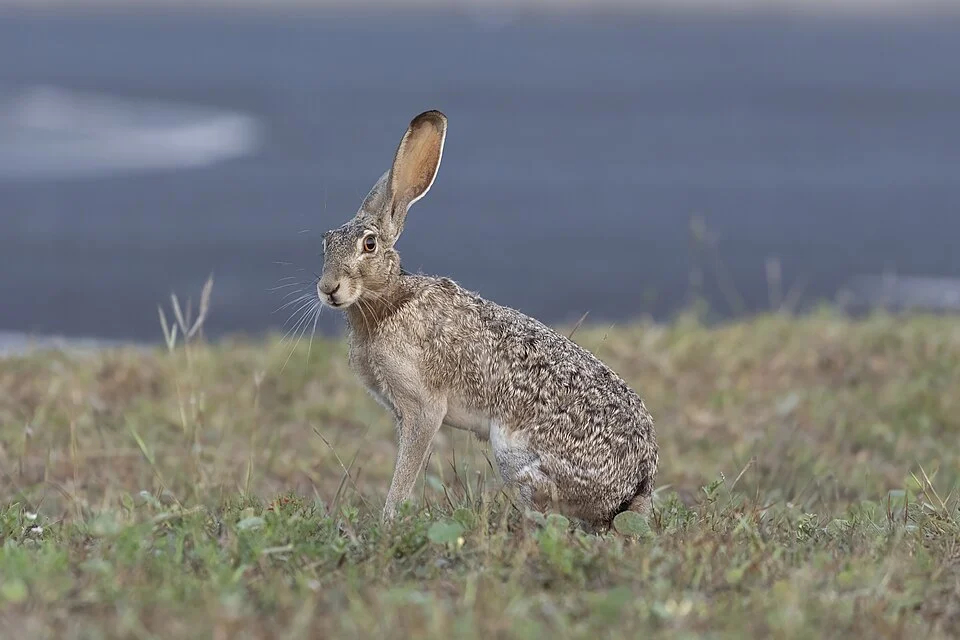
A Black-tailed Jackrabbit (Lepus californicus) South Padre Island, Texas, USA.
Chuck Homler d/b/a Focus On Wildlife · CC BY-SA 4.0 · Image sourceProvider-generated thumbnail requested at 800 pixels; no local editing Local WebP display rendition; resized without cropping.
Open encyclopedia reference
The black-tailed jackrabbit (Lepus californicus), also known as the American desert hare, is a common hare of the western United States and Mexico, where it is found at elevations from sea level up to 10,000 ft (3,000 m). Reaching a length around 2 ft (61 cm), and a weight from 3 to 6 lb (1.4 to 2.7 kg), the black-tailed jackrabbit is one of the largest North American hares. Black-tailed jackrabbits occupy mixed shrub-grassland terrains. Their breeding depends on the location; it typically peaks in spring, but may continue all year round in warm climates. Young are born fully furred with eyes open; they are well camouflaged and are mobile within minutes of birth, thus females do not protect or even stay with the young except during nursing. The average litter size is around four, but may be as low as two and as high as seven in warm regions. The black-tailed jackrabbit does not migrate or hibernate during winter and uses the same habitat of 0.4–1.2 mi2 (1.0–3.1 km2) year-round.
Wikipedia contributors, Black-tailed jackrabbit; see linked history · CC BY-SA 4.0 . Plain-text lead excerpt, at most 180 words; no infobox or later sections Retrieved 2026-10-05T10:43:19.411655+00:00. This reference remains separate from the taxonomic record.
Identity & source status
- Scientific name
- Lepus californicus Gray, 1837
- Name authority
- Gray, 1837
- Common name
- Black-tailed Jack Rabbit
- Rank
- species
- Accepted status
- accepted
- Kingdom
- Animalia
- Phylum
- Chordata
- Class
- Mammalia
- Order
- Lagomorpha
- Family
- Leporidae
- Genus
- Lepus
- Extinction status
- Recorded extant
Classification family tree
Nested taxonomic groups from the source. This is not a direct-ancestor chain, a dated evolutionary tree or a phylogenetic reconstruction.
- domainEukaryota (Chatton, 1925) Whittaker & Margulis, 1978
- kingdomAnimalia
- phylumChordata
- subphylumVertebrata
- infraphylumGnathostomata
- parvphylumOsteichthyes
- megaclassTetrapoda
- classMammalia Linnaeus, 1758
- subclassTheria Parker & Haswell, 1897
- infraclassEutheria Gill, 1872
- orderLagomorpha Brandt, 1855
- familyLeporidae Fischer, 1817
- genusLepus Linnaeus, 1758
- speciesLepus californicus Gray, 1837
Close classified relatives
These entries share the source’s genus, Lepus. They are not necessarily the closest relatives established by molecular evidence.
| Species | Classification | Source status |
|---|---|---|
| Mountain HareLepus timidus Linnaeus, 1758 | LeporidaeChordata | Accepted speciesRecorded extant |
| Alaska Arctic HareLepus othus Merriam, 1900 | LeporidaeChordata | Accepted speciesRecorded extant |
| Snowshoe HareLepus americanus Erxleben, 1777 | LeporidaeChordata | Accepted speciesRecorded extant |
| Ethiopian HareLepus fagani Thomas, 1903 | LeporidaeChordata | Accepted speciesRecorded extant |
| Arabian HareLepus capensis Linnaeus, 1758 | LeporidaeChordata | Accepted speciesRecorded extant |
| Yunnan HareLepus comus Allen, 1927 | LeporidaeChordata | Accepted speciesRecorded extant |
| Corsican HareLepus corsicanus de Winton, 1898 | LeporidaeChordata | Accepted speciesRecorded extant |
| Black JackrabbitLepus insularis W. Bryant, 1891 | LeporidaeChordata | Accepted speciesRecorded extant |
| Hainan HareLepus hainanus Swinhoe, 1870 | LeporidaeChordata | Accepted speciesRecorded extant |
| Tehuantepec JackrabbitLepus flavigularis Wagner, 1844 | LeporidaeChordata | Accepted speciesRecorded extant |
| White-tailed Jack RabbitLepus townsendii Bachman, 1839 | LeporidaeChordata | Accepted speciesRecorded extant |
| Arctic HareLepus arcticus Ross, 1819 | LeporidaeChordata | Accepted speciesRecorded extant |
Documented distribution
Source distribution statements, not a complete range map. A listed locality is not necessarily a place of origin.
North America
Source literature & publication evidence
References attached to this source record, including nomenclatural citations where supplied. This is a selected bibliography; abbreviated citations remain in the source’s form.
- https://www.itis.gov/servlet/SingleRpt/SingleRpt?search_topic=TSN&search_value=180115 Source fields: Taxon.tsv dwc:namePublishedIn, Taxon.tsv dcterms:references
Origins, evidence & remaining research
Name authority and publication references document nomenclature where the source supplies it. They do not establish evolutionary origins or the earliest fossil occurrence.
Specimen-level evidence, morphology, ecological research, phylogenetic studies, a comprehensive bibliography and a located literary passage have not yet been compiled for this record.
Dataset citation & attribution
This exact taxon in ChecklistBank · Catalogue of Life 2026-09-11
Catalogue of Life 2026-09-11; dataset 316321; doi:10.48580/dgz5n. https://creativecommons.org/licenses/by/4.0/ . Retrieved 5 October 2026.
Stable key: col:6PPZ6. Classification follows source parent identifiers. English common names may vary by region.