
smalltail shark
Carcharhinus porosus (Ranzani, 1839)
Accepted species in Catalogue of Life’s 11 September 2026 base release. This preserves the source classification and available supporting data; it is not a completed species monograph.
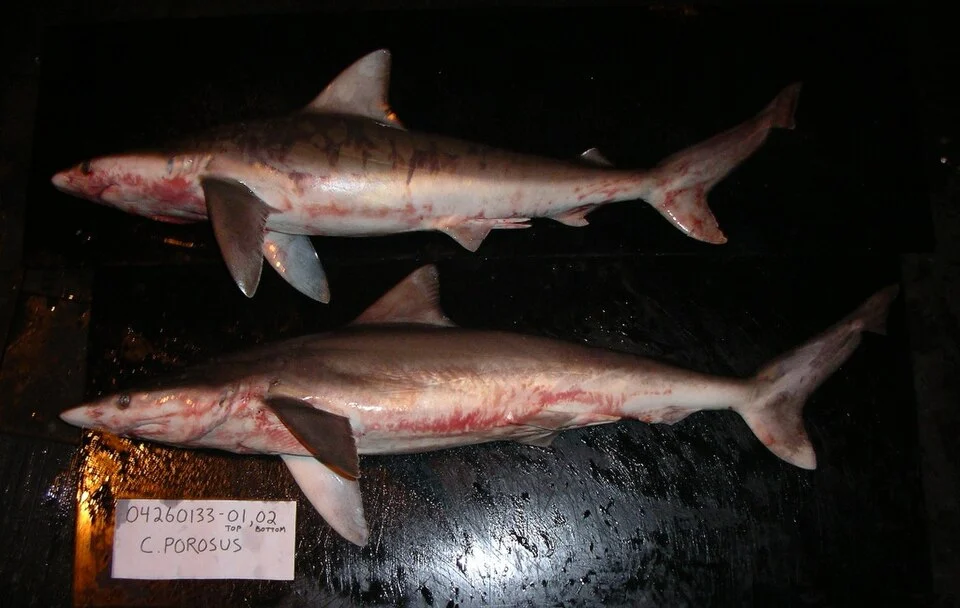
Smalltail sharks (Carcharhinus porosus) from Gulf of Mexico
SEFSC Pascagoula Laboratory; Collection of Brandi Noble, NOAA/NMFS/SEFSC · Public domain · Image sourceProvider-generated thumbnail requested at 800 pixels; no local editing Local WebP display rendition; resized without cropping.
Open encyclopedia reference
The smalltail shark (Carcharhinus porosus) is a species of requiem shark, and part of the family Carcharhinidae. It is found in the western Atlantic Ocean, from the northern Gulf of Mexico to southern Brazil. It inhabits shallow waters close to shore, particularly over muddy bottoms around estuaries. It tends to swim low in the water column and forms large aggregations segregated by sex. A slim species generally not exceeding 1.1 m (3.6 ft) in length, the smalltail shark has a rather long, pointed snout, a broad, triangular first dorsal fin, and a second dorsal fin that originates over the midpoint of the anal fin base. It is plain gray in color, without prominent markings on its fins. The diet of the smalltail shark consists mainly of bony fishes such as croakers, while crustaceans, cephalopods, and smaller sharks and rays may also be consumed. It is viviparous, meaning the developing embryos are sustained by a placental connection. Females bear litters of two to 9 young on a biennial cycle, following a roughly 12-month gestation period.
Wikipedia contributors, Smalltail shark; see linked history · CC BY-SA 4.0 . Plain-text lead excerpt, at most 180 words; no infobox or later sections Retrieved 2026-10-05T05:09:32.906450+00:00. This reference remains separate from the taxonomic record.
Identity & source status
- Scientific name
- Carcharhinus porosus (Ranzani, 1839)
- Name authority
- (Ranzani, 1839)
- Common name
- smalltail shark
- Rank
- species
- Accepted status
- accepted
- Kingdom
- Animalia
- Phylum
- Chordata
- Class
- Elasmobranchii
- Order
- Carcharhiniformes
- Family
- Carcharhinidae
- Genus
- Carcharhinus
- Extinction status
- Not supplied by this source
Source habitat flags: Marine: yes · Freshwater: no · Terrestrial: no. These do not form a complete habitat description.
Classification family tree
Nested taxonomic groups from the source. This is not a direct-ancestor chain, a dated evolutionary tree or a phylogenetic reconstruction.
- domainEukaryota (Chatton, 1925) Whittaker & Margulis, 1978
- kingdomAnimalia
- phylumChordata
- subphylumVertebrata
- infraphylumGnathostomata
- parvphylumChondrichthyes
- classElasmobranchii
- subclassNeoselachii
- infraclassSelachii
- superorderGaleomorphi
- orderCarcharhiniformes
- familyCarcharhinidae Jordan & Evermann, 1896
- genusCarcharhinus Blainville, 1816
- speciesCarcharhinus porosus (Ranzani, 1839)
Close classified relatives
These entries share the source’s genus, Carcharhinus. They are not necessarily the closest relatives established by molecular evidence.
| Species | Classification | Source status |
|---|---|---|
| Carcharhinus leiodon Garrick, 1985 | CarcharhinidaeChordata | Accepted speciesExtinction status not supplied |
| Carcharhinus fitzroyensis (Whitley, 1943) | CarcharhinidaeChordata | Accepted speciesExtinction status not supplied |
| hardnose sharkCarcharhinus macloti (Müller & Henle, 1839) | CarcharhinidaeChordata | Accepted speciesExtinction status not supplied |
| Carcharhinus obsoletus White, Kyne & Harris, 2019 | CarcharhinidaeChordata | Accepted speciesExtinction status not supplied |
| finetooth sharkCarcharhinus isodon (Valenciennes, 1839) | CarcharhinidaeChordata | Accepted speciesExtinction status not supplied |
| blacknose sharkCarcharhinus acronotus (Poey, 1860) | CarcharhinidaeChordata | Accepted speciesExtinction status not supplied |
| silvertip sharkCarcharhinus albimarginatus (Rüppell, 1837) | CarcharhinidaeChordata | Accepted speciesExtinction status not supplied |
| Carcharhinus cautus (Whitley, 1945) | CarcharhinidaeChordata | Accepted speciesExtinction status not supplied |
| Carcharhinus cerdale Gilbert, 1898 | CarcharhinidaeChordata | Accepted speciesExtinction status not supplied |
| Carcharhinus coatesi (Whitley, 1939) | CarcharhinidaeChordata | Accepted speciesExtinction status not supplied |
| whitecheek sharkCarcharhinus dussumieri (Müller & Henle, 1839) | CarcharhinidaeChordata | Accepted speciesExtinction status not supplied |
| Galapagos sharkCarcharhinus galapagensis (Snodgrass & Heller, 1905) | CarcharhinidaeChordata | Accepted speciesExtinction status not supplied |
Names & synonyms
Names explicitly linked to this accepted taxon in the source. Synonymy can change with revision.
| Recorded name | Source status |
|---|---|
| Carcharias henlei Müller & Henle, 1839 Müller & Henle, 1839 | ambiguous synonym |
| Carcharias porosus Ranzani, 1839 Ranzani, 1839 | synonym |
Source literature & publication evidence
References attached to this source record, including nomenclatural citations where supplied. This is a selected bibliography; abbreviated citations remain in the source’s form.
- https://www.marinespecies.org/aphia.php?p=taxdetails&id=217342 Source fields: Taxon.tsv dwc:namePublishedIn, Taxon.tsv dcterms:references
Origins, evidence & remaining research
Name authority and publication references document nomenclature where the source supplies it. They do not establish evolutionary origins or the earliest fossil occurrence.
Specimen-level evidence, morphology, ecological research, phylogenetic studies, a comprehensive bibliography and a located literary passage have not yet been compiled for this record.
Dataset citation & attribution
This exact taxon in ChecklistBank · Catalogue of Life 2026-09-11
Catalogue of Life 2026-09-11; dataset 316321; doi:10.48580/dgz5n. https://creativecommons.org/licenses/by/4.0/ . Retrieved 5 October 2026.
Stable key: col:5WZKL. Classification follows source parent identifiers. English common names may vary by region.