
finetooth shark
Carcharhinus isodon (Valenciennes, 1839)
Accepted species in Catalogue of Life’s 11 September 2026 base release. This preserves the source classification and available supporting data; it is not a completed species monograph.
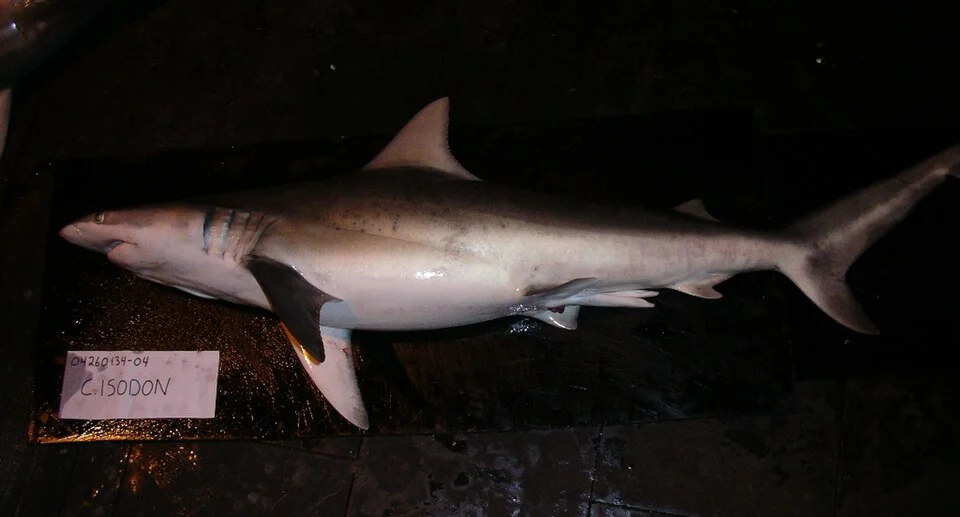
Male finetooth shark (Carcharhinus isodon) from the Gulf of Mexico
SEFSC Pascagoula Laboratory; Collection of Brandi Noble, NOAA/NMFS/SEFSC · Public domain · Image sourceProvider-generated thumbnail requested at 800 pixels; no local editing Local WebP display rendition; resized without cropping.
Open encyclopedia reference
The finetooth shark (Carcharhinus isodon) is a species of requiem shark, in the family Carcharhinidae, found in the western Atlantic Ocean, from North Carolina to Brazil. It forms large schools in shallow, coastal waters, and migrates seasonally following warm water. A relatively small, slender-bodied shark, the finetooth shark can be identified by its needle-like teeth, dark blue-gray dorsal coloration, and long gill slits. It attains a maximum length of 1.9 m (6.2 ft). The diet of this species consists primarily of small bony fishes, in particular menhaden. Like other members of its family, it is viviparous with females giving birth to two to six pups in estuarine nursery areas every other year.
Valued for its meat, the finetooth shark forms an important component of the commercial gillnet shark fishery operating off the southeastern United States. Population assessments suggest that this fishery does not currently pose a threat to U.S. populations of the species. This shark is not known to pose a danger to humans, though it snaps vigorously when captured and should be handled with caution.
Wikipedia contributors, Finetooth shark; see linked history · CC BY-SA 4.0 . Plain-text lead excerpt, at most 180 words; no infobox or later sections Retrieved 2026-10-05T04:59:09.541328+00:00. This reference remains separate from the taxonomic record.
Identity & source status
- Scientific name
- Carcharhinus isodon (Valenciennes, 1839)
- Name authority
- (Valenciennes, 1839)
- Common name
- finetooth shark
- Rank
- species
- Accepted status
- accepted
- Kingdom
- Animalia
- Phylum
- Chordata
- Class
- Elasmobranchii
- Order
- Carcharhiniformes
- Family
- Carcharhinidae
- Genus
- Carcharhinus
- Extinction status
- Not supplied by this source
Source habitat flags: Marine: yes · Freshwater: no · Terrestrial: no. These do not form a complete habitat description.
Classification family tree
Nested taxonomic groups from the source. This is not a direct-ancestor chain, a dated evolutionary tree or a phylogenetic reconstruction.
- domainEukaryota (Chatton, 1925) Whittaker & Margulis, 1978
- kingdomAnimalia
- phylumChordata
- subphylumVertebrata
- infraphylumGnathostomata
- parvphylumChondrichthyes
- classElasmobranchii
- subclassNeoselachii
- infraclassSelachii
- superorderGaleomorphi
- orderCarcharhiniformes
- familyCarcharhinidae Jordan & Evermann, 1896
- genusCarcharhinus Blainville, 1816
- speciesCarcharhinus isodon (Valenciennes, 1839)
Close classified relatives
These entries share the source’s genus, Carcharhinus. They are not necessarily the closest relatives established by molecular evidence.
| Species | Classification | Source status |
|---|---|---|
| Carcharhinus leiodon Garrick, 1985 | CarcharhinidaeChordata | Accepted speciesExtinction status not supplied |
| Carcharhinus fitzroyensis (Whitley, 1943) | CarcharhinidaeChordata | Accepted speciesExtinction status not supplied |
| hardnose sharkCarcharhinus macloti (Müller & Henle, 1839) | CarcharhinidaeChordata | Accepted speciesExtinction status not supplied |
| Carcharhinus obsoletus White, Kyne & Harris, 2019 | CarcharhinidaeChordata | Accepted speciesExtinction status not supplied |
| blacknose sharkCarcharhinus acronotus (Poey, 1860) | CarcharhinidaeChordata | Accepted speciesExtinction status not supplied |
| silvertip sharkCarcharhinus albimarginatus (Rüppell, 1837) | CarcharhinidaeChordata | Accepted speciesExtinction status not supplied |
| Carcharhinus cautus (Whitley, 1945) | CarcharhinidaeChordata | Accepted speciesExtinction status not supplied |
| Carcharhinus cerdale Gilbert, 1898 | CarcharhinidaeChordata | Accepted speciesExtinction status not supplied |
| Carcharhinus coatesi (Whitley, 1939) | CarcharhinidaeChordata | Accepted speciesExtinction status not supplied |
| whitecheek sharkCarcharhinus dussumieri (Müller & Henle, 1839) | CarcharhinidaeChordata | Accepted speciesExtinction status not supplied |
| Galapagos sharkCarcharhinus galapagensis (Snodgrass & Heller, 1905) | CarcharhinidaeChordata | Accepted speciesExtinction status not supplied |
| oceanic whitetip sharkCarcharhinus longimanus (Poey, 1861) | CarcharhinidaeChordata | Accepted speciesExtinction status not supplied |
Names & synonyms
Names explicitly linked to this accepted taxon in the source. Synonymy can change with revision.
| Recorded name | Source status |
|---|---|
| Aprionodon punctatus Gill, 1861 Gill, 1861 | synonym |
| Aprionodon isodon (Valenciennes, 1839) (Valenciennes, 1839) | synonym |
| Carcharias isodon Valenciennes, 1839 Valenciennes, 1839 | synonym |
Source literature & publication evidence
References attached to this source record, including nomenclatural citations where supplied. This is a selected bibliography; abbreviated citations remain in the source’s form.
- https://www.marinespecies.org/aphia.php?p=taxdetails&id=105791 Source fields: Taxon.tsv dwc:namePublishedIn, Taxon.tsv dcterms:references
Origins, evidence & remaining research
Name authority and publication references document nomenclature where the source supplies it. They do not establish evolutionary origins or the earliest fossil occurrence.
Specimen-level evidence, morphology, ecological research, phylogenetic studies, a comprehensive bibliography and a located literary passage have not yet been compiled for this record.
Dataset citation & attribution
This exact taxon in ChecklistBank · Catalogue of Life 2026-09-11
Catalogue of Life 2026-09-11; dataset 316321; doi:10.48580/dgz5n. https://creativecommons.org/licenses/by/4.0/ . Retrieved 5 October 2026.
Stable key: col:KV3M4. Classification follows source parent identifiers. English common names may vary by region.