
NATURAL HISTORY · CATALOGUE RECORD
Coney
Sylvilagus transitionalis (Bangs, 1895)
Source-backed taxonomic record
Accepted species in Catalogue of Life’s 11 September 2026 base release. This preserves the source classification and available supporting data; it is not a completed species monograph.
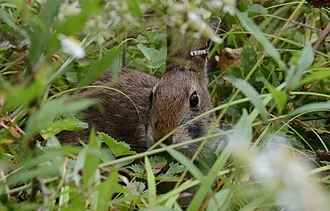
U.S. Secretary of the Interior Sally Jewell announced that a public-private partnership uniting foresters, farmers, birdwatchers, biologists, hunters and other conservationists has saved the New England cottontail from needing protection under the Endangered Species Act. The partnership has also initiated on-the-ground conservation efforts for the cottontail that will benefit the rabbit into the future. Jewell was joined by U.S. Senator Jeanne Shaheen, U.S. Fish and Wildlife Service Director Dan Ashe, U.S. Department of Agriculture Natural Resources Conservation Service Chief Jason Weller, and other conservation partners at an event to celebrate the success of the multi-state effort. Photo Credit Tami A. Heilemann
U.S. Department of the Interior · CC BY-SA 2.0 · Image sourceProvider-generated thumbnail requested at 320 pixels; no local editing Local WebP display rendition; resized without cropping.
Open encyclopedia reference
The New England cottontail (Sylvilagus transitionalis), also known as the gray rabbit, brush rabbit, wood hare, wood rabbit, or cooney, is a species of cottontail rabbit that appears in fragmented populations across New England and the state of New York, specifically from southern Maine to southern New York. This species bears a close resemblance to the eastern cottontail (Sylvilagus floridanus), which has been introduced in much of the New England cottontail home range. The eastern cottontail is now more common in it. In 2006, it was estimated that the current area of occupancy in its historic range is 12,180 km2 (4,700 sq mi) - some 86% less than the occupied range in 1960. Because of this decrease in this species' numbers and habitat, the New England cottontail is a candidate for protection under the Endangered Species Act. Cottontail hunting has been restricted in some areas where the eastern and New England cottontail species coexist in order to protect the remaining New England cottontail population.
Wikipedia contributors, New England cottontail; see linked history · CC BY-SA 4.0 . Plain-text lead excerpt, at most 180 words; no infobox or later sections Retrieved 2026-10-05T01:20:07.147964+00:00. This reference remains separate from the taxonomic record.
Identity & source status
- Scientific name
- Sylvilagus transitionalis (Bangs, 1895)
- Name authority
- (Bangs, 1895)
- Common name
- Coney
- Rank
- species
- Accepted status
- accepted
- Kingdom
- Animalia
- Phylum
- Chordata
- Class
- Mammalia
- Order
- Lagomorpha
- Family
- Leporidae
- Genus
- Sylvilagus
- Extinction status
- Recorded extant
Classification family tree
Nested taxonomic groups from the source. This is not a direct-ancestor chain, a dated evolutionary tree or a phylogenetic reconstruction.
- domainEukaryota (Chatton, 1925) Whittaker & Margulis, 1978
- kingdomAnimalia
- phylumChordata
- subphylumVertebrata
- infraphylumGnathostomata
- parvphylumOsteichthyes
- megaclassTetrapoda
- classMammalia Linnaeus, 1758
- subclassTheria Parker & Haswell, 1897
- infraclassEutheria Gill, 1872
- orderLagomorpha Brandt, 1855
- familyLeporidae Fischer, 1817
- genusSylvilagus Gray, 1867
- speciesSylvilagus transitionalis (Bangs, 1895)
Close classified relatives
These entries share the source’s genus, Sylvilagus. They are not necessarily the closest relatives established by molecular evidence.
| Species | Classification | Source status |
|---|---|---|
| Andean CottontailSylvilagus andinus (Thomas, 1897) | LeporidaeChordata | Accepted speciesRecorded extant |
| Apollinaris' CottontailSylvilagus apollinaris Thomas, 1920 | LeporidaeChordata | Accepted speciesRecorded extant |
| Cane CutterSylvilagus aquaticus (Bachman, 1837) | LeporidaeChordata | Accepted speciesRecorded extant |
| Audubon's CottontailSylvilagus audubonii (Baird, 1858) | LeporidaeChordata | Accepted speciesRecorded extant |
| Mexican CottontailSylvilagus cunicularius (Waterhouse, 1848) | LeporidaeChordata | Accepted speciesRecorded extant |
| Central American Lowland Forest CottontailSylvilagus gabbi (J. A. Allen, 1877) | LeporidaeChordata | Accepted speciesRecorded extant |
| Tres Marias CottontailSylvilagus graysoni (J. A. Allen, 1877) | LeporidaeChordata | Accepted speciesRecorded extant |
| Omilteme CottontailSylvilagus insonus (Nelson, 1904) | LeporidaeChordata | Accepted speciesRecorded extant |
| San José Brush RabbitSylvilagus mansuetus Nelson, 1907 | LeporidaeChordata | Accepted speciesRecorded extant |
| Dwarf TapetíSylvilagus tapetillus Thomas, 1913 | LeporidaeChordata | Accepted speciesRecorded extant |
| Barinas Wild RabbitSylvilagus varynaensis Durant & Guevara, 2001 | LeporidaeChordata | Accepted speciesRecorded extant |
| Brush RabbitSylvilagus bachmani (Waterhouse, 1839) | LeporidaeChordata | Accepted speciesRecorded extant |
Names & synonyms
Names explicitly linked to this accepted taxon in the source. Synonymy can change with revision.
| Recorded name | Source status |
|---|---|
| Lepus sylvaticus transitionalis Bangs, 1895 Bangs, 1895 | synonym |
Documented distribution
Source distribution statements, not a complete range map. A listed locality is not necessarily a place of origin.
Source literature & publication evidence
References attached to this source record, including nomenclatural citations where supplied. This is a selected bibliography; abbreviated citations remain in the source’s form.
- https://www.itis.gov/servlet/SingleRpt/SingleRpt?search_topic=TSN&search_value=180127 Source fields: Taxon.tsv dwc:namePublishedIn, Taxon.tsv dcterms:references
Origins, evidence & remaining research
Name authority and publication references document nomenclature where the source supplies it. They do not establish evolutionary origins or the earliest fossil occurrence.
Specimen-level evidence, morphology, ecological research, phylogenetic studies, a comprehensive bibliography and a located literary passage have not yet been compiled for this record.
Dataset citation & attribution
This exact taxon in ChecklistBank · Catalogue of Life 2026-09-11
Catalogue of Life 2026-09-11; dataset 316321; doi:10.48580/dgz5n. https://creativecommons.org/licenses/by/4.0/ . Retrieved 5 October 2026.
Stable key: col:53N9L. Classification follows source parent identifiers. English common names may vary by region.