
NATURAL HISTORY · CATALOGUE RECORD
Cane Cutter
Sylvilagus aquaticus (Bachman, 1837)
Source-backed taxonomic record
Accepted species in Catalogue of Life’s 11 September 2026 base release. This preserves the source classification and available supporting data; it is not a completed species monograph.
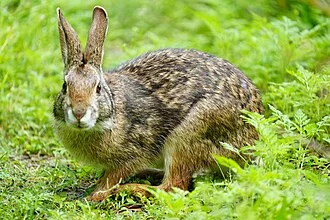
Swamp Rabbit (Sylvilagus aquaticus) in the United States
Brandon Johnson · CC BY 4.0 · Image sourceProvider-generated thumbnail requested at 320 pixels; no local editing Local WebP display rendition; resized without cropping.
Open encyclopedia reference
The swamp rabbit (Sylvilagus aquaticus), also known as the cane cutter, swamper, or cane jake, is a species of cottontail rabbit found in the swamps and wetlands of the southern United States. It is herbivorous, territorial, and nocturnal. The largest of the cottontail rabbits, it is similar in appearance to the eastern cottontail, but has distinctly smaller ears and orange-colored hind legs. Swamp rabbits are closely related to the marsh rabbit. The two species likely separated during the Pleistocene epoch. The swamp rabbit is most abundant in Alabama, Mississippi, and Louisiana, and also inhabits South Carolina, Arkansas, Tennessee, Texas, Oklahoma, Missouri, Kentucky, Illinois, Indiana, Georgia. Its habitat is largely dominated by regions near lowland water. Unlike other cottontail rabbits, the swamp rabbit is territorial and maintains a social order between higher- and lower-ranking males and females via displays of dominance, vocalizations, and occasional fighting. This rabbit is unique in that it ventures into water on its own, unlike other Texas rabbits, and is rarely spotted during the day due to its secretive nature.
Wikipedia contributors, Swamp rabbit; see linked history · CC BY-SA 4.0 . Plain-text lead excerpt, at most 180 words; no infobox or later sections Retrieved 2026-10-05T02:11:27.172873+00:00. This reference remains separate from the taxonomic record.
Identity & source status
- Scientific name
- Sylvilagus aquaticus (Bachman, 1837)
- Name authority
- (Bachman, 1837)
- Common name
- Cane Cutter
- Rank
- species
- Accepted status
- accepted
- Kingdom
- Animalia
- Phylum
- Chordata
- Class
- Mammalia
- Order
- Lagomorpha
- Family
- Leporidae
- Genus
- Sylvilagus
- Extinction status
- Recorded extant
Classification family tree
Nested taxonomic groups from the source. This is not a direct-ancestor chain, a dated evolutionary tree or a phylogenetic reconstruction.
- domainEukaryota (Chatton, 1925) Whittaker & Margulis, 1978
- kingdomAnimalia
- phylumChordata
- subphylumVertebrata
- infraphylumGnathostomata
- parvphylumOsteichthyes
- megaclassTetrapoda
- classMammalia Linnaeus, 1758
- subclassTheria Parker & Haswell, 1897
- infraclassEutheria Gill, 1872
- orderLagomorpha Brandt, 1855
- familyLeporidae Fischer, 1817
- genusSylvilagus Gray, 1867
- speciesSylvilagus aquaticus (Bachman, 1837)
Close classified relatives
These entries share the source’s genus, Sylvilagus. They are not necessarily the closest relatives established by molecular evidence.
| Species | Classification | Source status |
|---|---|---|
| Andean CottontailSylvilagus andinus (Thomas, 1897) | LeporidaeChordata | Accepted speciesRecorded extant |
| Apollinaris' CottontailSylvilagus apollinaris Thomas, 1920 | LeporidaeChordata | Accepted speciesRecorded extant |
| Audubon's CottontailSylvilagus audubonii (Baird, 1858) | LeporidaeChordata | Accepted speciesRecorded extant |
| Mexican CottontailSylvilagus cunicularius (Waterhouse, 1848) | LeporidaeChordata | Accepted speciesRecorded extant |
| Central American Lowland Forest CottontailSylvilagus gabbi (J. A. Allen, 1877) | LeporidaeChordata | Accepted speciesRecorded extant |
| Tres Marias CottontailSylvilagus graysoni (J. A. Allen, 1877) | LeporidaeChordata | Accepted speciesRecorded extant |
| Omilteme CottontailSylvilagus insonus (Nelson, 1904) | LeporidaeChordata | Accepted speciesRecorded extant |
| San José Brush RabbitSylvilagus mansuetus Nelson, 1907 | LeporidaeChordata | Accepted speciesRecorded extant |
| Dwarf TapetíSylvilagus tapetillus Thomas, 1913 | LeporidaeChordata | Accepted speciesRecorded extant |
| ConeySylvilagus transitionalis (Bangs, 1895) | LeporidaeChordata | Accepted speciesRecorded extant |
| Barinas Wild RabbitSylvilagus varynaensis Durant & Guevara, 2001 | LeporidaeChordata | Accepted speciesRecorded extant |
| Brush RabbitSylvilagus bachmani (Waterhouse, 1839) | LeporidaeChordata | Accepted speciesRecorded extant |
Names & synonyms
Names explicitly linked to this accepted taxon in the source. Synonymy can change with revision.
| Recorded name | Source status |
|---|---|
| Lepus aquaticus Bachman, 1837 Bachman, 1837 | synonym |
Documented distribution
Source distribution statements, not a complete range map. A listed locality is not necessarily a place of origin.
Source literature & publication evidence
References attached to this source record, including nomenclatural citations where supplied. This is a selected bibliography; abbreviated citations remain in the source’s form.
- https://www.itis.gov/servlet/SingleRpt/SingleRpt?search_topic=TSN&search_value=180121 Source fields: Taxon.tsv dwc:namePublishedIn, Taxon.tsv dcterms:references
Origins, evidence & remaining research
Name authority and publication references document nomenclature where the source supplies it. They do not establish evolutionary origins or the earliest fossil occurrence.
Specimen-level evidence, morphology, ecological research, phylogenetic studies, a comprehensive bibliography and a located literary passage have not yet been compiled for this record.
Dataset citation & attribution
This exact taxon in ChecklistBank · Catalogue of Life 2026-09-11
Catalogue of Life 2026-09-11; dataset 316321; doi:10.48580/dgz5n. https://creativecommons.org/licenses/by/4.0/ . Retrieved 5 October 2026.
Stable key: col:53N8N. Classification follows source parent identifiers. English common names may vary by region.