
NATURAL HISTORY · CATALOGUE RECORD
Tawny Owl
Strix aluco Linnaeus, 1758
Source-backed taxonomic record
Accepted species in Catalogue of Life’s 11 September 2026 base release. This preserves the source classification and available supporting data; it is not a completed species monograph.
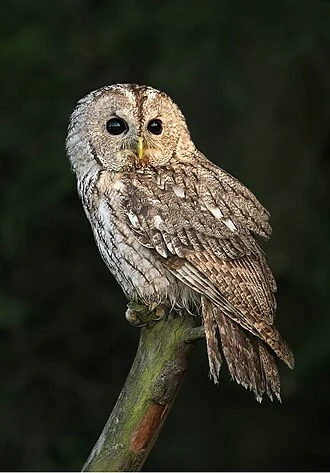
Strix aluco, Žďárské vrchy, CZ
Martin Mecnarowski (http://www.photomecan.eu/) · CC BY-SA 3.0 · Image sourceProvider-generated thumbnail requested at 320 pixels; no local editing Local WebP display rendition; resized without cropping.
Open encyclopedia reference
The tawny owl (Strix aluco), also called the brown owl, is a stocky, medium-sized owl in the family Strigidae. It is commonly found in woodlands across Europe, as well as western Siberia, and has seven recognized subspecies. The tawny owl's underparts are pale with dark streaks, whilst its upper body may be either brown or grey (in several subspecies, individuals may be of both colours). The tawny owl typically makes its nest in a tree hole where it can protect its eggs and young against potential predators. It is non-migratory and highly territorial: as a result, when young birds grow up and leave the parental nest, if they cannot find a vacant territory to claim as their own, they will often starve. The tawny owl is a nocturnal bird of prey. It is able to hunt successfully at night because of its vision, hearing adaptations and ability to fly silently. It usually hunts by dropping suddenly from a perch and seizing its prey, which it swallows whole.
Wikipedia contributors, Tawny owl; see linked history · CC BY-SA 4.0 . Plain-text lead excerpt, at most 180 words; no infobox or later sections Retrieved 2026-10-05T01:46:54.539834+00:00. This reference remains separate from the taxonomic record.
Identity & source status
- Scientific name
- Strix aluco Linnaeus, 1758
- Name authority
- Linnaeus, 1758
- Common name
- Tawny Owl
- Rank
- species
- Accepted status
- accepted
- Kingdom
- Animalia
- Phylum
- Chordata
- Class
- Aves
- Order
- Strigiformes
- Family
- Strigidae
- Genus
- Strix
- Extinction status
- Recorded extant
Classification family tree
Nested taxonomic groups from the source. This is not a direct-ancestor chain, a dated evolutionary tree or a phylogenetic reconstruction.
- domainEukaryota (Chatton, 1925) Whittaker & Margulis, 1978
- kingdomAnimalia
- phylumChordata
- subphylumVertebrata
- infraphylumGnathostomata
- parvphylumOsteichthyes
- megaclassTetrapoda
- classAves
- orderStrigiformes
- familyStrigidae
- subfamilyStriginae
- genusStrix Linnaeus, 1758
- speciesStrix aluco Linnaeus, 1758
Close classified relatives
These entries share the source’s genus, Strix. They are not necessarily the closest relatives established by molecular evidence.
| Species | Classification | Source status |
|---|---|---|
| Rufous-banded OwlStrix albitarsis (Bonaparte, 1850) | StrigidaeChordata | Accepted speciesRecorded extant |
| Hume's OwlStrix butleri (Hume, 1878) | StrigidaeChordata | Accepted speciesRecorded extant |
| Fulvous OwlStrix fulvescens (P. L. Sclater & Salvin, 1868) | StrigidaeChordata | Accepted speciesRecorded extant |
| Black-and-white OwlStrix nigrolineata (P. L. Sclater, 1859) | StrigidaeChordata | Accepted speciesRecorded extant |
| Ural OwlStrix uralensis Pallas, 1771 | StrigidaeChordata | Accepted speciesRecorded extant |
| Barred OwlStrix varia Barton, 1799 | StrigidaeChordata | Accepted speciesRecorded extant |
| African Wood OwlStrix woodfordii (A. Smith, 1834) | StrigidaeChordata | Accepted speciesRecorded extant |
| Maghreb OwlStrix mauritanica (Witherby, 1905) | StrigidaeChordata | Accepted speciesRecorded extant |
| Chaco OwlStrix chacoensis Cherrie & Reichenberger, 1921 | StrigidaeChordata | Accepted speciesRecorded extant |
| Black-banded OwlStrix huhula Daudin, 1800 | StrigidaeChordata | Accepted speciesRecorded extant |
| Rusty-barred OwlStrix hylophila Temminck, 1825 | StrigidaeChordata | Accepted speciesRecorded extant |
| Himalayan OwlStrix nivicolum (Blyth, 1845) | StrigidaeChordata | Accepted speciesRecorded extant |
Documented distribution
Source distribution statements, not a complete range map. A listed locality is not necessarily a place of origin.
Southern Asia
Source literature & publication evidence
References attached to this source record, including nomenclatural citations where supplied. This is a selected bibliography; abbreviated citations remain in the source’s form.
- Linnaeus, & Carolus. (1758). Systema Naturae per Regna Tria Naturae, Secundum Classes, Ordines, Genera, Species, Cum Characteribus, Differentiis, Synonymis, Locis, 10th Edition, Vol. 1. Source fields: Taxon.tsv dwc:namePublishedIn, Taxon.tsv dcterms:references
Origins, evidence & remaining research
Name authority and publication references document nomenclature where the source supplies it. They do not establish evolutionary origins or the earliest fossil occurrence.
Specimen-level evidence, morphology, ecological research, phylogenetic studies, a comprehensive bibliography and a located literary passage have not yet been compiled for this record.
Dataset citation & attribution
This exact taxon in ChecklistBank · Catalogue of Life 2026-09-11
Catalogue of Life 2026-09-11; dataset 316321; doi:10.48580/dgz5n. https://creativecommons.org/licenses/by/4.0/ . Retrieved 5 October 2026.
Stable key: col:532G9. Classification follows source parent identifiers. English common names may vary by region.