
NATURAL HISTORY · CATALOGUE RECORD
Chacma Baboon
Papio ursinus (Kerr, 1792)
Source-backed taxonomic record
Accepted species in Catalogue of Life’s 11 September 2026 base release. This preserves the source classification and available supporting data; it is not a completed species monograph.
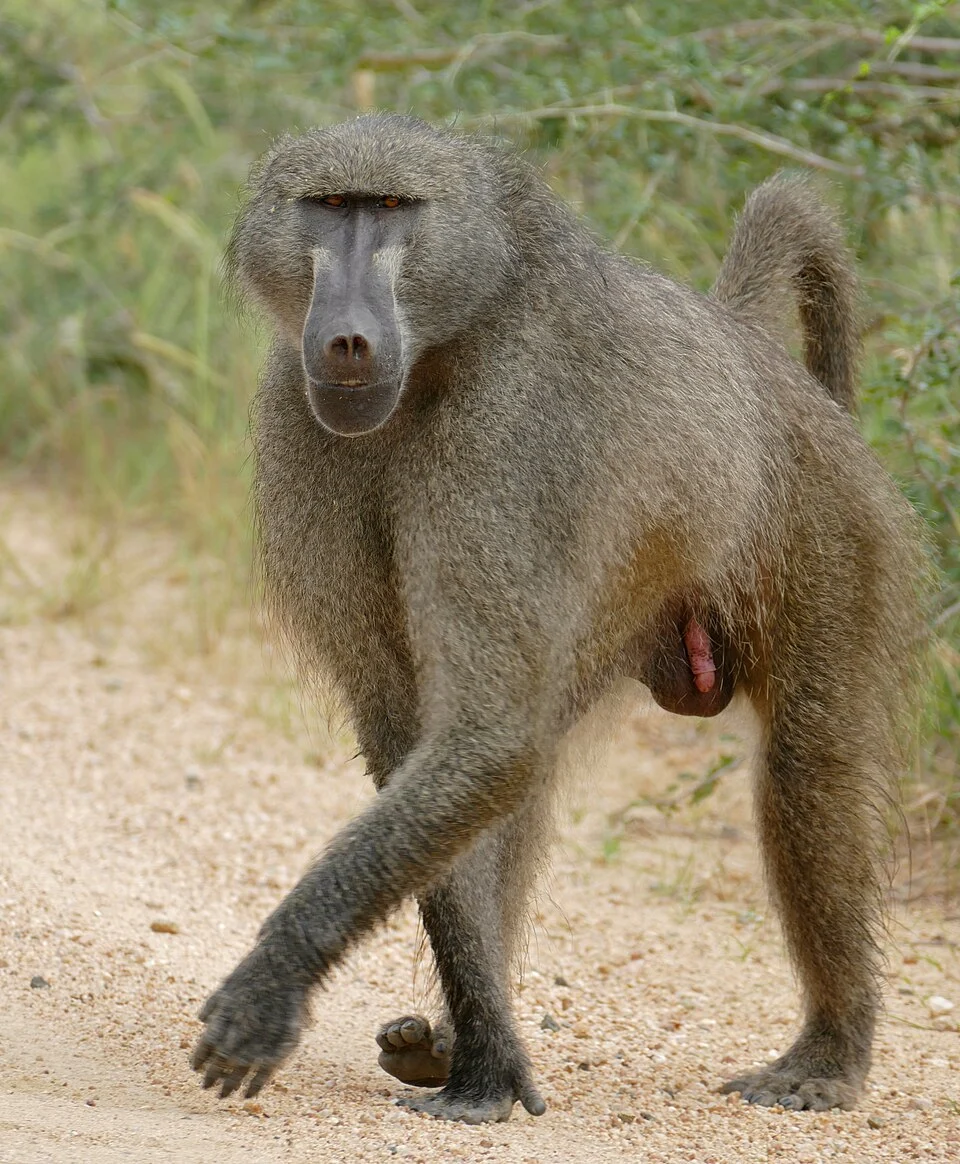
S140 Road East of Orpen, Kruger NP, SOUTH AFRICA
Bernard DUPONT from FRANCE · CC BY-SA 2.0 · Image sourceProvider-generated thumbnail requested at 800 pixels; no local editing Local WebP display rendition; resized without cropping.
Open encyclopedia reference
The chacma baboon (Papio ursinus), also known as the Cape baboon, is, like all other baboons, from the Old World monkey family. It is one of the largest of all monkeys. Located primarily in southern Africa, the chacma baboon has a wide variety of social behaviours, including a dominance hierarchy, collective foraging, adoption of young by females, and friendship pairings. These behaviors form parts of a complex evolutionary ecology. In general, the species is not threatened, but human population pressure has increased contact between humans and baboons. Hunting, trapping, and accidents kill or remove many baboons from the wild, thereby reducing baboon numbers and disrupting their social structure.
Wikipedia contributors, Chacma baboon; see linked history · CC BY-SA 4.0 . Plain-text lead excerpt, at most 180 words; no infobox or later sections Retrieved 2026-10-05T03:02:15.388623+00:00. This reference remains separate from the taxonomic record.
Identity & source status
- Scientific name
- Papio ursinus (Kerr, 1792)
- Name authority
- (Kerr, 1792)
- Common name
- Chacma Baboon
- Rank
- species
- Accepted status
- accepted
- Kingdom
- Animalia
- Phylum
- Chordata
- Class
- Mammalia
- Order
- Primates
- Family
- Cercopithecidae
- Genus
- Papio
- Extinction status
- Recorded extant
Classification family tree
Nested taxonomic groups from the source. This is not a direct-ancestor chain, a dated evolutionary tree or a phylogenetic reconstruction.
- domainEukaryota (Chatton, 1925) Whittaker & Margulis, 1978
- kingdomAnimalia
- phylumChordata
- subphylumVertebrata
- infraphylumGnathostomata
- parvphylumOsteichthyes
- megaclassTetrapoda
- classMammalia Linnaeus, 1758
- subclassTheria Parker & Haswell, 1897
- infraclassEutheria Gill, 1872
- orderPrimates Linnaeus, 1758
- suborderHaplorrhini Pocock, 1918
- infraorderSimiiformes Haeckel, 1866
- superfamilyCercopithecoidea Gray, 1821
- familyCercopithecidae Gray, 1821
- subfamilyCercopithecinae Gray, 1821
- tribePapionini
- genusPapio Erxleben, 1777
- speciesPapio ursinus (Kerr, 1792)
Close classified relatives
These entries share the source’s genus, Papio. They are not necessarily the closest relatives established by molecular evidence.
| Species | Classification | Source status |
|---|---|---|
| Olive BaboonPapio anubis (Lesson, 1827) | CercopithecidaeChordata | Accepted speciesRecorded extant |
| Yellow BaboonPapio cynocephalus (Linnaeus, 1766) | CercopithecidaeChordata | Accepted speciesRecorded extant |
| Hamadryas BaboonPapio hamadryas (Linnaeus, 1758) | CercopithecidaeChordata | Accepted speciesRecorded extant |
| Kinda BaboonPapio kindae Lönnberg, 1919 | CercopithecidaeChordata | Accepted speciesRecorded extant |
Documented distribution
Source distribution statements, not a complete range map. A listed locality is not necessarily a place of origin.
Source literature & publication evidence
References attached to this source record, including nomenclatural citations where supplied. This is a selected bibliography; abbreviated citations remain in the source’s form.
- https://www.itis.gov/servlet/SingleRpt/SingleRpt?search_topic=TSN&search_value=944210 Source fields: Taxon.tsv dwc:namePublishedIn, Taxon.tsv dcterms:references
Origins, evidence & remaining research
Name authority and publication references document nomenclature where the source supplies it. They do not establish evolutionary origins or the earliest fossil occurrence.
Specimen-level evidence, morphology, ecological research, phylogenetic studies, a comprehensive bibliography and a located literary passage have not yet been compiled for this record.
Dataset citation & attribution
This exact taxon in ChecklistBank · Catalogue of Life 2026-09-11
Catalogue of Life 2026-09-11; dataset 316321; doi:10.48580/dgz5n. https://creativecommons.org/licenses/by/4.0/ . Retrieved 5 October 2026.
Stable key: col:4CKZP. Classification follows source parent identifiers. English common names may vary by region.