
NATURAL HISTORY · CATALOGUE RECORD
Moupin Pika
Ochotona (Ochotona) thibetana (A. Milne-Edwards, 1871)
Source-backed taxonomic record
Accepted species in Catalogue of Life’s 11 September 2026 base release. This preserves the source classification and available supporting data; it is not a completed species monograph.
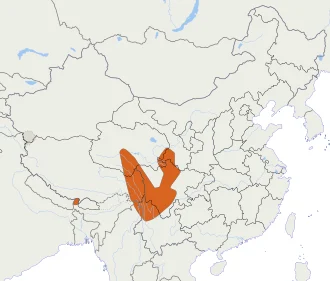
Range area of Moupin pika (Ochotona thibetana). Important note: The original IUCN Red List spatial data contained several mistakes due to inaccurate processing with data obtained prior to transfer of two subspecies to Ochotona nubrica. These mistakes were admitted by Andrew Smith's team in course of personal correspondence with Zorog.
A. T. Smith, A. F. Boyer – original assessment Canuckguy et al. – creation of the blank map Mithril – graphics Zorog – scientific advisor · CC BY-SA 3.0 · Image sourceProvider-generated thumbnail requested at 320 pixels; no local editing Local WebP display rendition; resized without cropping.
Open encyclopedia reference
The Moupin pika (Ochotona thibetana), also known as Moupin-pika, and Manipuri pika, is a species of mammal in the pika family, Ochotonidae. It has many subspecies, some of which may be distinct species. Its summer pelage is dark russet-brown with some light spots on the dorsal side, and ochraceous buff tinged on the belly. In winter it is lighter, with buff to dull brown dorsal pelage. A generalist herbivore, it is found in the mountains of the eastern Tibetan Plateau in China (Gansu, southern Qinghai, Yunnan, and Sichuan), Bhutan, India (Sikkim), and northern Myanmar. Both the International Union for Conservation of Nature Red List of Endangered Species and the Red List of China's Vertebrates classify it as a species of least concern; although one subspecies may be endangered.
Wikipedia contributors, Moupin pika; see linked history · CC BY-SA 4.0 . Plain-text lead excerpt, at most 180 words; no infobox or later sections Retrieved 2026-10-05T02:14:47.266064+00:00. This reference remains separate from the taxonomic record.
Identity & source status
- Scientific name
- Ochotona (Ochotona) thibetana (A. Milne-Edwards, 1871)
- Name authority
- (A. Milne-Edwards, 1871)
- Common name
- Moupin Pika
- Rank
- species
- Accepted status
- accepted
- Kingdom
- Animalia
- Phylum
- Chordata
- Class
- Mammalia
- Order
- Lagomorpha
- Family
- Ochotonidae
- Genus
- Ochotona
- Extinction status
- Recorded extant
Classification family tree
Nested taxonomic groups from the source. This is not a direct-ancestor chain, a dated evolutionary tree or a phylogenetic reconstruction.
- domainEukaryota (Chatton, 1925) Whittaker & Margulis, 1978
- kingdomAnimalia
- phylumChordata
- subphylumVertebrata
- infraphylumGnathostomata
- parvphylumOsteichthyes
- megaclassTetrapoda
- classMammalia Linnaeus, 1758
- subclassTheria Parker & Haswell, 1897
- infraclassEutheria Gill, 1872
- orderLagomorpha Brandt, 1855
- familyOchotonidae Thomas, 1897
- genusOchotona Link, 1795
- subgenusOchotona Link, 1795
- speciesOchotona (Ochotona) thibetana (A. Milne-Edwards, 1871)
Close classified relatives
These entries share the source’s genus, Ochotona. They are not necessarily the closest relatives established by molecular evidence.
| Species | Classification | Source status |
|---|---|---|
| Alpine PikaOchotona (Pika) alpina (Pallas, 1773) | OchotonidaeChordata | Accepted speciesRecorded extant |
| Gansu PikaOchotona (Ochotona) cansus Lyon, 1907 | OchotonidaeChordata | Accepted speciesRecorded extant |
| Black-lipped PikaOchotona (Ochotona) curzoniae (Hodgson, 1858) | OchotonidaeChordata | Accepted speciesRecorded extant |
| Forrest's PikaOchotona (Conothoa) forresti Thomas, 1923 | OchotonidaeChordata | Accepted speciesRecorded extant |
| Glover's PikaOchotona (Conothoa) gloveri Thomas, 1922 | OchotonidaeChordata | Accepted speciesRecorded extant |
| Northern PikaOchotona (Pika) hyperborea (Pallas, 1811) | OchotonidaeChordata | Accepted speciesRecorded extant |
| Large-eared PikaOchotona (Conothoa) macrotis (Günther, 1875) | OchotonidaeChordata | Accepted speciesRecorded extant |
| Ochotona (Pika) mantchurica Thomas, 1909 | OchotonidaeChordata | Accepted speciesRecorded extant |
| Nubra PikaOchotona (Ochotona) nubrica Thomas, 1922 | OchotonidaeChordata | Accepted speciesRecorded extant |
| Ochotona (Pika) opaca Argyropulo, 1939 | OchotonidaeChordata | Accepted speciesRecorded extant |
| Mongolian PikaOchotona (Pika) pallasi (Gray, 1867) | OchotonidaeChordata | Accepted speciesRecorded extant |
| Little PikaOchotona (Lagotona) pusilla (Pallas, 1769) | OchotonidaeChordata | Accepted speciesRecorded extant |
Documented distribution
Source distribution statements, not a complete range map. A listed locality is not necessarily a place of origin.
Source literature & publication evidence
References attached to this source record, including nomenclatural citations where supplied. This is a selected bibliography; abbreviated citations remain in the source’s form.
- https://www.itis.gov/servlet/SingleRpt/SingleRpt?search_topic=TSN&search_value=625333 Source fields: Taxon.tsv dwc:namePublishedIn, Taxon.tsv dcterms:references
Origins, evidence & remaining research
Name authority and publication references document nomenclature where the source supplies it. They do not establish evolutionary origins or the earliest fossil occurrence.
Specimen-level evidence, morphology, ecological research, phylogenetic studies, a comprehensive bibliography and a located literary passage have not yet been compiled for this record.
Dataset citation & attribution
This exact taxon in ChecklistBank · Catalogue of Life 2026-09-11
Catalogue of Life 2026-09-11; dataset 316321; doi:10.48580/dgz5n. https://creativecommons.org/licenses/by/4.0/ . Retrieved 5 October 2026.
Stable key: col:48DGZ. Classification follows source parent identifiers. English common names may vary by region.