
NATURAL HISTORY · CATALOGUE RECORD
domestic ferret
Mustela furo Linnaeus, 1758
Source-backed taxonomic record
Accepted species in Catalogue of Life’s 11 September 2026 base release. This preserves the source classification and available supporting data; it is not a completed species monograph.
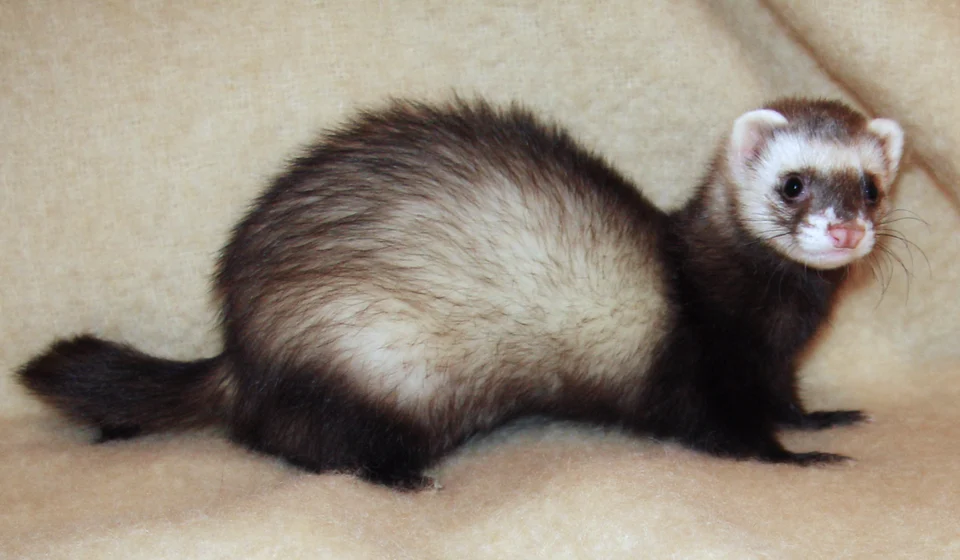
An image of a pet ferret.
Alfredo Gutiérrez · CC BY-SA 4.0 · Image sourceProvider-generated thumbnail requested at 800 pixels; no local editing Local WebP display rendition; resized without cropping.
Open encyclopedia reference
The ferret (Mustela furo) is a small, domesticated species belonging to the family Mustelidae. The ferret is most likely a domesticated form of the wild European polecat (Mustela putorius), as evidenced by the ferret's ability to interbreed with European polecats and produce hybrid offspring. Physically, ferrets resemble other mustelids because of their long, slender bodies. Including their tail, the average length of a ferret is about 50 cm (20 in); they weigh between 0.7 and 2.0 kg (1.5 and 4.4 lb); and their fur can be black, brown, white, or a mixture of those colours. The species is sexually dimorphic, with males being considerably larger than females. Ferrets may have been domesticated since ancient times, but there is widespread disagreement because of the sparseness of written accounts and the inconsistency of those which survive. Contemporary scholarship agrees that ferrets were bred for sport, hunting rabbits in a practice known as rabbiting. In North America, the ferret has become an increasingly prominent choice of household pet, with over five million in the United States alone.
Wikipedia contributors, Ferret; see linked history · CC BY-SA 4.0 . Plain-text lead excerpt, at most 180 words; no infobox or later sections Retrieved 2026-10-05T04:26:20.461861+00:00. This reference remains separate from the taxonomic record.
Identity & source status
- Scientific name
- Mustela furo Linnaeus, 1758
- Name authority
- Linnaeus, 1758
- Common name
- domestic ferret
- Rank
- species
- Accepted status
- accepted
- Kingdom
- Animalia
- Phylum
- Chordata
- Class
- Mammalia
- Order
- Carnivora
- Family
- Mustelidae
- Genus
- Mustela
- Extinction status
- Recorded extant
Classification family tree
Nested taxonomic groups from the source. This is not a direct-ancestor chain, a dated evolutionary tree or a phylogenetic reconstruction.
- domainEukaryota (Chatton, 1925) Whittaker & Margulis, 1978
- kingdomAnimalia
- phylumChordata
- subphylumVertebrata
- infraphylumGnathostomata
- parvphylumOsteichthyes
- megaclassTetrapoda
- classMammalia Linnaeus, 1758
- subclassTheria Parker & Haswell, 1897
- infraclassEutheria Gill, 1872
- orderCarnivora Bowdich, 1821
- suborderCaniformia Kretzoi, 1938
- familyMustelidae G. Fischer von Waldheim, 1817
- subfamilyMustelinae G. Fischer von Waldheim, 1817
- genusMustela Linnaeus, 1758
- speciesMustela furo Linnaeus, 1758
Close classified relatives
These entries share the source’s genus, Mustela. They are not necessarily the closest relatives established by molecular evidence.
| Species | Classification | Source status |
|---|---|---|
| Japanese WeaselMustela itatsi Temminck, 1844 | MustelidaeChordata | Accepted speciesRecorded extant |
| European MinkMustela lutreola (Linnaeus, 1761) | MustelidaeChordata | Accepted speciesRecorded extant |
| Indonesian Mountain WeaselMustela lutreolina Robinson & Thomas, 1917 | MustelidaeChordata | Accepted speciesRecorded extant |
| Malay WeaselMustela nudipes Desmarest, 1822 | MustelidaeChordata | Accepted speciesRecorded extant |
| European PolecatMustela putorius Linnaeus, 1758 | MustelidaeChordata | Accepted speciesRecorded extant |
| Missing-toothed Pygmy WeaselMustela aistoodonnivalis Wu & Kao, 1991 | MustelidaeChordata | Accepted speciesRecorded extant |
| Altai Mountain WeaselMustela altaica Pallas, 1811 | MustelidaeChordata | Accepted speciesRecorded extant |
| ErmineMustela erminea Linnaeus, 1758 | MustelidaeChordata | Accepted speciesRecorded extant |
| Steppe PolecatMustela eversmanii Lesson, 1827 | MustelidaeChordata | Accepted speciesRecorded extant |
| Black-footed FerretMustela nigripes (Audubon & Bachman, 1851) | MustelidaeChordata | Accepted speciesRecorded extinct |
| Least WeaselMustela nivalis Linnaeus, 1766 | MustelidaeChordata | Accepted speciesRecorded extant |
| Siberian WeaselMustela sibirica Pallas, 1773 | MustelidaeChordata | Accepted speciesRecorded extant |
Names & synonyms
Names explicitly linked to this accepted taxon in the source. Synonymy can change with revision.
| Recorded name | Source status |
|---|---|
| Mustela putorius furo Linnaeus, 1758 Linnaeus, 1758 | synonym |
Documented distribution
Source distribution statements, not a complete range map. A listed locality is not necessarily a place of origin.
Australia
Caribbean
Europe & Northern Asia (excluding China)
Middle America
North America
South America
Southern Asia
Source literature & publication evidence
References attached to this source record, including nomenclatural citations where supplied. This is a selected bibliography; abbreviated citations remain in the source’s form.
- https://www.itis.gov/servlet/SingleRpt/SingleRpt?search_topic=TSN&search_value=1086143 Source fields: Taxon.tsv dwc:namePublishedIn, Taxon.tsv dcterms:references
Origins, evidence & remaining research
Name authority and publication references document nomenclature where the source supplies it. They do not establish evolutionary origins or the earliest fossil occurrence.
Specimen-level evidence, morphology, ecological research, phylogenetic studies, a comprehensive bibliography and a located literary passage have not yet been compiled for this record.
Dataset citation & attribution
This exact taxon in ChecklistBank · Catalogue of Life 2026-09-11
Catalogue of Life 2026-09-11; dataset 316321; doi:10.48580/dgz5n. https://creativecommons.org/licenses/by/4.0/ . Retrieved 5 October 2026.
Stable key: col:44QWQ. Classification follows source parent identifiers. English common names may vary by region.