
NATURAL HISTORY · CATALOGUE RECORD
Steppe Polecat
Mustela eversmanii Lesson, 1827
Source-backed taxonomic record
Accepted species in Catalogue of Life’s 11 September 2026 base release. This preserves the source classification and available supporting data; it is not a completed species monograph.
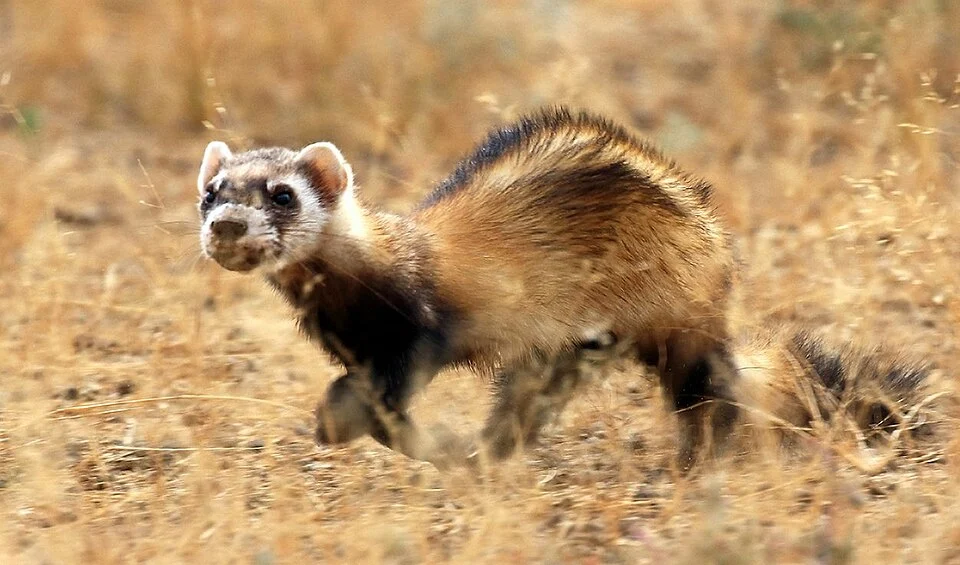
Wild steppe polecat at the Stepnoi Sanctuary, Astrakhan oblast, Russia
Andrey Giljov · CC BY-SA 4.0 · Image sourceProvider-generated thumbnail requested at 800 pixels; no local editing Local WebP display rendition; resized without cropping.
Open encyclopedia reference
The steppe polecat (Mustela eversmanii), also known as the white or masked polecat, is a species of mustelid native to Central and Eastern Europe and Central and East Asia. It is listed as Least Concern on the IUCN Red List because of its wide distribution, occurrence in a number of protected areas, and tolerance to some degree of habitat modification.
It is generally of a very light yellowish colour, with dark limbs and a dark mask across the face. Compared to its relative, the European polecat, the steppe polecat is larger in size and has a more powerfully built skull.
The steppe polecat is a nomadic animal which typically only settles in one area until its prey, mainly ground squirrels, are extirpated. It mates from March to May, and generally gives birth to litters of three to six kits, which attain their full growth at the age of two years. It hunts for larger prey than the European polecat, including pikas and marmots.
Wikipedia contributors, Steppe polecat; see linked history · CC BY-SA 4.0 . Plain-text lead excerpt, at most 180 words; no infobox or later sections Retrieved 2026-10-05T03:46:42.271977+00:00. This reference remains separate from the taxonomic record.
Identity & source status
- Scientific name
- Mustela eversmanii Lesson, 1827
- Name authority
- Lesson, 1827
- Common name
- Steppe Polecat
- Rank
- species
- Accepted status
- accepted
- Kingdom
- Animalia
- Phylum
- Chordata
- Class
- Mammalia
- Order
- Carnivora
- Family
- Mustelidae
- Genus
- Mustela
- Extinction status
- Recorded extant
Classification family tree
Nested taxonomic groups from the source. This is not a direct-ancestor chain, a dated evolutionary tree or a phylogenetic reconstruction.
- domainEukaryota (Chatton, 1925) Whittaker & Margulis, 1978
- kingdomAnimalia
- phylumChordata
- subphylumVertebrata
- infraphylumGnathostomata
- parvphylumOsteichthyes
- megaclassTetrapoda
- classMammalia Linnaeus, 1758
- subclassTheria Parker & Haswell, 1897
- infraclassEutheria Gill, 1872
- orderCarnivora Bowdich, 1821
- suborderCaniformia Kretzoi, 1938
- familyMustelidae G. Fischer von Waldheim, 1817
- subfamilyMustelinae G. Fischer von Waldheim, 1817
- genusMustela Linnaeus, 1758
- speciesMustela eversmanii Lesson, 1827
Close classified relatives
These entries share the source’s genus, Mustela. They are not necessarily the closest relatives established by molecular evidence.
| Species | Classification | Source status |
|---|---|---|
| domestic ferretMustela furo Linnaeus, 1758 | MustelidaeChordata | Accepted speciesRecorded extant |
| Japanese WeaselMustela itatsi Temminck, 1844 | MustelidaeChordata | Accepted speciesRecorded extant |
| European MinkMustela lutreola (Linnaeus, 1761) | MustelidaeChordata | Accepted speciesRecorded extant |
| Indonesian Mountain WeaselMustela lutreolina Robinson & Thomas, 1917 | MustelidaeChordata | Accepted speciesRecorded extant |
| Malay WeaselMustela nudipes Desmarest, 1822 | MustelidaeChordata | Accepted speciesRecorded extant |
| European PolecatMustela putorius Linnaeus, 1758 | MustelidaeChordata | Accepted speciesRecorded extant |
| Missing-toothed Pygmy WeaselMustela aistoodonnivalis Wu & Kao, 1991 | MustelidaeChordata | Accepted speciesRecorded extant |
| Altai Mountain WeaselMustela altaica Pallas, 1811 | MustelidaeChordata | Accepted speciesRecorded extant |
| ErmineMustela erminea Linnaeus, 1758 | MustelidaeChordata | Accepted speciesRecorded extant |
| Black-footed FerretMustela nigripes (Audubon & Bachman, 1851) | MustelidaeChordata | Accepted speciesRecorded extinct |
| Least WeaselMustela nivalis Linnaeus, 1766 | MustelidaeChordata | Accepted speciesRecorded extant |
| Siberian WeaselMustela sibirica Pallas, 1773 | MustelidaeChordata | Accepted speciesRecorded extant |
Names & synonyms
Names explicitly linked to this accepted taxon in the source. Synonymy can change with revision.
| Recorded name | Source status |
|---|---|
| Mustela eversmanii amurensis (Ognev, 1930) (Ognev, 1930) | synonym |
| Mustela eversmanii eversmanii Lesson, 1827 Lesson, 1827 | synonym |
| Mustela eversmanii michnoi (Kastschenko, 1910) (Kastschenko, 1910) | synonym |
| Mustela eversmanii talassicus Ognev, 1928 Ognev, 1928 | synonym |
| Mustela eversmanii hungarica Éhik, 1928 Éhik, 1928 | synonym |
| Mustela eversmannii Lesson, 1827 Lesson, 1827 | synonym |
| Mustela eversmanii admirata (Pocock, 1936) (Pocock, 1936) | synonym |
| Mustela eversmanii larvatus (Hodgson, 1849) (Hodgson, 1849) | synonym |
Documented distribution
Source distribution statements, not a complete range map. A listed locality is not necessarily a place of origin.
Southern Asia
Source literature & publication evidence
References attached to this source record, including nomenclatural citations where supplied. This is a selected bibliography; abbreviated citations remain in the source’s form.
- https://www.itis.gov/servlet/SingleRpt/SingleRpt?search_topic=TSN&search_value=726280 Source fields: Taxon.tsv dwc:namePublishedIn, Taxon.tsv dcterms:references
Origins, evidence & remaining research
Name authority and publication references document nomenclature where the source supplies it. They do not establish evolutionary origins or the earliest fossil occurrence.
Specimen-level evidence, morphology, ecological research, phylogenetic studies, a comprehensive bibliography and a located literary passage have not yet been compiled for this record.
Dataset citation & attribution
This exact taxon in ChecklistBank · Catalogue of Life 2026-09-11
Catalogue of Life 2026-09-11; dataset 316321; doi:10.48580/dgz5n. https://creativecommons.org/licenses/by/4.0/ . Retrieved 5 October 2026.
Stable key: col:44QWJ. Classification follows source parent identifiers. English common names may vary by region.