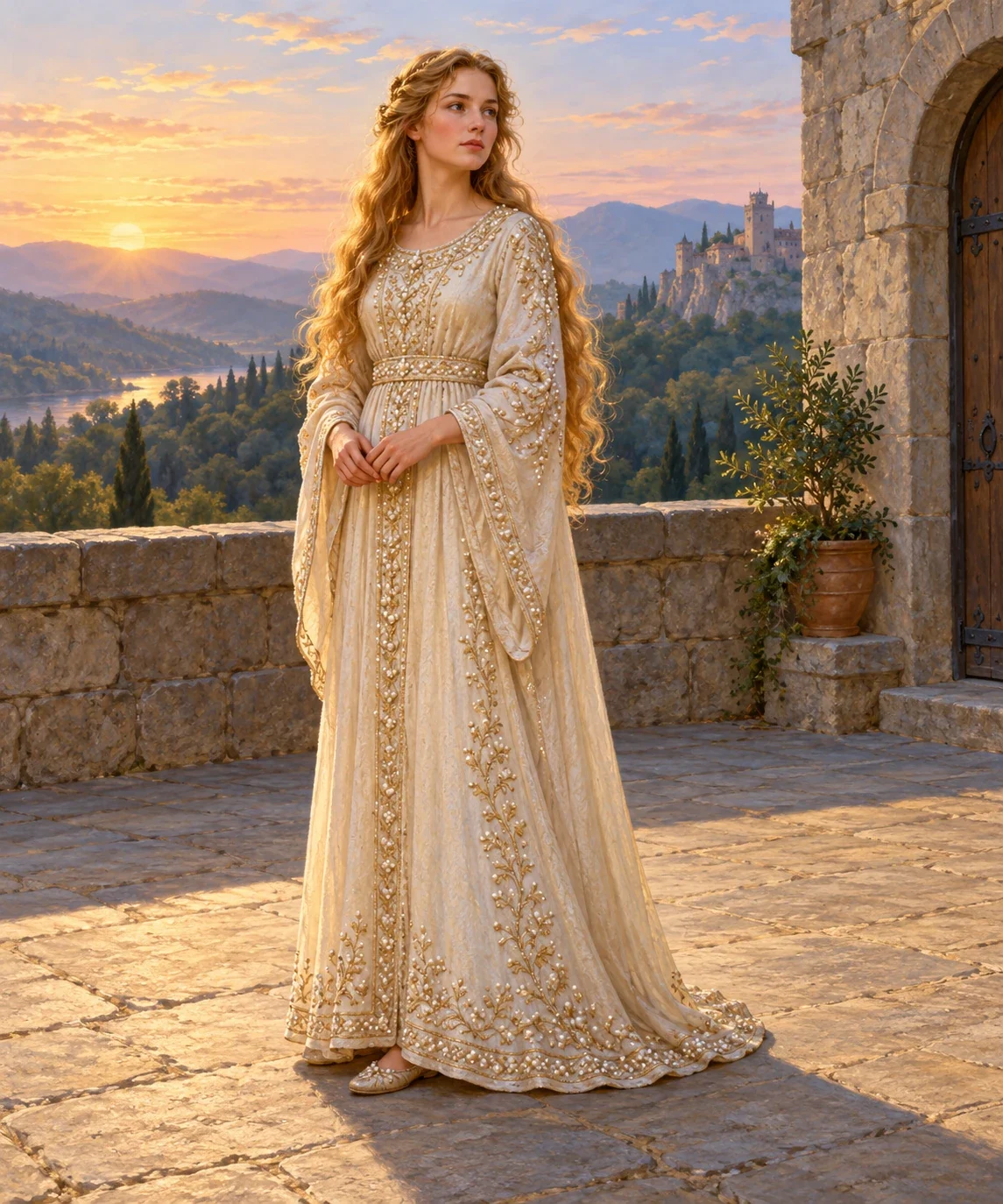
AI narrative interpretation of Zoolvisia in her pearl robe before her talisman is broken.
Face, robe construction, pearl arrangement and castle setting are imagined after the cited literary scene, not a historical or ethnic portrait.
Overview
Zoolvisia is the named princess of the eighth tale in Seklemian’s 1898 collection. At first she rules a dangerous territory: hunters follow a beautiful antelope into a forest, encounter a welcoming tent and fountain, and die after eating and drinking. A young prince, seeking his missing father, refuses the apparent hospitality and discovers the poisoned banquet’s victims. When the riders who collect the dead hunters’ property arrive, their leader wears a complete suit of white armour and has long hair. The prince recognizes a woman, challenges her, and learns her name. The narrator later describes her hair as golden and her horse as a horse of lightning.
A monk explains that Zoolvisia is endowed with a talisman and commands forty maids who act as Amazons. At daybreak she ascends her castle tower in a robe of pearls and cries out three times; trespassers hearing her voice die. The same explanation identifies the alluring antelope as Zoolvisia herself. The tale therefore supplies particular abilities, but does not describe a separate animal spirit that accompanies her, a fixed monstrous anatomy, or a visible talisman of any specified material. The Amazon comparison is the printed narrator’s description of the attendants, not proof of a Greek historical setting.
Following the monk’s instructions, the prince sets up a cap and cloak on a stick, hides in a trench and seals his ears with beeswax. He waits until the third cry has ended before appearing. Zoolvisia acknowledges that he has overcome her, says that her talisman is broken and that she has become a mere woman, then welcomes him into the castle. Her golden hair draws him up to her window. They marry, and she gives him her extraordinary horse and a lock of hair in a pearl box. The initial powers and the later married woman belong to successive stages; the story does not show her continuing to kill by voice after the test.
The lost box reaches the King of the East, who desires Zoolvisia. A witch enters the couple’s household by pretending to be a stranded pilgrim, despite Zoolvisia’s first suspicion and the horse’s resistance. The witch wins her confidence and persuades her to learn the secret of her husband’s strength: his magic dagger. Zoolvisia discloses that secret, and the witch throws the dagger into a pond, leaving the prince inert. Snakes overcome the maids, and the witch carries Zoolvisia away in a flying pitcher. The episode makes her vulnerable after her former supremacy; it does not transfer the witch’s snake-whip or flying vessel to Zoolvisia as personal attributes.
The prince’s twenty-one adopted fairy cousins recover the dagger from a fish and restore him. Zoolvisia, resisting marriage to the eastern king, recognizes a message carried by the ring she exchanged with her husband and arranges to visit the public garden. He rescues her there, defeats the tyrannical king and his favourites, and returns with her to reign at the people’s invitation. Her trajectory includes predatory rule, love, betrayal of confidence, captivity and renewed queenship. Seklemian’s account is an edited English presentation selected from a broader Armenian collection history. This is Zoolvisia in one mediated English telling, not a universal Armenian fairy category, an exclusive modern national origin or evidence of present-day community belief.
Origins & earliest records
Tale VIII, Zoolvisia, pp. 59–73, in A. G. Seklemian’s The Golden Maiden (1898). The collection draws on his notes and two books by Bishop Sirwantzdiants; no individual narrator or tale-specific locality is identified.
Records & interpretation
Complete tale VIII, including the opening hunt, monk’s explanation, breaking of the talisman, abduction, rescue and royal ending; complete introduction and storyteller’s address also read.
Selected bibliography
Documented works and useful reading. This is not a list of every appearance.
- 01
The Golden Maiden and Other Folk Tales and Fairy Stories Told in Armenia
VIII, Zoolvisia, pp. 59–73; complete introduction and The Story-Teller to His Audience establish the edition’s mixed and edited collection history.
Family & connections
A source-supported family tree or inspiration record has not yet been compiled for this profile. Related reading below indicates a connection in subject matter, not a proven lineage or creative influence.
References
Sources supporting this profile. Linked pages have their own scope and editorial standards.
- Historical collector’s English retelling/translationSeklemian, The Golden Maiden: complete original English tales and framingResearch access: 2026-10-21
Image credits
AI-generatedAI narrative interpretation of Zoolvisia in her pearl robe before her talisman is broken.
Face, robe construction, pearl arrangement and castle setting are imagined after the cited literary scene, not a historical or ethnic portrait.