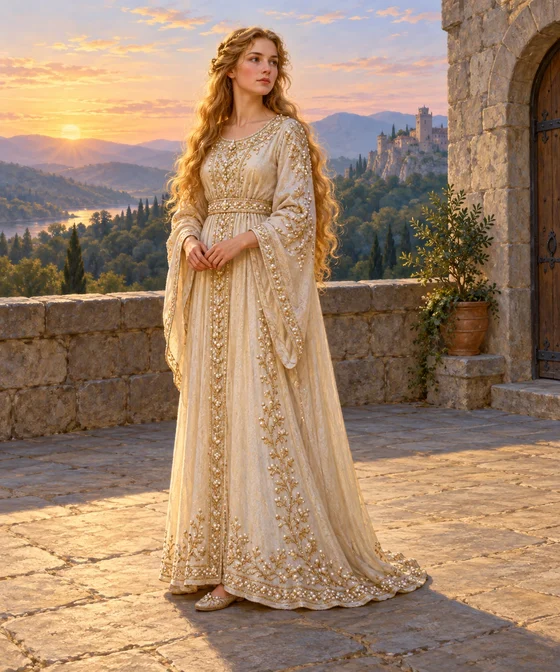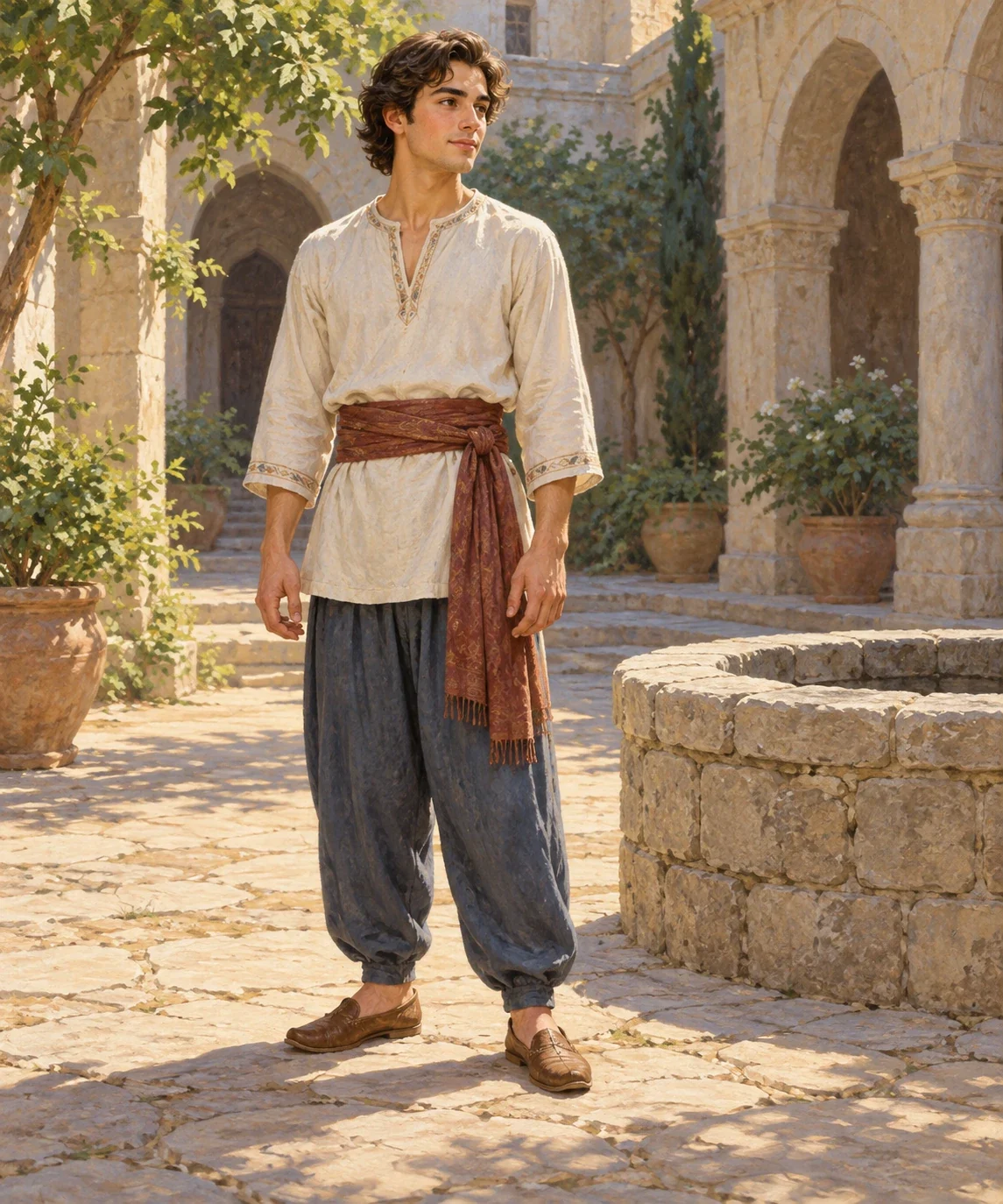
AI narrative interpretation of the Dragon-child in his restored human form.
Adult appearance, clothing, well and courtyard are imagined. The image does not reconstruct the unspecified original hybrid anatomy.
Overview
The Dragon-child is a royal character in the ninth tale of Seklemian’s collection. A childless king envies a snake surrounded by its offspring and complains to Heaven. Later a child comes to the palace, described as a monster half man and half dragon. The sequence does not say that a snake gives birth to him or identify reptilian parents. Because he is of royal birth, the household does not kill him; instead it confines him in a dry well. Goat’s milk initially sustains him, but as he grows the kingdom supplies girls and then maidens for him to devour. The text gives no detailed division of human and dragon body parts, wings, horns, colour or fire-breathing.
A widower’s daughter is selected after her stepmother insists on sending her rather than her own daughter. The threatened maiden receives instructions in a dream: she is to be lowered into the well wrapped in a bull’s skin, with three skinfuls of black goat’s milk and a knife. She must answer the Dragon-child’s demand that she emerge by asking him to leave his dragon skin so that she can bathe him. The dragon skin bursts in his anger and a handsome youth comes out. She cuts herself free, breaks a front tooth in her fall, and bathes him in milk. He thanks her for releasing him from his bondage. They are brought up from the well and marry. The dream-guided exchange and milk are the stated means of release; the tale names no sorcerer who imposed the condition.
When the restored prince leaves for war, he asks that his wife remain at home. Her stepmother nevertheless gains access through the wife’s father, pushes her out to sea during a bathing trip and sends her own daughter to the palace in her place. The actual bride survives by holding an empty cask and reaches a distant shore. There she encounters a different young man, later called the Sun-child, who has been punished for attempting to shoot the Sun. She becomes his companion and bears his child. The Dragon-child is not that man, and he does not inherit the Sun-child’s prohibition against daylight or the Sun’s fiery form.
A long middle episode follows the Sun-child’s mother, whose journey to the Sun’s mother obtains water that restores her son. The Dragon-child re-enters the action after returning from war. He recognizes that the woman substituted for his wife lacks the golden front tooth he had supplied after the well accident. Unable to find the missing bride, he travels to see the recovered Sun-child and his mother. At supper the serving woman smiles and reveals the golden tooth, allowing him to recognize her. Thus the dental detail first associated with an injury becomes a specific recognition device, not a general supernatural mark possessed by all dragon spouses.
Having shared bread, the two husbands agree to resolve their claims without fighting. They make the woman eat salt meat and ride with separate pitchers of water, treating her request for a drink as a choice of husband. She calls first to the Sun-child, then to the Dragon-child, gives the infant to its father, the Sun-child, and states that she is the Dragon-child’s wedded wife. She drinks from the Dragon-child’s pitcher and returns with him. The Dragon-child is this particular royal character, distinct from the tale’s Sun-child and the Sun himself; this profile does not define a general dragon species.
Origins & earliest records
Tale IX, Dragon-Child and Sun-Child, pp. 73–85, in Seklemian’s The Golden Maiden (1898). The printed telling does not identify a separate named informant or a tale-specific collection site.
Records & interpretation
Complete tale IX read, including the king’s complaint, well and milk episode, the bride’s substitution, the separate Sun-child and solar recovery narrative, and the final recognition and choice.
Selected bibliography
Documented works and useful reading. This is not a list of every appearance.
- 01
The Golden Maiden and Other Folk Tales and Fairy Stories Told in Armenia
IX, Dragon-Child and Sun-Child, pp. 73–85; complete tale and framing read. The royal Dragon-child, separate cursed Sun-child and the Sun are distinct actors.
Family & connections
A source-supported family tree or inspiration record has not yet been compiled for this profile. Related reading below indicates a connection in subject matter, not a proven lineage or creative influence.
References
Sources supporting this profile. Linked pages have their own scope and editorial standards.
- Historical collector’s English retelling/translationSeklemian, The Golden Maiden: complete original English tales and framingResearch access: 2026-10-21
Image credits
AI-generatedAI narrative interpretation of the Dragon-child in his restored human form.
Adult appearance, clothing, well and courtyard are imagined. The image does not reconstruct the unspecified original hybrid anatomy.