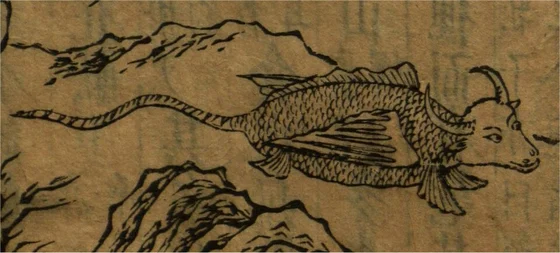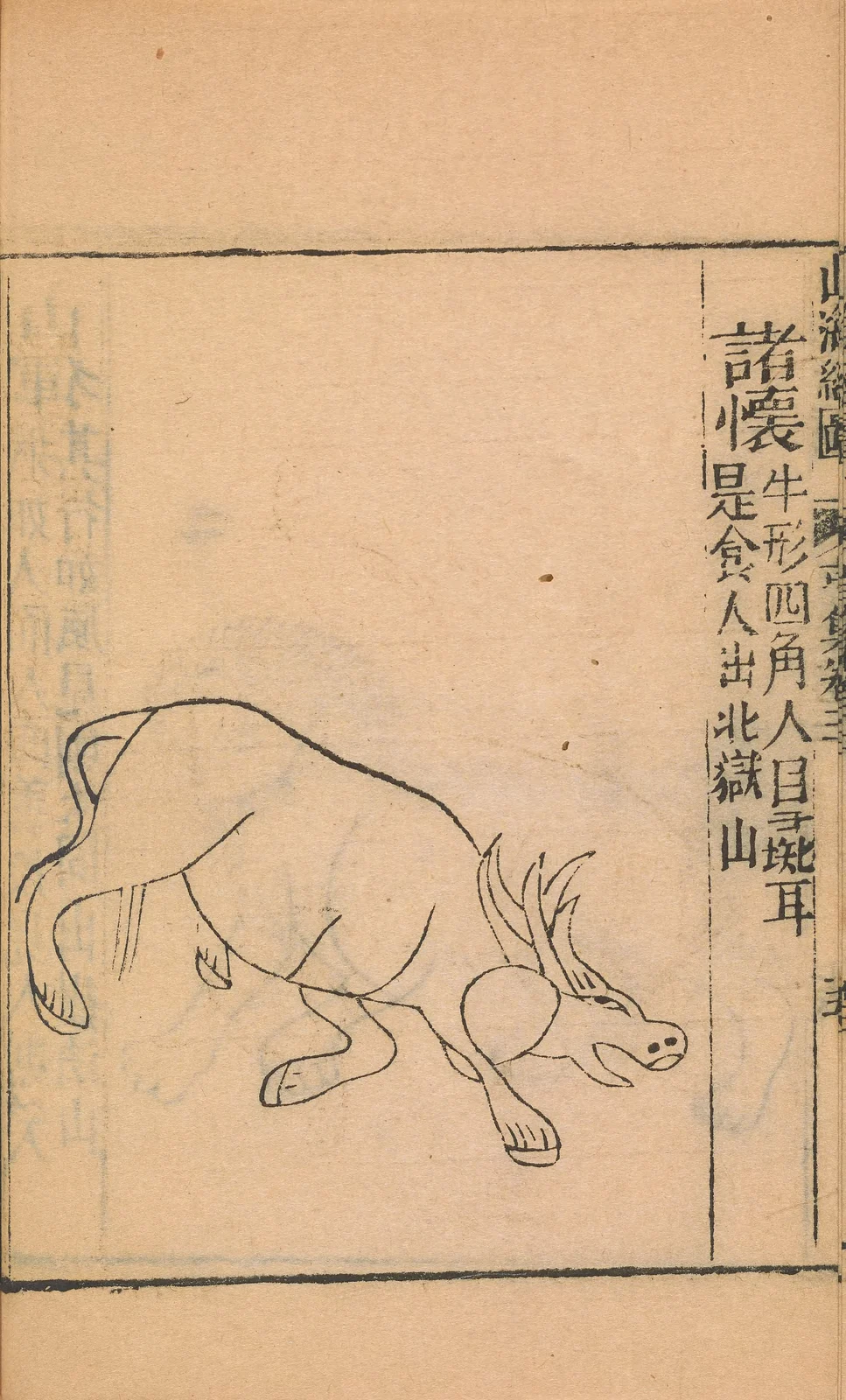
Zhuhuai of Mount Beiyue, anonymous1667 Shanhaijing illustration
Printed諸懷 caption states ox form, four horns, human eyes, pig ears, man-eating and北嶽山. Four-horn count is explicit caption evidence even where drawing overlaps outlines. Physical Smithsonian edition1667; ancient text composition is earlier. Anonymous illustrator; GuoPu commentator and WuZhongheng editor, neither asserted as artist.
Overview
Zhuhuai belongs to Mount Beiyue in the Shanhaijing’s first northern itinerary. It resembles an ox, but has four horns, human eyes, and pig’s ears. Its call resembles a goose, and the entry explicitly says that it eats people. Each borrowed feature comes from the named description rather than from a generalized image of a horned demon.
The Zhuhuai River is listed in the same passage and contains a separate dog-headed fish with an infantlike cry. That fish’s body and asserted dietary effects should not be merged into the land beast. Zhuhuai’s predation is direct, but no victim, battle, or protective technique is specified. The passage provides a threatening hybrid anatomy and sound without a developed moral explanation or an account of how the species originated.
Origins & earliest records
China; Shanhaijing, Northern Mountains
Records & interpretation
Directly read Chinese primary-text transcription, with exact named geographical locator; no historical scan claimed.
Selected bibliography
Documented works and useful reading. This is not a list of every appearance.
- 01
Shanhaijing: Northern Mountains
First northern sequence; Mount Beiyue 北嶽山
Family & connections
A source-supported family tree or inspiration record has not yet been compiled for this profile. Related reading below indicates a connection in subject matter, not a proven lineage or creative influence.
Primary records and illustrations
Shanhaijing, Northern Mountains
北山經. First northern sequence; Mount Beiyue 北嶽山
Directly read transcription, not a collated historical scan. Identifying passage: 其狀如牛,而四角、人目、彘耳,其名曰諸懷。 No exact illustrated plate verified.
References
Sources supporting this profile. Linked pages have their own scope and editorial standards.
- Primary-text transcriptionShanhaijing, Northern Mountains: First northern sequence; Mount Beiyue 北嶽山Research access: 2026-10-05
Image credits
Historical illustrationZhuhuai of Mount Beiyue, anonymous1667 Shanhaijing illustration
Printed諸懷 caption states ox form, four horns, human eyes, pig ears, man-eating and北嶽山. Four-horn count is explicit caption evidence even where drawing overlaps outlines. Physical Smithsonian edition1667; ancient text composition is earlier. Anonymous illustrator; GuoPu commentator and WuZhongheng editor, neither asserted as artist.