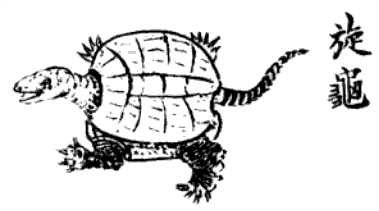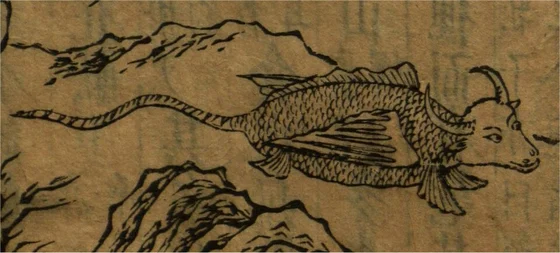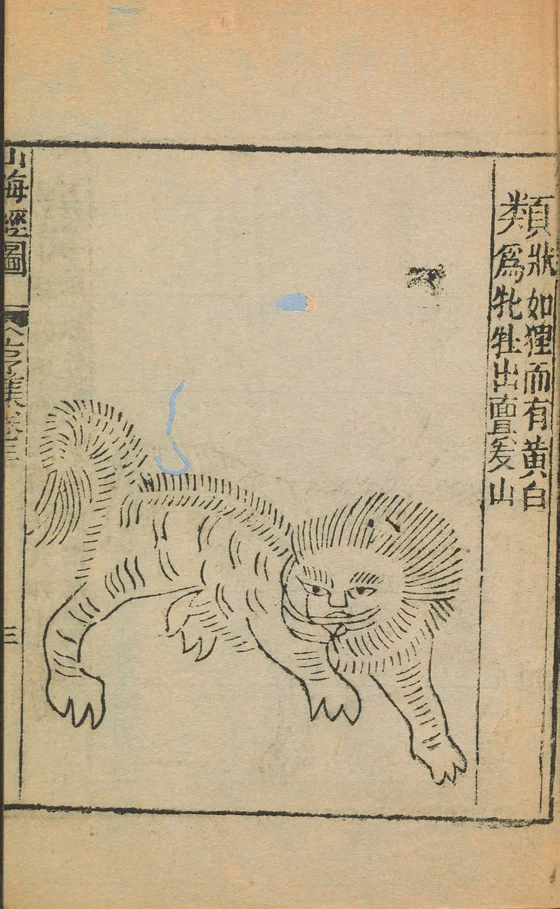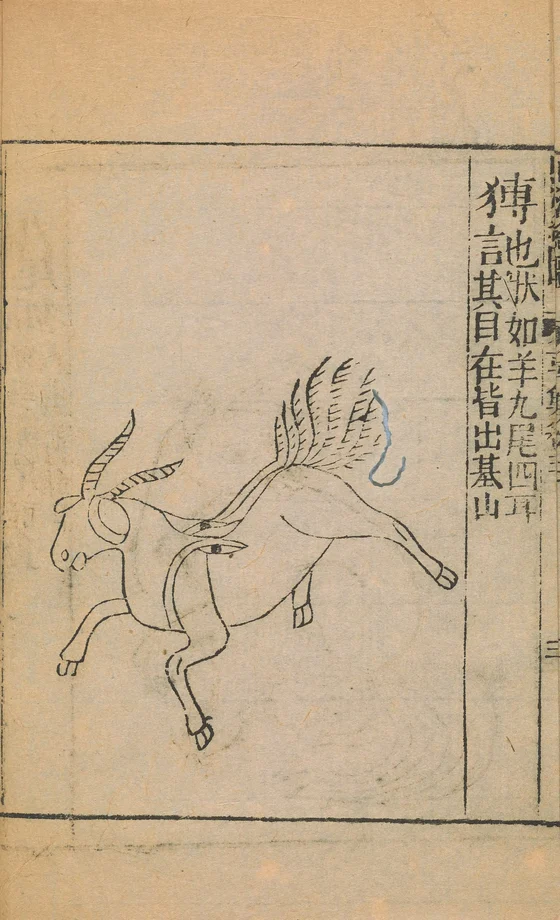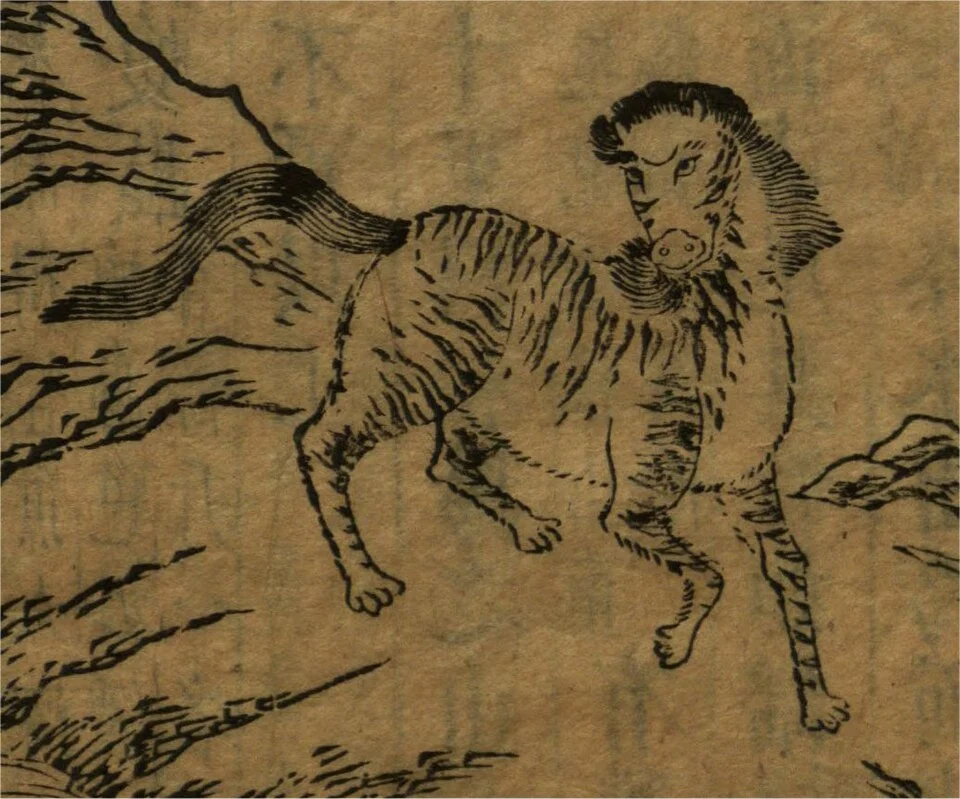
lushu, named historical Shan hai jing woodcut
Exact named figure in the Southern Mountains section of a seventeenth-century illustrated Shan hai jing edition. Historical interpretation, not a biological photograph. Source file cites the Library of Congress digitized edition.
Overview
Lushu belongs to Mount Niuyang in the first southern itinerary of the Shanhaijing. Its body resembles a horse, but its white head, tigerlike markings, and red tail assemble features that would not identify an ordinary horse. Its call sounds like a song. The same passage associates wearing something from the creature with benefit to descendants; the displayed commentary interprets the worn material as its skin or tail.
The surrounding account lists the mountain’s red and white metals and then moves into its waters, placing Lushu within a geographical inventory. It is a specifically described literary beast, rather than a universally defined horse demon. Its song is given as an audible characteristic, without a story of seducing travellers. The descendant-related effect is a claim of the ancient text, not a present medical or fertility recommendation.
Origins & earliest records
China; Shanhaijing, Southern Mountains
Records & interpretation
Directly read Chinese primary-text transcription; exact section and geographical passage retained. No matched scan or illustration verified.
Selected bibliography
Documented works and useful reading. This is not a list of every appearance.
- 01
Shanhaijing: Southern Mountains
First southern sequence; Mount Niuyang 杻陽之山; hosted text displays commentary separately in brackets.
Family & connections
A source-supported family tree or inspiration record has not yet been compiled for this profile. Related reading below indicates a connection in subject matter, not a proven lineage or creative influence.
Primary records and illustrations
Shanhaijing, Southern Mountains
南山經. First southern sequence; Mount Niuyang 杻陽之山
Directly read transcription, not a collated historical scan. Identifying passage: 有獸焉,其狀如馬而白首,其文如虎而赤尾,其音如謠。 Base text and bracketed commentary distinguished; no exact plate assigned.
References
Sources supporting this profile. Linked pages have their own scope and editorial standards.
- Primary-text transcriptionShanhaijing, Southern Mountains: First southern sequence; Mount Niuyang 杻陽之山Research access: 2026-10-05
Image credits
Historical illustrationlushu, named historical Shan hai jing woodcut
Exact named figure in the Southern Mountains section of a seventeenth-century illustrated Shan hai jing edition. Historical interpretation, not a biological photograph. Source file cites the Library of Congress digitized edition.