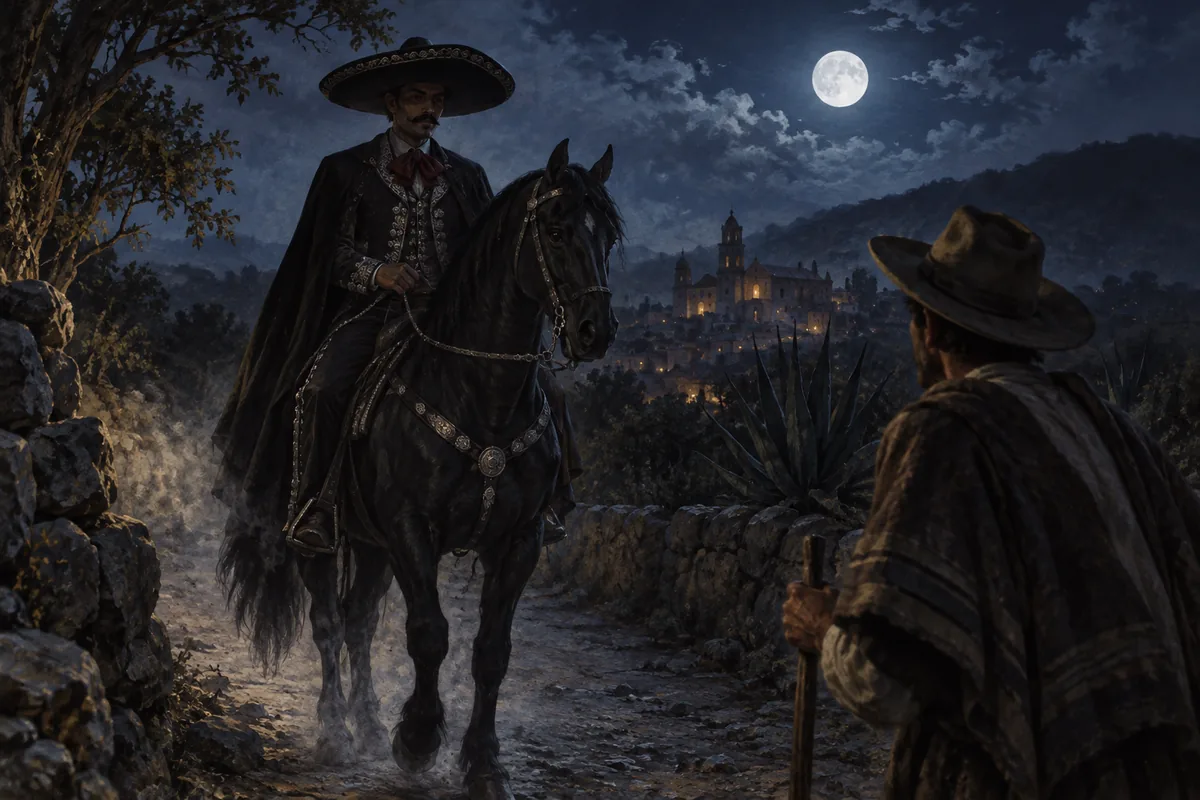
AI interpretation of Yobaltaba. An imaginary well-dressed male charro/horseman apparition with a horse on a quiet nighttime path, selecting male charro witness alone. No female death figure, naked children or merged variants. Outfit, face, horse and setting imagined, not authentic regional attire or a real informant portrait.
AI-generated unofficial original narrative interpretation. Selected scene: An imaginary well-dressed male charro/horseman apparition with a horse on a quiet nighttime path, selecting male charro witness alone. No female death figure, naked children or merged variants. Outfit, face, horse and setting imagined, not authentic regional attire or a real informant portrait. Fine anatomy, garments, objects and setting are modern AI imagined visual details, not an historical reconstruction, community portrait, authentic artifact or evidence of living practice.
Overview
Elena del Carmen Arano Leal records a Calería informant describing Yobaltaba as an elegant charro and skilled bullfighter. She also quotes Albano Rojas Aldana’s 1998 account of appearances that vary between communities: a well-dressed man or horseman with a malicious laugh, encounters near children, and manifestations in dark caves. Delgado Calderón’s regional atlas independently includes naked children, a charro or catrín, and a giant among its nighttime forms.
Arano also preserves a contrasting passage from Antonio Francisco Rodríguez Alvarado’s undated personal notes. There, Yobaltabani is death dressed as a woman, frightening households until people cease to fear her. A Santiago Tuxtla variation describes a short, bow-legged pursuer whose rapid, noisy steps follow late-night walkers. This separate female account should not be silently replaced by the male charro portrait.
Origins & earliest records
Arano’s inspected university edition bears copyright 2011, despite bibliographies sometimes listing 2012. Her cited Rojas Aldana fascicle appeared in February–March 1998; Rodríguez Alvarado’s personal notes are undated. These are identifiable written witnesses, while the initial formation and earliest circulation of the oral accounts remain unestablished.
Records & interpretation
Arano separates her unnamed Calería informant from the two quoted regional writers. Their incompatible bodily descriptions establish variation, rather than a single fixed appearance. Her source's proposed word derivation is not independently verified here. The atlas supplies another published regional description but does not identify the narrator of each form.
Selected bibliography
Documented works and useful reading. This is not a list of every appearance.
- 01
Formas comunicativas en rituales de curación en Calería, Veracruz
Universidad Veracruzana, Biblioteca Digital de Humanidades 10; inspected p. 90 quotes contrasting appearances, bibliography p. 213 identifies their source works; copyright p. 4 verifies 2011.
- 02
Manifestaciones culturales mestizas
Veracruz atlas; printed pp. 197–198 place Yobaltaba among regional nighttime apparitions.
Family & connections
A source-supported family tree or inspiration record has not yet been compiled for this profile. Related reading below indicates a connection in subject matter, not a proven lineage or creative influence.
References
Sources supporting this profile. Linked pages have their own scope and editorial standards.
- ResearchArano Leal: direct university edition, Yobaltaba p. 90 and bibliographyResearch access: 2026-10-05
- ResearchDelgado Calderón: Los Tuxtlas apparition forms in Veracruz atlasResearch access: 2026-10-05
Image credits
AI-generated interpretationAI interpretation of Yobaltaba. An imaginary well-dressed male charro/horseman apparition with a horse on a quiet nighttime path, selecting male charro witness alone. No female death figure, naked children or merged variants. Outfit, face, horse and setting imagined, not authentic regional attire or a real informant portrait.
AI-generated unofficial original narrative interpretation. Selected scene: An imaginary well-dressed male charro/horseman apparition with a horse on a quiet nighttime path, selecting male charro witness alone. No female death figure, naked children or merged variants. Outfit, face, horse and setting imagined, not authentic regional attire or a real informant portrait. Fine anatomy, garments, objects and setting are modern AI imagined visual details, not an historical reconstruction, community portrait, authentic artifact or evidence of living practice.