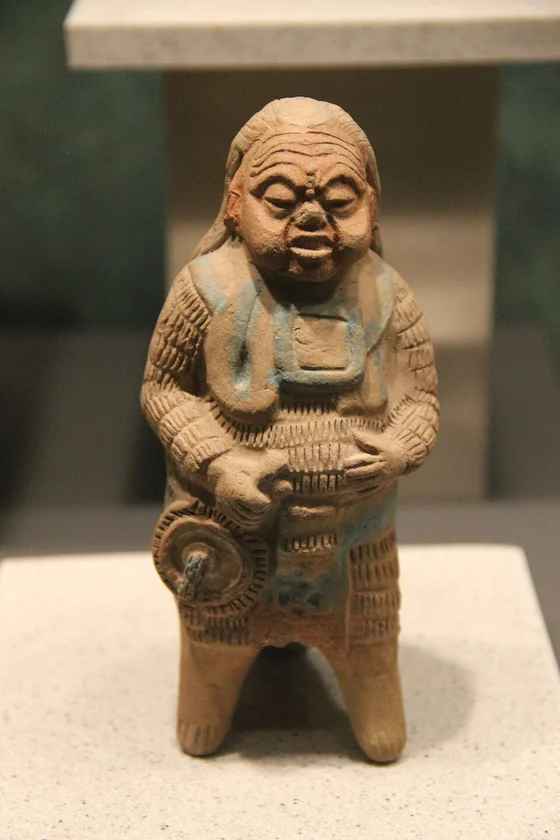
A sourced illustration has not yet been added. This gap is included in the coverage record.
Overview
Romualdo Acevedo recounts Felipa Avendaño's experience in the Jacatepec countryside: a chaneque throws stones until she protests that she is planting her own milpa rather than stealing another person's crops. The narrative then describes little people disturbing unattended houses, spilling food and water and putting a flower in a gun barrel. It was published within Molinari and Aguilar Medina's study drawing on Weitlaner's Chinantla material.
Elisa Ramírez's separate published marriage tale gives chanecos two fingers, an underground home and stores of money. An older chaneca seeks a five-fingered human husband for her daughter. Their children are the hoped-for reason for the union. When he later visits his mother, he cannot regain entry to the other world and eventually dies. These details belong to that tale; they are not prescribed anatomy or fate for every regional chaneque.
A separate 2011 field study in Santo Domingo Tonalá, in Oaxaca’s Mixteca Baja, recorded former hunters who had become deer guardians. Their chaneques care for and heal deer, alongside a mountain understood as the animals’ owner. This places the beings within relationships between hunting, restraint and community conservation. The authors interviewed thirteen residents and identify this particular group of witnesses by occupation, without naming individual tellers. Their published discussion summarizes the accounts rather than transcribing a complete individual tale. It therefore supports this locally attributed role, while leaving the beings’ bodies and particular encounters undescribed. The article contrasts another community’s identification of the deer itself as the mountain’s lord; that difference is not erased by treating neighboring traditions as interchangeable.
Origins & earliest records
The 2013 INAH publication presents earlier collected Chinantla material and names the people transmitting the Jacatepec episode. Ramírez's 2017 article is a later narrative witness. Neither provides a securely established first appearance of all beings called chaneques, whose roles and names require regional attribution rather than one invented ancient biography.
Records & interpretation
The original INAH PDF's printed pp. 19, 38 and 50 were read, including its explanation of using Weitlaner's data. Publication metadata identifies Diario de Campo 12 (2013). Ramírez's complete web narrative was also inspected. Her marriage account and the Chinantla stone-throwing story are separate witnesses, with no demonstrated common narrator or unchanged appearance.
Selected bibliography
Documented works and useful reading. This is not a list of every appearance.
- 01
Cosmovisión de la vida cotidiana en Chiltepec, Oaxaca
Diario de Campo 12:19–56; story 15, Chaneques, p. 50.
- 02
Chaneques
Arqueología Mexicana 147:16–17; online narrative and regional interpretation.
- 03
Conocimiento y usos de Odocoileus virginianus en Santo Domingo Tonalá, Oaxaca
Therya 4(1); methods and results. DOI 10.12933/therya-13-92.
Family & connections
A source-supported family tree or inspiration record has not yet been compiled for this profile. Related reading below indicates a connection in subject matter, not a proven lineage or creative influence.
References
Sources supporting this profile. Linked pages have their own scope and editorial standards.
- Primary textINAH: Molinari and Aguilar Medina, Chiltepec study (2013), p. 50Research access: 2026-10-05
- Primary textElisa Ramírez: Chaneques, Arqueología Mexicana 147 (2017)Research access: 2026-10-05
- Ethnozoological field researchTonalá field studyResearch access: 2026-10-05
Image credits
A sourced illustration has not yet been added. This gap is included in the coverage record.